APEC summit: Xi and Putin open historic talks before Trump
Xi Jinping and Vladimir Putin opened the APEC summit in Shenzhen ahead of Donald Trump's arrival for a historic trilateral meeting on Thursday.
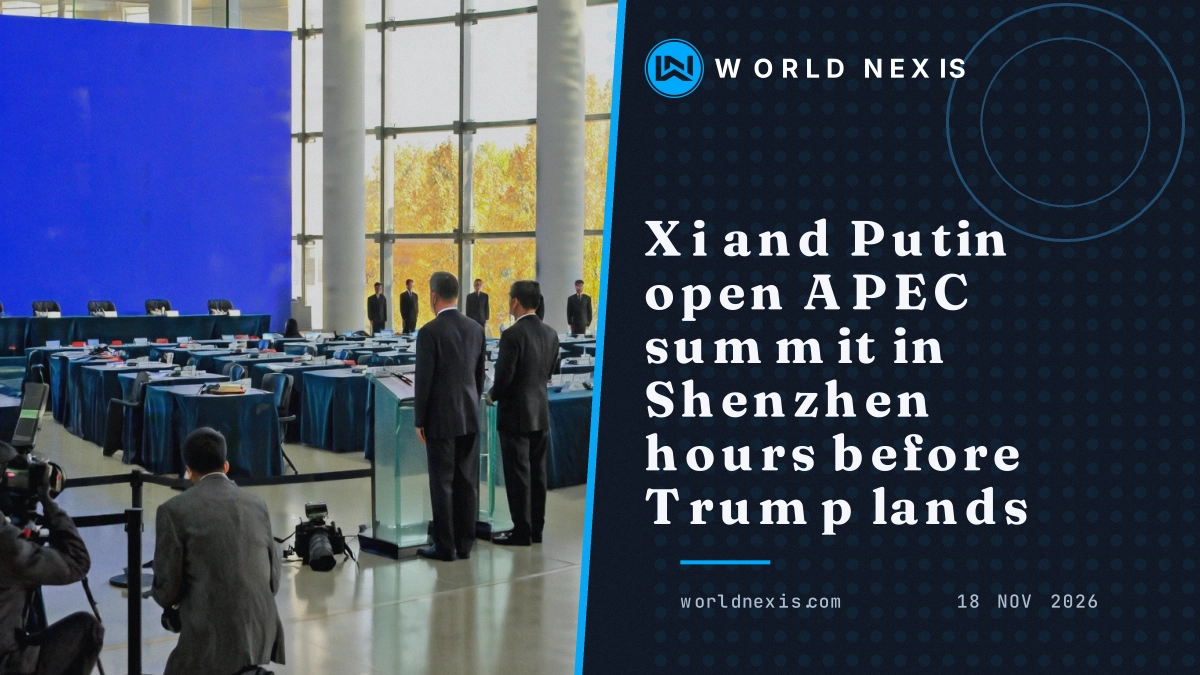
Xi Jinping and Vladimir Putin opened the APEC summit in Shenzhen on Wednesday with back-to-back speeches calling for closer economic and technological cooperation, hours before Donald Trump was due to land in China for the first three-way meeting of the leaders on Thursday.
Trump flew in from Manila, where he met President Ferdinand Marcos Jr. and said the two countries had “just consummated a very big trade deal”, without giving any details. Manila did not announce any agreement.
Key points
- Xi used his opening address to call for freer trade and deeper cooperation on artificial intelligence and the digital economy.
- Putin spoke hours after Ukraine destroyed the Kerch road bridge, and described Western powers as “former hegemons”.
- The APEC summit’s centerpiece is a trilateral meeting on Thursday, with nuclear proliferation, Iran, Ukraine and trade on the table.
- Secretary of State Marco Rubio said Washington faces no imminent Iranian threat after reports of a possible dirty bomb plot.
Xi and Putin set the tone at the APEC summit
Addressing the APEC chief executives’ meeting, Xi said governments should “not only eliminate trade and investment barriers… but also promote inclusive and balanced development”. He urged members to build partnerships for scientific and technological innovation and to deepen cooperation in the digital economy and artificial intelligence.
Putin followed him on stage and used the APEC summit platform to attack the West, calling sanctions imposed after his invasion of Ukraine a failure that had instead made Russia stronger. He described Europe as being in a “humiliating decline” and Western powers as “former hegemons”, according to the Guardian’s live coverage.
The Russian leader spoke after Ukraine destroyed the Kerch road bridge linking occupied Crimea to Russia, a major blow to his four-year-old war, the Guardian reported. He and Xi then headed into a bilateral meeting, Chinese and Russian state media said, with outlets billing the encounter as a reunion with an “old friend”.
Trump’s Manila detour and a contested trade claim
Before flying to Shenzhen for the APEC summit, Trump visited the Malacañang Presidential Palace, where he called the US-Philippine relationship “one of America’s oldest and most important alliances in the Pacific” and suggested closer cooperation on technology, energy and defense.
He also praised a late-night snack of Jollibee fried chicken sent to his delegation, calling the chain’s reported popularity in the United States “fantastic”. Inside the palace, he said: “Our people share common history, common values, common interests, common architectural tastes.”
At a state luncheon he announced the trade deal, saying it “took place very quickly” and was “a fair deal for both countries”. In a later social media post, he said the agreement “will be a true landmark” and would be good for farmers and the energy business.
A day earlier in Manila, Trump met Quad leaders from Australia, India and Japan and announced an $85 million investment in artificial intelligence software, which he called the “greatest opportunity for economic growth since the Industrial Revolution”. Protests took place in the Philippine capital ahead of his visit, with demonstrators carrying “Trump Out” signs and rejecting a planned AI hub.
The White House said the trilateral meeting would center on reducing the proliferation of nuclear weapons. Trump has said denuclearization is a “tough subject” and that Iran and Ukraine would also be discussed, although an official said at the weekend that Ukraine was not expected to come up. It remains unclear whether North Korea’s Kim Jong-un will attend; Rubio said the president was willing to engage but did not confirm that a meeting had been set.
Rubio dismisses Iran dirty bomb plot reporting
Rubio told reporters traveling with the president that he does not believe Washington faces an imminent Iranian attack, after a CNN report said Tehran was considering a radioactive “dirty bomb” aimed at senior administration officials.
The secretary of state aimed his criticism at the leaking of intelligence rather than at the threat itself. “Some of your intelligence sources are liars. Others are liars and criminals,” he said, arguing that some sources invent access they do not have while others disclose classified material improperly.
“We have threat streams every day, and the majority of them are not credible. We have to follow up on them.”
Asked directly whether he feared an imminent attack on Washington, Rubio replied: “I am not.” The Guardian reported that Trump separately said the US was “looking into” the dirty bomb plot, even as the White House said there were “no credible threats” at this time, and that his administration takes the idea “very seriously”.
Analysis
Having covered conflict, sanctions and summitry on this beat, I look first at what each leader needs from the photograph rather than from the communiqué. Xi gets a venue, a theme of Chinese convening power and a stage for his pitch on AI governance. Putin, arriving hours after losing the Kerch bridge, gets the one thing sanctions cannot take from him: a seat at the top table beside the US president.
That is why the Yalta comparisons, floated by the Guardian and others, tell only half the story. Yalta produced a settlement. Thursday’s trilateral meeting has no agreed agenda beyond the White House’s language on nuclear proliferation, and officials cannot even agree in public on whether Ukraine is on the list. I side with those who see a legitimacy win for Moscow and a modest one for Beijing, with Washington’s leverage confined to the nuclear file. The strongest counter-argument is that a president who has already floated a Kim Jong-un meeting may be willing to trade something real on denuclearization, which would make the sceptics look small.
On the Iran story, I think Rubio’s core judgment, that threat streams arrive daily and most are not credible, is better supported by the evidence than the alarm in the original reporting, which rested on unnamed sources. Yet I part company with him on the leak complaint: if officials inside the government believe a plot is serious enough to brief journalists, the public interest in disclosure outweighs the embarrassment in the Situation Room. The muddle between Trump saying he is “looking into” the dirty bomb plot and the White House saying there are no credible threats is the part readers should actually worry about.
What happens next
Trump is due to arrive in Shenzhen on Wednesday evening, with the trilateral meeting scheduled for Thursday on the sidelines of the APEC summit. Nuclear proliferation, Iran and trade are expected to dominate, and a Kim Jong-un appearance remains unconfirmed.
Related coverage
- Apec summit: Xi and Putin hold major talks as Trump lands
- Trump Asia trip: first Quad summit, historic Xi-Putin talks
- Trump Asia trip: Manila stop opens historic Xi-Putin summit
Sources
- Apec summit live: Xi and Putin start talks; Rubio says Trump serious about meeting Kim Jong-un (theguardian.com)
- Trump meets with Philippine leader ahead of summit with Putin and Xi, possible meeting with Kim Jong Un (cbsnews.com)
- Rubio dismisses Iranian (israelnationalnews.com)
- US Secy of state Rubio says "no imminent threat" to US capital amid report of alleged Iranian plot (aninews.in)
- Rubio dismisses imminent attack threat to Washington after Iran plot report (samaa.tv)
About the author: Marcus Ellington is World Nexis News’s International Correspondent, covering world affairs. The analysis section reflects the writer’s view.

Marcus Ellington
Marcus Ellington is International Correspondent at World Nexis News, reporting on diplomacy, conflict and the political forces reshaping Europe, the Middle East, Asia and the Americas. Based in London, he focuses on explaining why events unfold as they do, using official statements, diplomatic documents and…



