Shenzhen summit: historic Trump-Putin-Xi peace declaration
At the Shenzhen summit, Trump, Putin and Xi signed a peace declaration that omits Ukraine and Iran wars, as Russia strikes three Kyiv bridges.
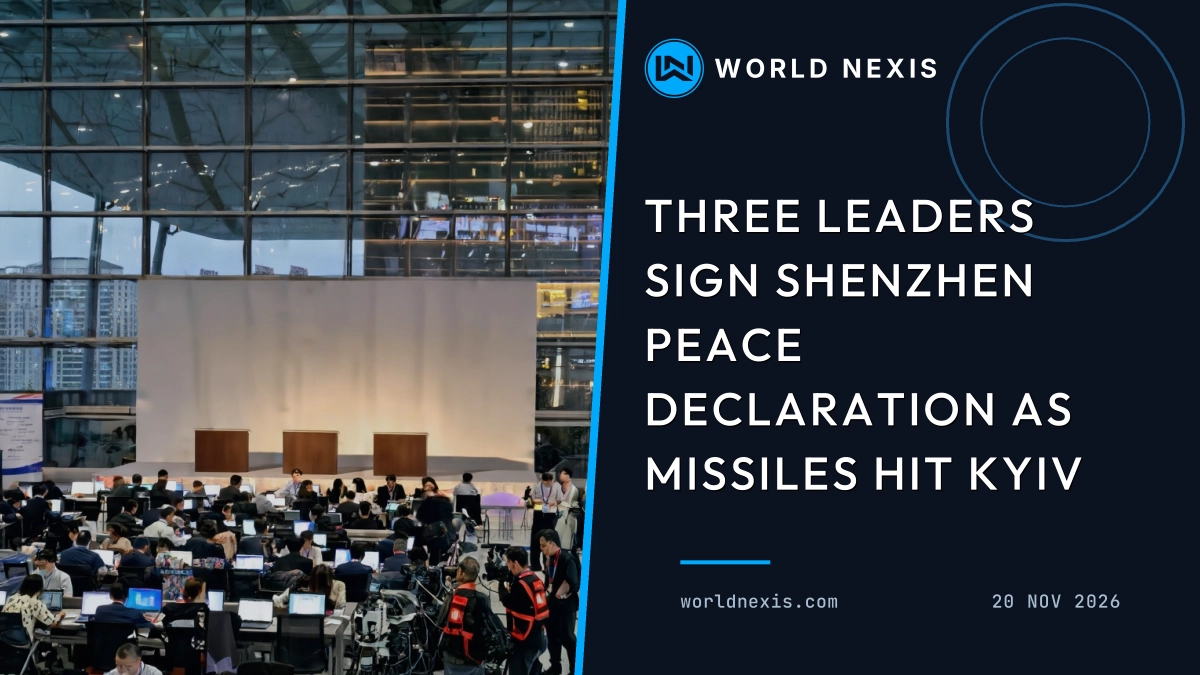
Three presidents signed a joint peace declaration at the Shenzhen summit on Thursday, the first trilateral meeting between the leaders of the United States, Russia and China, yet the document makes no mention of the wars in Ukraine or Iran. Donald Trump, Vladimir Putin and Xi Jinping met on the sidelines of the APEC gathering in the southern Chinese city, in talks Xi likened to a “peace summit”.
The declaration sets out shared priorities rather than binding commitments. It lists reform of the United Nations, boosting oil supplies and the protection of diplomatic immunity, but stays silent on the conflicts that dominate the agendas of the same governments.
Key points
- Trump, Putin and Xi held the first three-way summit of the three powers, at the Shenzhen summit on the sidelines of APEC.
- The joint declaration covers UN reform, oil supplies and diplomatic immunity, but not the wars in Ukraine or Iran.
- Putin promised a “painful” response after Ukrainian strikes on the Kerch bridge to Crimea.
- European allies met in Berlin and said they had a united position on future talks with Moscow.
What the Shenzhen summit produced
Washington, Moscow and Beijing had held one-to-one meetings before, but the Trump-Putin-Xi talks were the first three-way discussion of their kind. The session was watched less for what it might settle than for the fact that it happened at all, and for what the three leaders were willing to sign.
What they signed is a statement of intent. The priorities it lists — UN reform, more oil on the market, protection for diplomats — are areas where the three governments can agree without conceding anything on the ground. Neither the war in Ukraine nor the war in Iran appears in the text.
Speaking after the talks, Putin said the Americans had been “insistently” asking Russia to let European countries join any negotiations. He said Moscow was not opposed to the idea but wanted to know what Europe would bring, and had invited European governments to Moscow so their positions could be clarified before Russia decided the format of its dialogue with Ukraine.
He also rejected warnings from European capitals. “Every day” Russia heard that European leaders expected war by 2030, he said. “But we are not planning to attack anyone… Is that normal? I do not think so.” He added that discussing European security without the Europeans was pointless.
Missiles over Kyiv after a revenge vow
Putin used the same press conference to promise that Russia’s response to the bombing of the Kerch bridge to Crimea would be “painful”, after Ukrainian strikes on the strategic link to the peninsula.
Kyiv’s mayor then said Russian ballistic missiles had damaged three of the city’s bridges. The strikes underlined how little the Shenzhen summit has changed on the battlefield, and how quickly a diplomatic gathering can be overtaken by events.
Europe’s answer: a united front in Berlin
Ukraine’s allies gathered in Berlin for a summit of the Coalition of the Willing. The message from the host governments was that Europe now has a common approach to any talks with Moscow.
“Europe has a clear and consistent and united negotiating position,” the UK prime minister, Andy Burnham, said. Germany’s chancellor, Friedrich Merz, said Moscow’s “maximalist demands are not realistic” and rejected any settlement imposed on the continent by bigger powers. “A ‘Yalta format’ will not bring peace,” he said, referring to the 1945 settlement between the United States, the Soviet Union and Britain.
Merz also played down the Shenzhen summit, describing it as above all “a photo opportunity”. Volodymyr Zelensky, who travelled to Berlin, was blunter about Russian intentions: “Putin has always said no.”
US envoys briefed the meeting. Jared Kushner, one of the two American officials in Berlin, said Trump had returned believing that “peace is achievable”, and that Washington wanted a deal with Moscow “with Europe by his side”. He said the Russians were now “comfortable” with Ukraine receiving security guarantees modelled on Nato’s Article Five, which obliges members to come to one another’s defence.
That is a striking claim, since Moscow has rejected Ukrainian membership of Nato outright and has given no public sign of accepting a binding defence guarantee for Kyiv. Merz said US involvement was raising the chances of peace, while insisting that any serious discussion of European security must follow a peace agreement with Ukraine.
Why it matters
The declaration does not stop a single missile. Three of the world’s most powerful governments have signed a document that leaves out wars two of its signatories are party to, so nothing in it commits anyone to a ceasefire, a withdrawal or a new round of arms control. For households in Britain and across Europe, the costs of the conflict — in defence budgets, energy prices and the wider security order — remain unresolved.
For Kyiv, the Shenzhen summit produced an invitation rather than a guarantee. Ukraine’s allies say they will accept terms only if they are acceptable to Europe and Ukraine, but the sequencing they describe means the fighting continues while the format of talks is still being argued over.
Analysis
Having covered conflict and foreign policy for World Nexis News, I look first at what a summit document leaves out. The Shenzhen summit will be remembered for the photograph, not the text: a peace declaration that will not name Ukraine or Iran is not a peace plan, it is an agreement to discuss something else. Merz’s description of it as “a photo opportunity” is closer to the truth than the word historic.
I side with Berlin and Kyiv on this. The evidence arrived within hours of the handshakes: a promise of a “painful” response to strikes on the Kerch bridge, and ballistic missiles damaging bridges in the Ukrainian capital. A settlement that excludes the country being attacked, and which its own president says has been rejected at every turn, cannot credibly be called peacemaking.
The strongest counter-argument is Kushner’s claim that Moscow is now comfortable with Article Five-style guarantees for Ukraine. If that is written down, verified and accepted by the Kremlin, it would be the most consequential movement in this process, and dismissing it out of hand would be a mistake. But a briefing from an envoy is not a treaty, and I would want to hear Moscow say it in public.
What happens next
European governments have been invited to Moscow to set out their positions, after which the Kremlin says it will decide the format of any talks with Ukraine. Berlin’s allies say serious discussions on European security can only follow a peace agreement with Ukraine.
What we don’t know yet
No European government has said publicly whether it will send officials to Moscow. The pledges made at the Shenzhen summit on UN reform and oil supplies carry no timetable and no mechanism. And Trump has said that limits on nuclear arms with China and Russia will be “very hard to achieve”, leaving the arms control track that the leaders discussed without an agreed outcome.
Related coverage
- Trump Xi Putin summit: 3 leaders vow peace in historic talks
- Trump Xi summit: historic first three-way talks with Putin
- Trump Xi Putin summit: historic three-way talks in China
Further reading
- Europe ready for talks with Russia on ending war in Ukraine, leaders say
- Race to be next UN secretary general exposes divisions among world powers
About the author: Marcus Ellington is the International Correspondent at World Nexis News (WNN), covering world affairs. The analysis section reflects the writer’s view.

Marcus Ellington
Marcus Ellington is International Correspondent at World Nexis News, reporting on diplomacy, conflict and the political forces reshaping Europe, the Middle East, Asia and the Americas. Based in London, he focuses on explaining why events unfold as they do, using official statements, diplomatic documents and…