Jensen Huang faces Congress as Nvidia shares slide 6%
Jensen Huang returns to Nvidia and faces Congress next week over China export ties, as shares slide 6% and lawmakers question Trump's role in it.
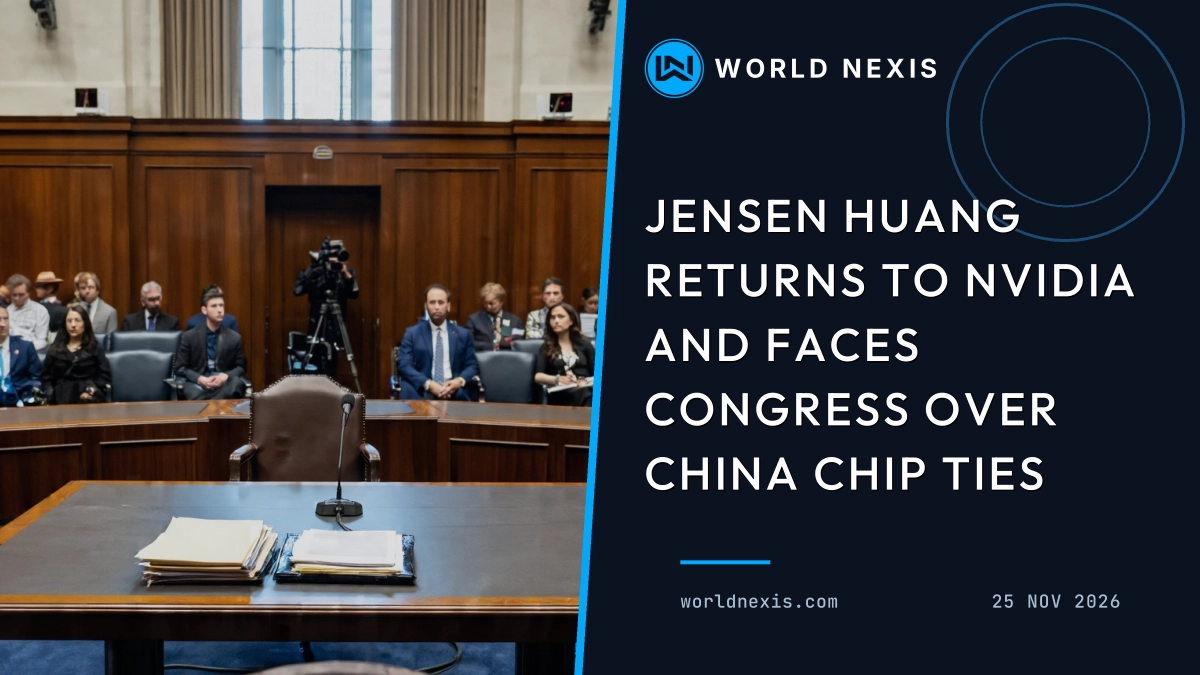
Jensen Huang is back running Nvidia and heading straight into a Washington gauntlet, with Congress set to question him behind closed doors on 1 and 2 December before a public Senate hearing on 3 December. Nvidia shares closed down nearly 6 percent on Tuesday, giving back part of the 31 percent surge that followed Monday’s reinstatement, a U-turn President Donald Trump says he helped push through.
The board’s decision ended a turbulent week for the chipmaker at the centre of the artificial intelligence boom. Jensen Huang resigned after disclosures about extramarital affairs, including a relationship with a former Megaspeed executive whom US intelligence suspects of spying for China. He was back in the job less than two weeks later.
Key points
- Nvidia’s directors reinstated Jensen Huang on Monday, saying they had input from senior levels of the US government and were confident his return posed no national security risk.
- Trump said he spoke to the directors and convinced them to bring Jensen Huang back.
- Huang and Nvidia general counsel Tim Teter face closed-door congressional interviews before a public Senate Banking Committee hearing.
- Attorney General Todd Blanche declined to say whether the Justice Department or the FBI had investigated Jensen Huang.
Jensen Huang faces Congress with China policy on the table
The 3 December hearing is framed around US export rules and global AI competition, yet the questioning will be narrower. Lawmakers want to know what Nvidia knew about Megaspeed, a Singapore-based data center customer, and when it knew it. The China export controls debate will dominate the afternoon.
Jensen Huang and Teter will be asked the same questions privately a day or two earlier. The Republican chairs of the committees involved said in a statement that the board’s “brief internal investigation” and the reinstatement “do not erase the national security threats and questions that must be addressed.”
Scepticism crosses party lines. Republican congressman Don Bacon said Nvidia should have “ignored the Administration’s inexplicable desire to save Huang”. Republican Senator Pete Ricketts said the chief executive’s conduct “doesn’t absolve Nvidia of answering for national security concerns and unaccounted-for chips”.
Democrats are focused on the White House’s role. Congressman Robert Garcia, the incoming chairman of the House oversight committee, said Trump’s “direct involvement” in the decision “raises serious national security and corruption questions”. Senator Ruben Gallego said Congress needed to “investigate what stock positions took place before the announcement”.
Megaspeed and the export control fight
Megaspeed sits at the heart of the case. The commerce and justice departments said in a joint statement last week that they opened an investigation into the firm in 2024 over potential export control violations, and the commerce department has said it is preparing to blacklist the company. Megaspeed is alleged to have smuggled Nvidia chips into China and to have provided remote access to the technology.
The commercial cost for Nvidia is easy to see. “Going forward, they’ll be subject to more export controls so that their chips don’t end up in China and data centers in Asia,” said Gil Luria of D.A. Davidson. “In that way, Nvidia’s market has shrunk, and that business will go away.”
StoneX analyst Cody Acree said tighter restrictions are coming regardless. “There will definitely be tighter restrictions, and any dealings directly with China will be the government’s primary focus,” he said.
Boardroom risk meets the AI trade
Reinstating a chief executive who resigned days earlier carries legal exposure as well as political cost. Charles Elson, founding director of the John L. Weinberg Center for Corporate Governance at the University of Delaware, expects a wave of shareholder lawsuits over what Nvidia disclosed and when.
The company was already sued by shareholders this month over alleged failures to disclose information about Jensen Huang’s relationship with Alice Huang, a former Megaspeed executive. Board chairman Harvey Jones said the return was in the “best interests of our stockholders, employees, partners and customers”.
Investors are weighing three things, according to Nigel Green of deVere Group: “how its leadership sits with Washington, how it handles China and how long AI spending keeps growing at this speed”.
Why it matters
Nvidia’s chips sit inside the data centers behind chatbots, research tools and consumer services, so decisions about who runs the company are no longer purely commercial. The fallout reaches savers with Nvidia in their pension funds, engineers whose work depends on the AI buildout, and companies in Asia that rely on American hardware.
The bigger precedent is governance. If a board can reverse a resignation within days after hearing from senior officials, the line between industrial policy and corporate decision-making becomes hard to defend.
Analysis
Having covered AI policy and export controls for World Nexis News, I look first at what the board actually disclosed, and when. The sequence troubles me. A chief executive steps down over an alleged espionage link and returns within days, with a statement that directors had input from senior levels of the US government. That is not how a national security review normally ends.
In my view, the sceptics have the stronger case. Not because Jensen Huang is uniquely unfit, but because the process skipped the step that would have settled the argument: a transparent, published finding on Megaspeed and on what Nvidia knew. The best counter-argument is that Nvidia is a strategic asset in an AI race with China, and that a leadership vacuum at the top of the supply chain carries its own security cost. That is fair, and it argues for doing the review properly rather than skipping it.
Tuesday’s trading tells its own story. A 31 percent jump followed by a nearly 6 percent slide in Nvidia shares is not confidence; it is a company repriced on political headlines rather than chip demand. I expect investors to hold their nerve until the December hearings, then react to whatever the testimony reveals.
What happens next
Jensen Huang and Teter give closed-door interviews on 1 and 2 December, and Huang appears publicly before the Senate Banking Committee on 3 December. The commerce department continues its push to blacklist Megaspeed, and the investigation opened in 2024 remains open.
Litigation is the second track. Elson expects shareholder suits, and Nvidia has not said whether it will press on with its own inquiry into whether Huang was targeted by Chinese intelligence.
What we don’t know yet
Blanche would neither confirm nor deny a Justice Department or FBI inquiry into Huang, so it is unclear whether a federal investigation exists at all. It is also unclear how far new export restrictions will reach, or whether the board’s confidence that Huang poses no security risk survives three days of testimony.
Related coverage
- Jensen Huang reinstated as Nvidia CEO, shares surge 30%
- Nvidia reinstates Jensen Huang as shares surge more than 31%
- Nvidia investigation: Huang faces 3 days of hearings
Further reading
- US attorney general dodges questions about Nvidia investigation
- Can Jensen Huang put out the fire he started at Nvidia?
About the author: Priya Nair is the Technology Correspondent at World Nexis News (WNN), covering technology. The analysis section reflects the writer’s view.

Priya Nair
Priya Nair is Technology Correspondent at World Nexis News, covering artificial intelligence, cybersecurity, consumer devices and the companies building them. Based in London, she explains how new technology works, who it affects and what the evidence actually shows, with attention to privacy, competition and the…