New US tariffs: Section 301 named as China rate could double to 40%
The US is preparing new US tariffs on China, the EU and 14 other economies over industrial subsidies, replacing duties the Supreme Court struck down.
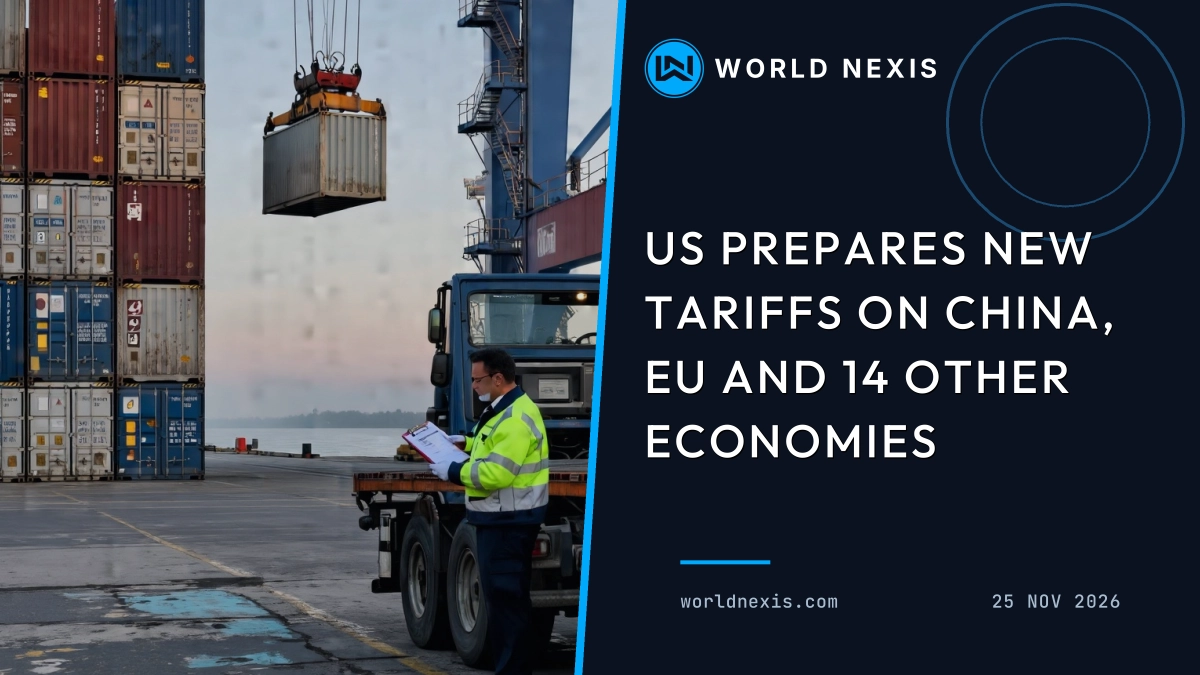
Updated 26 Nov 2026, 01:51 (UK time): The administration named Section 301 of the Trade Act of 1974 as the legal basis for the proposed new US tariffs, said they would be targeted rather than blanket and would not stack on existing duties except for China, where the 20% levy could double to 40% if Beijing breaks the trade truce.
The proposed new US tariffs now have a legal name. The administration says the levies would be enforced under Section 301 of the Trade Act of 1974, the provision that allows Washington to respond when it determines another country’s practices are unfair and harm US commerce. Officials also confirmed the duties are targeted at specific goods in each country rather than blanket, and that they would replace the tariffs the Supreme Court invalidated earlier this year rather than sit alongside them.
China is the one exception to both rules. The proposed 20% levy on Chinese goods would be added on top of pre-existing 25% duties tied to forced technology transfer, and officials have said the rate could be doubled to 40% if Beijing does not abide by the agreed trade truce while talks continue. For every other partner in the 14-economy action, the new rate is meant to stand alone.
The timetable has also firmed up slightly. US Trade Representative Jamieson Greer said trading partners had already been told what is coming and that none of the measures would take effect earlier than a couple of months from now, with January the earliest target for completing the required public comment process. That is the first real guidance on timing after a proposal that set rates but no dates.
For importers, the non-stacking rule is the useful part: it means China can be priced as a separate line rather than folded into everything else. But a 20% rate that can become 40% on a diplomatic judgement is not a number anyone can put in a contract. I would rather have the threat published than hidden, though I doubt many finance teams will thank anyone for it.
Updated 25 Nov 2026, 16:27 (UK time): The US Trade Representative has formally proposed the new US tariffs with published rates, naming 14 trading partners including China, the EU and India, in a proposal that must still go through public comment and hearings.
The trade representative’s office has put numbers on the new US tariffs. Its proposal names 14 trading partners, among them China, the EU, India, Japan, South Korea, Taiwan, Vietnam, Singapore, Switzerland, Malaysia, Thailand, Indonesia, Cambodia and Bangladesh. Chinese goods would carry an additional 20% levy, Indian goods up to 25% and Vietnamese goods up to 35%. The US Trade Representative, Jamieson Greer, determined that the practices of 14 economies relating to structural excess capacity and production in manufacturing are unreasonable and burden US commerce.
The rates are a proposal, not a schedule. They must pass a public notice and comment process, with hearings expected before anything takes effect, and officials have given no implementation timeline. Some figures are explicitly negotiable: the 25% proposed for India could fall to 17% if New Delhi reaches a reciprocal trade agreement addressing the investigation’s findings, and Vietnam’s rate could drop to 20% on comparable commitments.
This answers the question our earlier reporting left open on the size of the duties. It does not answer the ones that matter for contracts: the product lines, the treatment of exemptions, and whether these levies sit alongside the July round of 10% to 12.5% levies on 60 partners. Importers now have a range to model, but still no fixed number to sign against.
I think a published range is better than silence, and the negotiable clauses are the honest part of the document. But a tariff that moves with talks is still a cost nobody can put in a price list, and the comment period pushes the real decision past the holiday season.
The United States is preparing to publish new US tariffs on China, the European Union and 14 other economies, with the Office of the US Trade Representative expected to release the findings of a months-long subsidies investigation within days. The action would cover 16 economies in total and replace the sweeping duties the Supreme Court struck down earlier this year.
Two people familiar with the plans said an announcement is expected soon, though they cautioned that the timing could still slip. Neither the White House nor the trade representative’s office responded to questions about the investigation.
Key points
- The US Trade Representative’s Office is set to publish the results of a months-long investigation into industrial subsidies in 16 economies, including China and the EU.
- New US tariffs would replace the broad duties announced in April 2025, which the Supreme Court ruled unconstitutional in February.
- In July, the White House put levies of 10% to 12.5% on 60 trading partners over forced-labour enforcement, a first step in rebuilding its tariff wall.
- The administration argues that state-backed overproduction has pushed a wave of cheaper goods into the US market, undercutting American manufacturers.
What the new US tariffs would target
The case rests on the White House’s claim that the 16 economies make more manufactured goods than their own markets can absorb, with industrial subsidies doing much of the work. That surplus, officials argue, arrives in the US as lower-priced imports that undercut domestic companies and their workers.
The rates, the products covered and the exact 14 economies joining China and the EU have not been published. Those details will decide how much of the burden lands on importers, retailers and, eventually, shoppers.
The findings would set out how subsidies in each of the 16 economies have affected US producers, and the duties would follow from them. The review itself is not new: the US trade investigation has been running for months and is now close to completion.
The subsidy case is the second step in the administration’s effort to rebuild its tariff programme. The first came in July.
Why the Supreme Court ruling forced a rethink
The administration’s tariff architecture has been rebuilt twice in under a year. The first set of duties, announced in April 2025, was ruled unconstitutional by the Supreme Court in February, removing the White House’s broadest legal instrument.
July brought the first replacement: levies of 10% to 12.5% on 60 trading partners, justified on the grounds that those countries had failed to enforce bans on goods made with forced labour. The new US tariffs on subsidies narrow the field to 16 economies and rest on a different legal argument.
That narrower footing does not mean smaller duties. No rate has been announced for the 16-economy action, and officials have not said whether the new levies would sit alongside the July round or replace it.
Why it matters
For households, the practical question is price. Duties are collected at the border from importers, and part of that cost is typically passed through to buyers. With China, the EU and 14 others in scope, the reach of the new US tariffs is unusually wide for a single action.
For companies, the bigger cost may be planning. Importers who spent this year redrawing supply contracts around one tariff schedule now face another version, with the rates and product lines still unknown.
Analysis
Having covered market structure and corporate strategy for World Nexis News, I read this less as a trade offensive than as a repair job. The Supreme Court took away the administration’s broadest tool in February, and everything since has been an attempt to rebuild leverage inside the law. On that narrow test, the subsidy case looks stronger: it targets a specific practice and rests on months of evidence.
Yet I think the improvisation is the real story. Businesses have been handed a struck-down regime, a stopgap in July and now a 16-economy action, with no published rates to plan against. The fairest counter-argument is that without replacement duties Washington would lose all leverage in a dispute it cannot afford to drop.
I still side with the importers. A tariff you cannot predict is a cost you cannot price, and that cost is passed on before any duty is paid. I also think bundling the EU with China weakens the case: a subsidy complaint against Beijing is a pointed argument, while a 16-country sweep invites the same legal questions that sank the first version.
What happens next
The trade representative’s office is expected to publish its findings in the coming days, with the new US tariffs to follow. Officials have stressed that the timetable is not fixed.
What we don’t know yet
Three details will decide the impact: the rates, the product list and which 14 economies are named alongside China and the EU. Until those are published, estimates of the cost to importers and households are guesswork.
The administration has also not said how it would handle exemptions, exclusions or any overlap with the July levies. Those choices, more than the headline announcement, will determine who pays.
Related coverage
- Center Parcs costs hit tipping point, boss warns of red tape
- Consumer confidence jumps 11.4 points, Fed decision looms
- Kalshi Utah charges: state drops 14 felony counts as Kalshi exits
Further reading
About the author: Daniel Whitmore is the Business & Markets Editor at World Nexis News (WNN), covering business & markets. The analysis section reflects the writer’s view.

Daniel Whitmore
Daniel Whitmore is Business & Markets Editor at World Nexis News, based in New York. He leads coverage of companies, economies, markets and the forces that move them, from central bank decisions to corporate earnings and the cost-of-living pressures facing households on both sides of…



