Consumer confidence jumps 11.4 points, Fed decision looms
US consumer confidence jumped 11.4 points to 103.3 in November as midterm uncertainty cleared and gas prices fell, leaving the Fed a harder call.
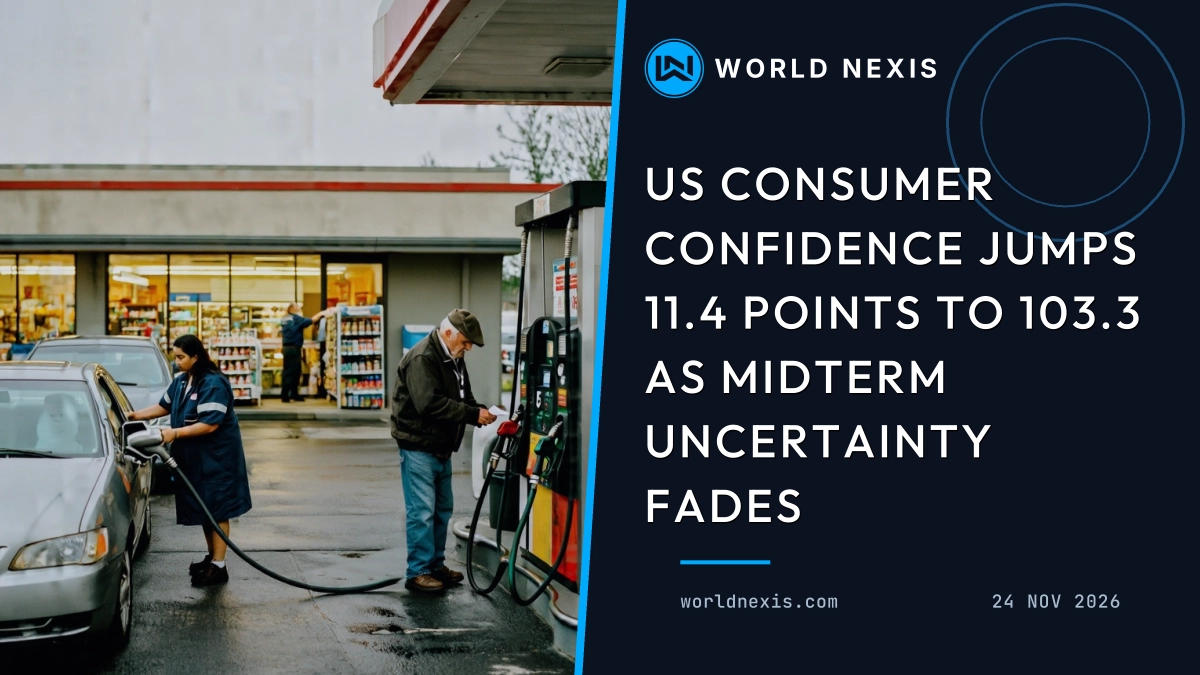
US consumer confidence jumped 11.4 points to 103.3 in November, the Conference Board said on Tuesday, as midterm election uncertainty cleared and gasoline prices kept falling. The reading landed far above the 92.2 forecasters had expected and delivered the second strong survey in a week.
Key points
- The Conference Board’s consumer confidence index climbed to 103.3, an 11.4-point rise on October.
- Democrats and independent voters grew sharply more optimistic, while Republicans slipped but remained the most confident group.
- Twelve-month inflation expectations fell for a second month but stay high at 5.7%.
- The Federal Reserve meets in two weeks, with a quarter-point rate increase expected.
Inside the consumer confidence numbers
The improvement ran across the survey rather than sitting in a single question. Both the present situation index and the expectations index posted strong gains for the month, the Conference Board said. Forecasters in a Dow Jones consensus had looked for 92.2, so the headline figure beat expectations by a wide margin.
Households also read the labor market differently. The share of Americans describing jobs as “plentiful” rose to 30.8% from 26.2%, while those calling work “hard to get” fell to 18.4%. The gap between the two widened to 12.4 percentage points.
That jobs gap matters for anyone weighing a new employer or a bigger loan. A wider spread between plentiful and hard-to-get work usually means households feel secure enough to move, and to spend.
Prices are where the mood still sours. Expected inflation over the next 12 months eased for a second straight month but remains 5.7%, well above the 2% target the Fed has chased for roughly five and a half years.
Consumers “continued to express frustration with high prices and rising costs” while also citing “hope for the general economy,” said Fergus McCormick, the board’s senior economist for global indicators.
Why the midterms and cheaper gas lifted consumer confidence
Consumer confidence split along party lines, as it has all year. Optimism among Democrats and independent voters improved sharply, the Conference Board said, while confidence among Republicans dipped slightly. Republicans nonetheless remain the most optimistic of the three groups.
That split means the headline gain is really a story about the voters who backed the winning side. Republican confidence slipped but stayed above both other groups, so the shift in mood is narrower than a single index number suggests.
Two forces did most of the work. The midterm campaign left households with an unresolved question about who would control Washington, and that question is now settled. Gasoline prices have also been sliding, easing the most visible weekly cost in most budgets.
A second survey pointed the same way. The University of Michigan’s November reading, released on Friday, showed a 7.3% increase in sentiment since October, with a similar partisan pattern. Both are closely watched measures of US consumer sentiment, and both now show the winning side cheering and the losing side cooling.
Why it matters
For households, the practical question is what a brighter mood does to the cost of borrowing. A Fed that treats this report as proof the economy can absorb another increase will keep mortgage rates, car loans and credit card balances expensive into the winter.
The consumer confidence reading will not move a single mortgage payment on its own. What it can do is shift expectations, and cheaper fuel plus a settled election is the combination that usually comes before steadier spending.
For the parties, the numbers cut both ways. Democrats can argue that the uncertainty lifting is the reward for the result they delivered. Republicans can point to inflation expectations still near 6% as evidence that the squeeze has not gone away.
Analysis
Having covered markets and the Fed for World Nexis News for five years, I read a consumer confidence number as a weather vane rather than a thermometer. November’s jump is best understood as a release of tension. Take away the election and the falling gasoline price, and little in the report says households feel richer than they did in the summer.
That is why I side with Fergus McCormick’s framing over the more triumphant readings doing the rounds on trading desks. Relief and frustration can sit on the same answer sheet, and 5.7% expected inflation is frustration with a number attached. The strongest counter-argument is that sentiment surveys have a poor record of predicting actual spending, and on that point the bulls are right.
My expectation is that the Fed raises by a quarter point in two weeks regardless, because a survey of mood is not the evidence it would need to stop. President Donald Trump has blamed a $6 trillion stock market slide on the Democrats’ midterm wins and what he called “bad” policies, which suggests the political argument over this economy is getting louder, not quieter. If gasoline prices tick back up in December, the credit Democrats are claiming will fade faster than it arrived.
What happens next
The Federal Reserve meets in two weeks and is expected to raise its benchmark rate by a quarter point, a decision that will shape borrowing costs into the new year.
Then comes the next consumer confidence reading, which will test whether November was a one-off release of post-election tension or the start of a more durable recovery in mood. Holiday trading will give the first hint of whether any of it reaches the till.
What we don’t know yet
Whether Republican households return to their earlier optimism is still open. So is whether the fall in gasoline prices lasts through the winter, and whether any of this turns into spending rather than sentiment.
Related coverage
- Amazon drone crash prompts FAA probe as 500-city push looms
- Kalshi Utah charges: state moves to dismiss 14 felony counts
- Jensen Huang reinstatement sparks backlash over Trump role
Further reading
- Syria land mine casualties soar, two years after war
- Consumer confidence shoots up after Democrats’ midterm victories — though inflation worries persist
About the author: Daniel Whitmore is the Business & Markets Editor at World Nexis News (WNN), covering business & markets. The analysis section reflects the writer’s view.

Daniel Whitmore
Daniel Whitmore is Business & Markets Editor at World Nexis News, based in New York. He leads coverage of companies, economies, markets and the forces that move them, from central bank decisions to corporate earnings and the cost-of-living pressures facing households on both sides of…