Jensen Huang reinstatement sparks backlash over Trump role
Jensen Huang reinstatement at Nvidia has triggered Republican backlash, after Donald Trump said he personally convinced the board to bring back its CEO.
Updated 25 Nov 2026, 19:21 (UK time): Financial disclosure filings show President Trump held millions of dollars in Nvidia stock while pressing the board to reinstate Jensen Huang, adding a conflict-of-interest question to the story.
New financial disclosures show President Donald Trump held between $13 million and $58 million in Nvidia stock at the end of 2025, while he was pressing the chipmaker’s board to reinstate Jensen Huang. The filings, lodged with the Office of Government Ethics, also record more than 100 Nvidia trades worth between $27 million and nearly $98 million between January 2025 and September 2026.
The value of those shares rose by between $1.3 million and $14.8 million on the day Huang returned, before some of the gain faded. Nvidia stock jumped more than 30% as the reinstatement was confirmed. The White House says the president’s portfolio is independently managed by third-party institutions and that neither he nor his family can direct or influence investment decisions.
The disclosure adds a personal financial dimension to the Jensen Huang reinstatement, which Trump has described as his own deal. Ethics specialists questioned whether a president should hold a large stake in a company whose leadership he openly helped change. I think the independent-management defence is worth hearing, but it does not erase the appearance problem when the president claims credit for the move and then benefits from the rally.
The Jensen Huang reinstatement at Nvidia has turned into a political problem for the White House, after some Republicans condemned the deal Donald Trump says he personally brokered. Nvidia restored Huang as president and chief executive on 23 November 2026, days after he resigned over an affair allegation involving a woman US investigators suspect of links to Chinese intelligence.
Key points
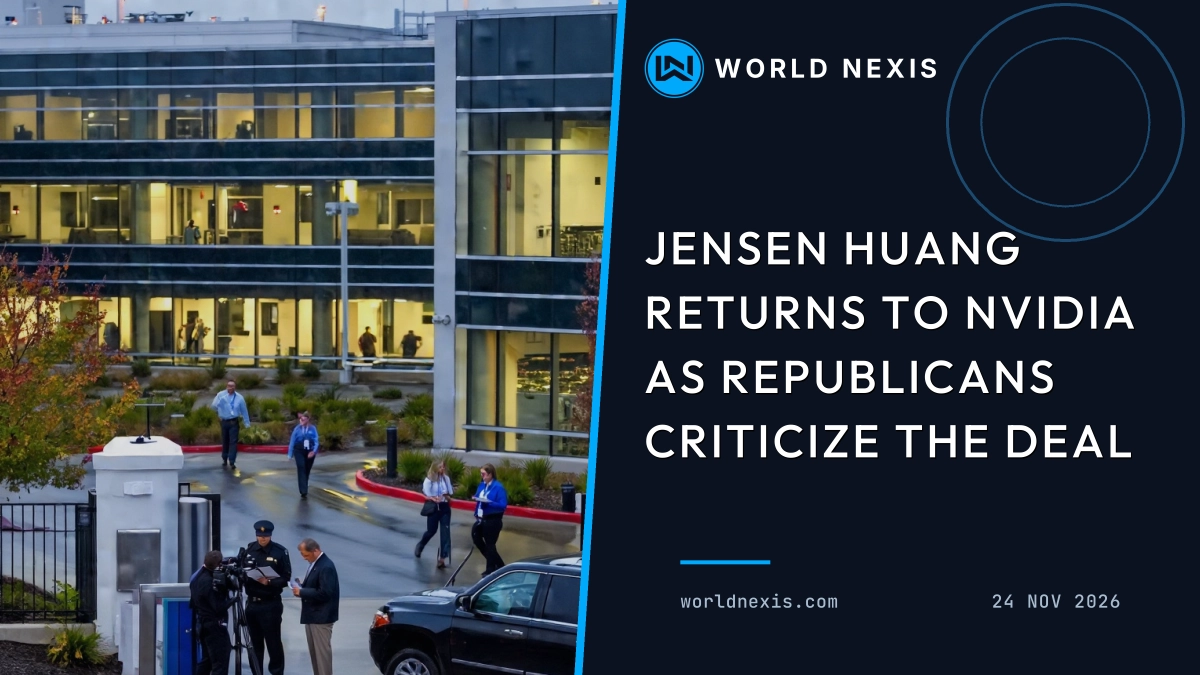
- Huang returned as Nvidia president and CEO on 23 November, meeting staff at the company’s Santa Clara headquarters.
- Trump said he spoke to board members “directly and indirectly” and told them: “I convinced them. I made the deal.”
- Some Republicans have criticized the Jensen Huang reinstatement, and the security investigation behind it remains open.
- Board chair Harvey C. Jones said Huang is “the right person to lead NVIDIA”.
How the Jensen Huang reinstatement was agreed
Trump set out his version of events in a phone interview on Monday. He said the board had asked for assurances that Huang was not a national security threat, and that he gave them. “They did ask for assurance on the national security threat, and we gave them assurance, at least with everything we know, and we know a lot,” he said.
He also said a “very thorough investigation” by the US government had “exonerated” Huang. According to the president, that review found Huang “did nothing wrong”.
Before recommending the move, Trump said he consulted Attorney General Todd Blanche and Director of National Intelligence Jay Clayton. “I had to go to them before I recommended this,” he said. “Look, I can’t do this and then all of a sudden have somebody get indicted for, for whatever.”
The president framed the choice as a question of talent rather than clearance. “We have to protect our geniuses, and he’s certainly a genius,” he said, adding that “the bigger threat would be losing the brain power of somebody like Jensen”. After the board acted, he said he telephoned Huang with one instruction: “work hard”.
Nvidia’s own statements were far more conventional. Huang said he was “honored to return to NVIDIA and lead one of the most consequential technology companies in the world at the beginning of a new industrial revolution”. Jones said the board believed the reinstatement was “in the best interest of our stockholders, employees, partners and customers”.
Backlash grows over the Nvidia board decision
The Jensen Huang reinstatement has drawn public criticism from some Republicans, and it has not settled the questions that forced him out. Nvidia had said it did not intend to reinstate him before the public pressure and private calls changed the outcome.
That reversal is the detail critics keep returning to. A board that had already decided against a chief executive changed course within days, after a president who had raised the case publicly made clear which answer he wanted. Trump has not disguised his part in it. “I spoke to them,” he said. “Let me put it this way: And I convinced them. I made the deal.”
Why Beijing is watching the Jensen Huang reinstatement
Beijing has dismissed claims that Alice Huang, the woman at the center of the affair allegation, was recruited by China’s Ministry of State Security. Chinese state media has described the episode as a smear campaign, and the Global Times called it a “witch hunt”.
The president has said he and Xi Jinping discussed Huang, without offering detail. Beijing has not commented on the reinstatement itself. The investigation, meanwhile, continues, which leaves a presidential endorsement sitting alongside a case that has not been resolved in either direction.
Why it matters
The Jensen Huang reinstatement is a precedent before it is a corporate story. A president has now publicly claimed credit for changing the leadership of a chipmaker at the heart of the US-China technology rivalry, while a counter-intelligence investigation into the people around that leader is still running.
For investors, the practical question is what happens if the case produces charges. Trump himself raised that risk, saying he could not recommend the move and then “all of a sudden have somebody get indicted”. A board normally carries that exposure privately. This time it sits with the White House too.
Analysis
Having spent five years at World Nexis News covering corporate strategy and market structure, I read the Jensen Huang reinstatement less as a story about one executive than about who now holds the risk of a bad call. In my view, the evidence supports the critics rather than the White House.
A board can reasonably decide that a chief executive is worth keeping while an allegation is unresolved. That is a commercial judgment, and Nvidia’s directors are entitled to make it. What is much harder to defend is a president announcing he “made the deal” and handing those directors an assurance he described as limited to “everything we know”. That shifts the reputational cost of an unfinished investigation from the company to the state.
The strongest counter-argument is that running a chipmaker requires no security clearance, and that no charges have been brought. If none ever come, Trump will present himself as the man who saved a national asset from a Washington pile-on, and the Nvidia CEO return will be judged on results. Even so, this looks less like a board exercising judgment than a board taking a call from the Oval Office.
What happens next
Huang is back at Nvidia’s Santa Clara headquarters and running the company with the board’s public backing. The investigation into Alice Huang continues. Clayton addressed the case in a television interview on Sunday, and the government has given no signal that it has closed the file.
The next test is whether the White House names the investigation it says cleared Huang, and whether the assurances given to the board were ever written down.
What we don’t know yet
It is still unclear which government investigation the president was describing when he said Huang had been exonerated. The White House has not publicly identified it. Nor is it known what form the board’s assurances took. Beijing has also yet to respond formally.
Related coverage
- Jensen Huang reinstatement sparks national security scrutiny
- Jensen Huang reinstated as Nvidia CEO, shares surge 30%
- Nvidia reinstates Jensen Huang as shares surge more than 31%
Further reading
- What Jensen Huang’s return to Nvidia teaches China’s Xi about Trump
- ‘I made the deal’: Trump says he ‘convinced’ Nvidia board to reinstate Jensen Huang
About the author: Daniel Whitmore is the Business & Markets Editor at World Nexis News (WNN), covering business & markets. The analysis section reflects the writer’s view.

Daniel Whitmore
Daniel Whitmore is Business & Markets Editor at World Nexis News, based in New York. He leads coverage of companies, economies, markets and the forces that move them, from central bank decisions to corporate earnings and the cost-of-living pressures facing households on both sides of…



