Jensen Huang reinstatement sparks national security scrutiny
Nvidia's board has unanimously reinstated Jensen Huang as CEO with Trump's backing, as the Jensen Huang reinstatement reignites national security fears.
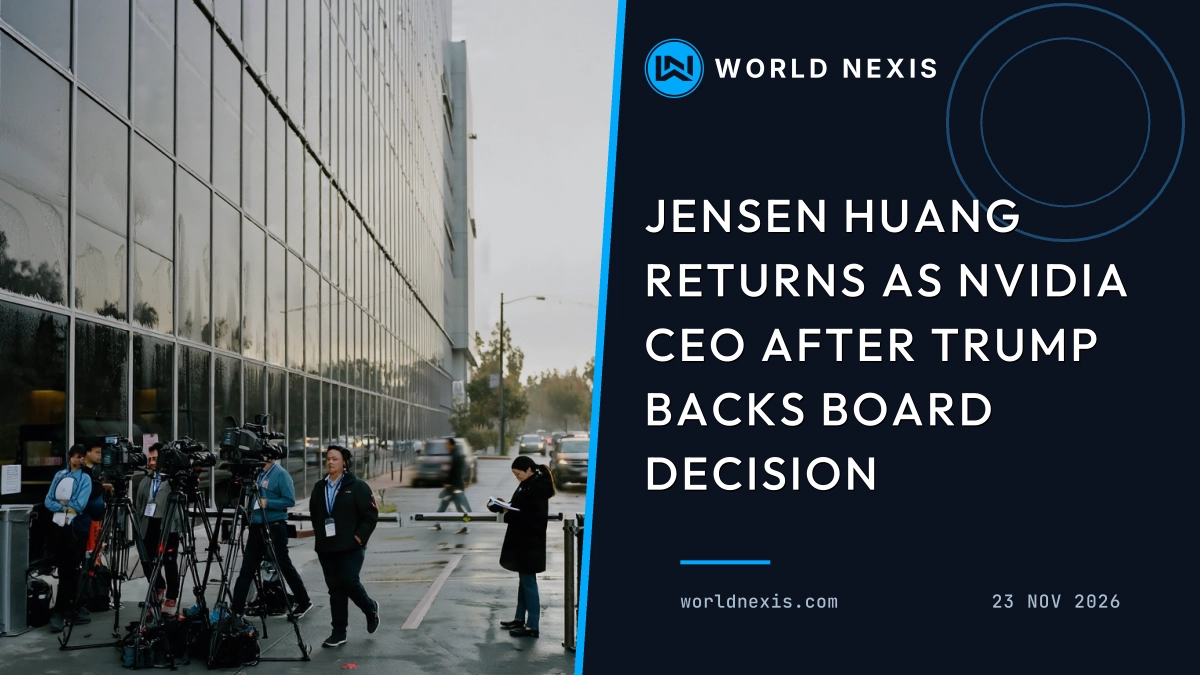
Nvidia’s board voted unanimously on Monday to restore Jensen Huang as president, chief executive and board director, a Jensen Huang reinstatement that followed input from senior US government officials and an immediate endorsement from Donald Trump. The announcement came before markets opened on 23 November and reversed a resignation that had lasted less than two weeks. Nvidia shares jumped sharply, lifting the wider US market with them.
Key points
- Directors approved the Jensen Huang reinstatement in a unanimous vote after meetings with him and contact with senior government officials.
- Trump said he pushed for the move, called it “the correct and proper decision” and insists there is no national security risk.
- Huang quit less than two weeks ago after reports of an affair with a woman suspected of being a Chinese spy.
- Shares rose sharply on the news, and the company’s internal investigation into Huang is continuing.
How the Jensen Huang reinstatement came together
The company said directors reached the decision after “a series of conversations and meetings” with Huang and after taking input from people at senior levels of the United States government. The board said it was satisfied with his candor and his capacity to lead the business.
The Jensen Huang reinstatement was also remarkably quick. Directors had signaled only days earlier that they did not intend to bring him back, and Huang had said publicly that he would return if they permitted it. Every director backed him in the end, and the Nvidia board decision was announced as a unanimous vote.
Huang, who co-founded the company, framed his return around the artificial intelligence boom. “I am honored to return to NVIDIA and lead one of the most consequential technology companies in the world at the beginning of a new industrial revolution,” he said in the company’s statement. “I take this responsibility with the greatest humility and renewed commitment.”
What Trump said about national security
The Jensen Huang reinstatement drew an unusually direct White House role in a personnel decision at a private company. In a phone interview on Monday, Trump said he had been “speaking to the board directly and indirectly, and I felt very strongly about it”. He said his conviction hardened as he watched events at the company, which he called “a very important part of our country”.
Trump said directors had asked for assurances on the security question and that the administration gave them, based on everything the government knows. He also said he spoke with Huang the night before the announcement and argued that losing Huang’s “brain power” would be “a far bigger threat” than his return. The president described the outcome as “the correct and proper decision”.
He said there is “no reason to believe that Jensen’s return to NVIDIA poses any risk to National Security”, and that Attorney General Todd Blanche had confirmed Washington “does not possess evidence that he has engaged in any unlawful conduct”. Trump added that Nvidia should keep its own compliance with US export controls under review, and that Huang was needed to secure the success of the company and the American economy.
The scandal behind the U-turn
Huang resigned after reports that he had an affair with a woman suspected of being a Chinese spy. The story turned a boardroom succession into a Washington problem, because Nvidia’s most advanced chips sit at the center of the US-China technology contest.
That is why the Nvidia national security risk question has outlasted the corporate drama. Controls on advanced AI chips are among the few real levers Washington holds in its rivalry with Beijing, and the credibility of those controls depends on who is trusted to run the firms that build the hardware.
The Jensen Huang reinstatement therefore does more than fill a management vacancy. It sets a precedent for how a chipmaker answers an espionage allegation that has never been tested in public by any US agency.
Why it matters
For savers, the decision is a reminder of how much of Nvidia’s value rests on one person. The chipmaker sits inside countless index funds and retirement accounts, so a governance shock at the top reaches households that never buy a single share directly.
For the wider economy, America’s most valuable semiconductor company is now anchored to political assurances rather than a published review. Suppliers, data-center developers and foreign buyers must price in the possibility that Washington’s position shifts again.
Analysis
Having covered corporate governance and market structure for World Nexis News, I look first at the sequence of events, and the sequence bothers me more than the outcome. A board that had just said it would not restore its founder reversed course after conversations with the government, while its own internal investigation was still running. That is not a compliance process. It is a phone call.
The strongest counter-argument is Trump’s: a strategically vital company losing its founder in the middle of an AI boom carries real economic risk, and the government says it holds no evidence of unlawful conduct. I accept that continuity has value. But continuity is a commercial argument, and it cannot answer a security question that has been raised but not settled.
I side with the reading that the Jensen Huang reinstatement damages the export-control regime more than it protects Nvidia. If assurances can be given verbally to directors, nobody outside the room can test them, and the next chief executive facing similar allegations will expect the same treatment. A written finding from the agencies involved would have cost the White House a week and bought the company years of credibility.
What happens next
The Jensen Huang reinstatement will be tested quickly: Huang is expected to appear before congressional committees next week, where he will face questions about the affair, the espionage allegations and Nvidia’s export-control compliance. The company’s internal investigation continues, and directors have not said when it will report.
What we don’t know yet
It is unclear what assurances the administration actually gave the board, and whether any US agency has formally reviewed the allegation at the heart of the story. Nor is it known whether Huang’s testimony will be open to the public.
Related coverage
- Nvidia rehire call: Trump backs Jensen Huang’s return
- Solomon Islands PM flies to Canberra for key security talks
- M&S franchise talks: major shift for 42 European stores
Further reading
- Trump says he spoke to Nvidia board directly about Jensen Huang and insists CEO’s return doesn’t pose a national security risk – live
- Nvidia’s board of directors brings Jensen Huang back as CEO
About the author: Daniel Whitmore is the Business & Markets Editor at World Nexis News (WNN), covering business & markets. The analysis section reflects the writer’s view.

Daniel Whitmore
Daniel Whitmore is Business & Markets Editor at World Nexis News, based in New York. He leads coverage of companies, economies, markets and the forces that move them, from central bank decisions to corporate earnings and the cost-of-living pressures facing households on both sides of…



