Solomon Islands PM flies to Canberra for key security talks
Solomon Islands PM Matthew Wale flies to Canberra on Wednesday for talks with Anthony Albanese, with a reported $1bn security deal unconfirmed.
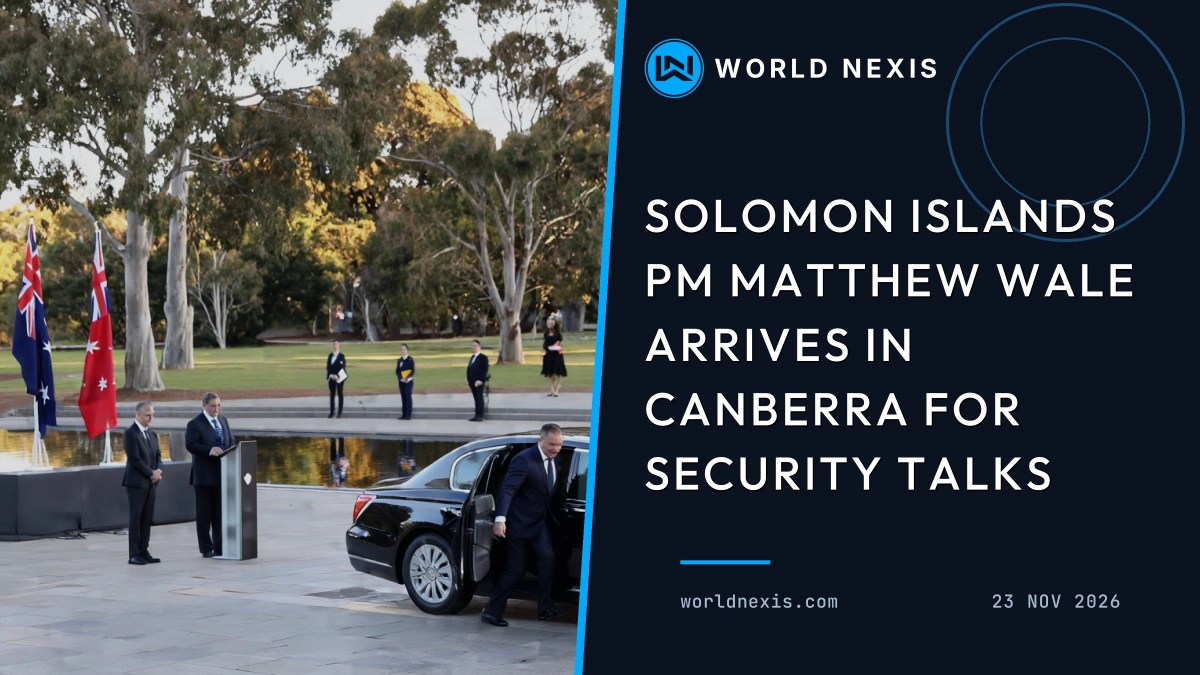
Solomon Islands PM Matthew Wale will fly to Canberra this week for formal talks with Anthony Albanese, the fifth meeting between the two leaders since May. Mr Wale arrives in Australia on Wednesday, and both countries say they aim to firm up a security partnership.
Key points
- Solomon Islands PM Matthew Wale lands in Australia on Wednesday for formal talks in Canberra.
- It is the fifth meeting between Mr Wale and Anthony Albanese since the Solomon Islands leader took office in May.
- Mr Albanese said the two countries are stronger when they face global uncertainty “together as partners”.
- Reports point to a treaty worth almost $1 billion in Australian funding, a figure neither government has confirmed.
Why the Solomon Islands PM is heading to Canberra
Mr Albanese will host his Solomon Islands counterpart for official talks in the Australian capital. The Australian prime minister presented the visit as the next step in a relationship he describes as long-standing and close.
“Australia and the Solomon Islands share a longstanding friendship built on respect, connections and a shared vision for our region,” Mr Albanese said in a statement before the trip.
He went on to say that “at a time of global uncertainty, we are stronger when we face these challenges together as partners”. Mr Albanese added that he looked forward to welcoming “my friend, Prime Minister Wale” back to Australia.
Fifth meeting since May
The Canberra talks will be the fifth time the two leaders have met since Mr Wale took the leadership of the Pacific nation in May. Their most recent encounter came at a pre-COP summit in Fiji, where the impact of climate change on Pacific countries was the focus. They also met on the sidelines of the UN General Assembly in New York in September.
A leader who has looked towards Australia
Since taking office, Mr Wale has sought to align the Solomon Islands more closely with Australia. His first overseas visit as leader was to Canberra earlier this year. The Solomon Islands PM has stressed that his country’s main alliance is with Australia, after the Solomon Islands signed a security pact with China in 2022.
Australia-Solomon Islands security talks and an unconfirmed $1 billion
The visit follows reports that the two governments have agreed a treaty under which Australia would provide almost $1 billion in funding to the Solomon Islands. Neither side has published the text, and the sum has not been confirmed by either government.
If the figure holds, the package would sit at the centre of these Australia Solomon Islands security talks rather than at their edges. For now, the public record consists of the leaders’ statements and the timetable of the visit itself.
The 2022 security pact with China remains the backdrop. It changed the terms of the conversation in Canberra, and it explains why successive Australian governments have put Pacific relationships near the top of their foreign policy priorities.
Why it matters
For people in the Solomon Islands, the outcome shapes who helps fund policing, transport links and public services across a country of many islands spread over a wide stretch of ocean. For Australian taxpayers, the question is whether a reported $1 billion commitment produces visible results.
The visit also matters well beyond the two capitals. Small Pacific states have become the setting for competition between larger powers, and each security arrangement signed in the region tends to set a precedent for the next one.
For the Solomon Islands PM, the test is delivery. A partnership described in warm language still has to show up in clinics, classrooms and coastguard patrols.
Analysis
Pacific diplomacy is the file I watch most closely at World Nexis News, and I read this visit as consolidation rather than a fresh start. Mr Wale will have met Mr Albanese five times in seven months, and he chose Canberra for his first trip abroad as leader. Those are the choices of a leader deliberately re-anchoring his country, not one keeping every option open.
I think the facts support the Australian government’s argument that steady, leader-level engagement is what actually moves a relationship. A treaty unveiled in one burst of publicity would mean little on its own; repeated meetings build the working trust that makes a security partnership function. My worry is the gap between the reported package and what has been confirmed, because almost $1 billion is a large number to leave unverified while both governments talk up the partnership.
The strongest counter-argument is that Canberra is buying influence, and that Pacific governments resent being treated as prizes in a wider contest. That criticism has force, which is why the transparency test now matters more than the summitry. In my view the burden sits with Australia: publish the terms, and let Solomon Islands voters judge delivery rather than announcements.
What happens next
The Solomon Islands PM arrives in Australia on Wednesday, with formal talks alongside Mr Albanese to follow in Canberra. Both governments have said the aim is to firm up a security partnership, so the days after the visit should show whether a treaty text and a funding figure are released.
What we don’t know yet
No treaty text has been published, and neither government has confirmed the reported funding figure or the timeframe attached to it. It is also unclear whether any agreement will be signed during this visit or left for a later date.
Related coverage
- AI killer robots: US pushes optional rules as Geneva talks run to 4:30 a.m.
- COP31 talks collapse as EU and UK reject fossil fuel deal
- COP31 talks risk collapse on day 2 as fossil fuels omitted
Further reading
- ‘Together as partners’: Solomons PM to fly in for talks
- ‘Together as partners’: Solomons PM to fly in for talks
About the author: Marcus Ellington is the International Correspondent at World Nexis News (WNN), covering world affairs. The analysis section reflects the writer’s view.

Marcus Ellington
Marcus Ellington is International Correspondent at World Nexis News, reporting on diplomacy, conflict and the political forces reshaping Europe, the Middle East, Asia and the Americas. Based in London, he focuses on explaining why events unfold as they do, using official statements, diplomatic documents and…



