AI killer robots: US pushes optional rules as Geneva talks run to 4:30 a.m.
UN talks on AI killer robots in Geneva ended with a two-year extension and no binding rules, leaving a 2028 accord target and a missed 2026 deadline.
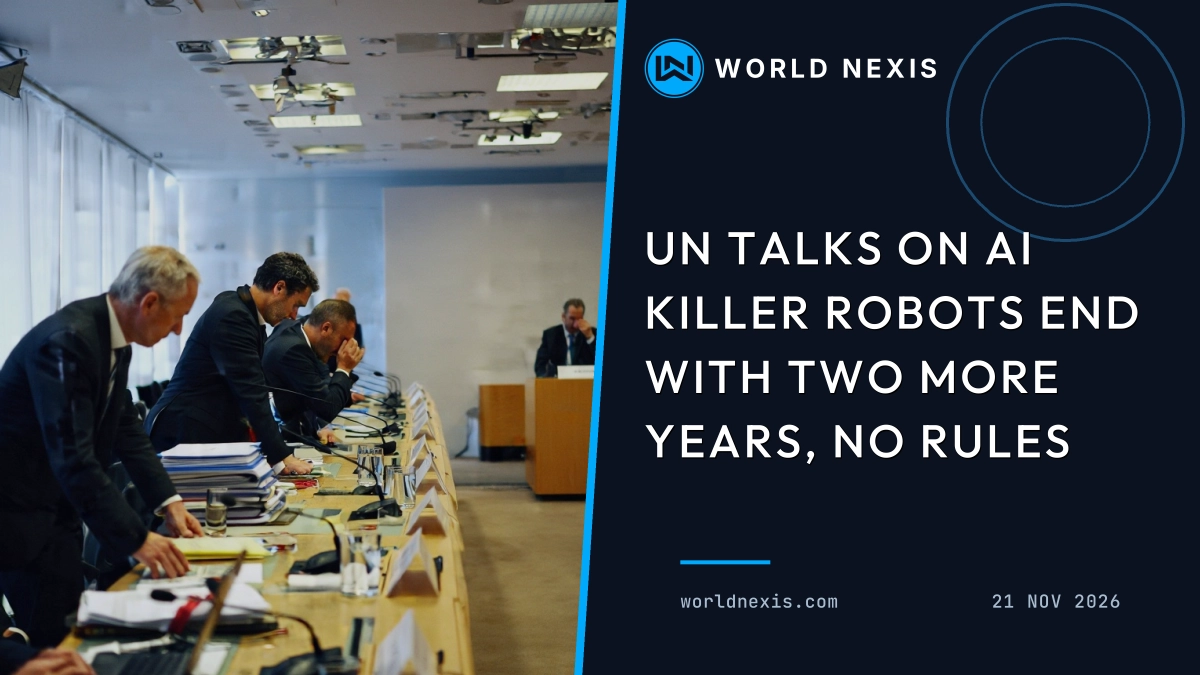
Updated 21 Nov 2026, 17:31 (UK time): Reporting from inside the Geneva conference shows how the AI killer robots outcome was reached: talks ran to 4:30 a.m. Saturday, Russia opened by objecting to the agenda, the United States floated a five-year window for voluntary guidelines, and the mandate now allows rules that may be binding or merely optional — prompting the Red Cross to say it regrets the result.
The Geneva conference on AI killer robots did not simply run out of time. It ran past it. Negotiators worked through the night and announced a compromise at 4:30 a.m. on Saturday, after a week in which Russia opened proceedings by objecting to the meeting’s agenda and the United States floated a five-year window for voluntary, nonbinding guidelines. The text that emerged gives countries two years to propose regulations that could be legally binding, but could equally be optional.
The International Committee of the Red Cross had said before the talks that binding rules were needed within a year, and said immediately afterwards that it regretted the outcome and renewed its appeal for a treaty. Its legal adviser, Georgia Hinds, argued that a machine cannot be held accountable for a violation of the law and that the commander remains responsible for the lawfulness of any use of force. Humanitarian groups point to Ukraine, Sudan and Gaza, where the United Nations says drones accounted for 80 percent of civilian deaths in Sudan this year.
What this changes is the precision of the charge sheet. World Nexis News reported that binding rules were left open; the record now shows how they were left open, with a formal American proposal for nonbinding guidance and Russian procedural resistance inside a forum where consensus hands every delegation a veto. It also hardens the proliferation worry: unlike nuclear weapons, autonomous systems are cheap enough for nonstate and criminal groups to buy or build.
A treaty without Washington and Moscow would bind almost no one, which is the strongest defence of staying at the table. But a mandate that permits optional rules is not a compromise between binding and nonbinding; it is a decision to decide nothing, written into the paperwork.
Talks on AI killer robots at the United Nations in Geneva ended on Saturday with a deal to keep talking for two more years, and no commitment to binding rules on machines that can pick and kill targets without human control.
Scores of countries closed a week-long UN weapons conference by agreeing to “elaborate” a possible accord on lethal autonomous weapons systems by 2028. They stopped well short of the legally binding instrument sought by UN Secretary-General António Guterres, by many governments and by campaigners.
Key points
- UN-backed talks on AI killer robots in Geneva ended on Saturday with an agreement to extend discussions for two more years.
- Countries will work towards a possible accord on lethal autonomous weapons systems by 2028, with no promise that it will bind anyone.
- A push by seven countries, including Austria, Brazil and Mexico, to open formal negotiations on a rulebook fell short.
- Campaigners accused major military powers, naming Russia and the United States, of blocking stronger language.
What the AI killer robots talks actually produced
The conference sat under the Convention on Certain Conventional Weapons, which 128 countries have ratified. Decisions there are taken by consensus, so a single government can stall any text, and outcomes tend to settle at the lowest common denominator.
That structure shaped Saturday’s result. Rather than a mandate to negotiate, delegations settled on a two-year extension and a 2028 horizon for what the document describes as a possible accord. Whether such an accord would bind its signatories was left open.
Before the meeting, seven countries proposed launching negotiations on a rulebook. It would have prevented or limited the ability of machines to kill without human control or accountability. Austria, Belgium, Ireland, Mexico, New Zealand, Panama and Brazil backed the plan, and it did not carry.
The outcome also reflects a wider pattern. With major conflicts under way, arms-control diplomacy has struggled to produce binding texts, while leading military powers compete for advantage in AI-enabled warfare.
A deadline missed
Guterres had set a 2026 deadline for starting negotiations towards an agreement on autonomous weapons systems. He leaves office at the end of the year, so that target will pass without being met.
Campaigners say armed drones able to strike targets independently have already been used in a small number of cases in conflict zones. A wide rollout has not happened yet, which is why they argue the window for rules is closing.
Glass half full, or half empty
Izumi Nakamitsu, the UN high representative for disarmament affairs, called the outcome a “significant achievement”. She also acknowledged a “glass half full or half empty” situation, pointing to Guterres’ hope for a legally binding deal this year.
Outside the hall, the verdict was harsher. The Stop Killer Robots coalition lamented a “watered-down mandate”. Beatrice Fihn, founder of the international law advocacy group Lex International, said the decision amounted to “pushing the can down the road for two more years”.
Max Tegmark, a machine learning specialist at the Massachusetts Institute of Technology and founder of the Future of Life Institute, said: “States have agreed it is sufficient to just talk about the issue, for the 14th year, while these weapons enable atrocities.”
Brazil’s ambassador, Frederico Meyer, put the gap between the technology and the process plainly. “Technology is moving faster than diplomacy,” he said. “Diplomats are very slow.”
Pope Leo XIV and a range of humanitarian groups have framed the question as existential, urging governments to rein in AI weapons before they become too common to regulate easily.
Why it matters
The practical effect is that the fastest-moving military technology of the decade has no international rulebook, and none is now scheduled before 2028. Countries developing autonomous weapons keep a free hand in the meantime.
For ordinary readers, the stakes are accountability as much as armament. If a machine selects and kills a person, the question of who answers for it, whether a commander, a programmer or a state, remains legally unsettled. These talks have not settled it.
Analysis
Having covered disarmament and conflict for World Nexis News, I look first at the forum rather than at the final communiqué. The Convention on Certain Conventional Weapons runs on consensus, which hands every government a veto. A body built that way will not deliver binding limits on AI killer robots that Russia and the United States want to develop.
On the evidence here, the campaigners have the better of the argument. A two-year extension, with the question of binding rules left open, is a delay dressed as progress, and the 2026 deadline Guterres set has slipped.
The strongest counter-argument is Nakamitsu’s: a treaty without the major military AI powers would be a pledge among the willing only, and keeping them at the table has value. But that case holds only while talking produces something, and 14 years in it has not. What I would watch now is whether a smaller group of states gives up on consensus and drafts rules of its own.
What happens next
Delegations will keep meeting over the next two years under the extended mandate, with 2028 as the target for elaborating a possible accord. Guterres hands over at the end of the year without his 2026 starting gun having fired.
What we don’t know yet
It is unclear whether the seven countries that pushed for negotiations will try again, or whether any government will pursue rules outside the UN framework. Nor is it settled whether a 2028 accord would cover the armed drones already able to strike targets independently.
Related coverage
- Ukraine security guarantee: Europe ready for major talks
- Coalition of the Willing: Martin backs major US-Russia talks
- Trump Xi Putin summit: 3 leaders vow peace in historic talks
Further reading
- Nations at UN talks on AI killer robots agree to more talks but no firm commitment to rein them in
- Nations at UN talks on AI killer robots agree to more talks but no firm commitment to rein them in
About the author: Marcus Ellington is the International Correspondent at World Nexis News (WNN), covering world affairs. The analysis section reflects the writer’s view.

Marcus Ellington
Marcus Ellington is International Correspondent at World Nexis News, reporting on diplomacy, conflict and the political forces reshaping Europe, the Middle East, Asia and the Americas. Based in London, he focuses on explaining why events unfold as they do, using official statements, diplomatic documents and…



