Ukraine security guarantee: Europe ready for major talks
Europe's leaders agree a united position on a Ukraine security guarantee in Berlin, as Kushner says Russia is comfortable with Nato-style protection.
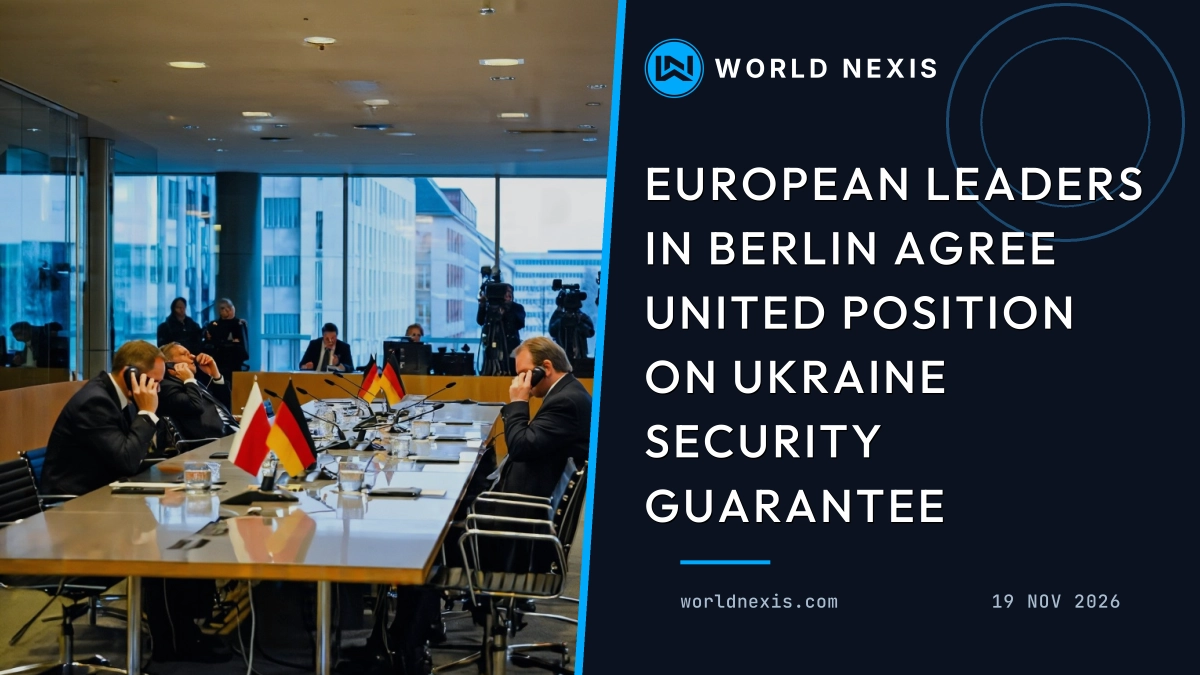
Europe’s push to turn a Ukraine security guarantee from a slogan into a signed text gathered pace on Thursday, when allied leaders meeting in Berlin declared a single negotiating position and US envoys said Moscow was now “comfortable” with the idea. The shift came hours after Donald Trump, Vladimir Putin and Xi Jinping put their names to a four-point “peace declaration” in Shenzhen that did not mention Ukraine at all.
Key points
- Leaders of the Coalition of the Willing met in Berlin, among them UK Prime Minister Andy Burnham, German Chancellor Friedrich Merz, French President Emmanuel Macron and Ukraine’s Volodymyr Zelensky.
- US envoy Jared Kushner said Trump wants a deal with Moscow “with Europe by his side” and that Russia is “comfortable” with a Ukraine security guarantee modelled on Nato’s Article Five.
- Putin said Russia was not against a European role in the talks, but wanted to establish “what Europe will bring to these talks”.
- The Shenzhen declaration covered UN reform, oil supplies, nuclear risk and the International Criminal Court, but said nothing about the wars in Ukraine or Iran.
Berlin: a united front, and a price
At the summit of Ukraine’s backers, the four leaders said Europe now holds “a clear and consistent and united negotiating position”. Burnham said the continent was ready to enter negotiations to help end Russia’s war in Ukraine.
Merz struck a more cautious note. He said Moscow’s “maximalist demands are not realistic” and that “a Yalta format will not bring peace”, a reference to the 1945 settlement between the US, the Soviet Union and Britain. He added that any attempt to divide Europe into spheres of influence run by major powers would be unacceptable.
Macron pressed allies to do the “maximum” on air defence, the systems Kyiv needs to repel Russian attacks. Zelensky, who wants four-party talks with Russia, has called Nato and EU membership the “best security guarantee” available to his country. Of the Russian president he said simply: “Putin has always said no.”
The Ukraine security guarantee Kushner described
Jared Kushner, one of two US envoys in Berlin, said Trump had left Shenzhen believing that “peace is achievable”. He said the Russians were willing to trust the judgement of US negotiators that Europe should be at the table, and that Moscow was “comfortable” with a Ukraine security guarantee built on Nato’s collective defence clause.
Article Five obliges alliance members to come to the defence of a country under attack. Russia rejects Ukrainian membership of Nato outright, so any Ukraine security guarantee of that kind would have to sit outside the alliance, with all the questions about enforcement that implies.
Kushner also said Trump wanted to make a deal with Moscow “with Europe by his side”. That framing matters, because Putin has so far refused to give the Europeans a seat at the US-led process.
In his own press conference, Putin said Russia was not against their involvement but wanted clarity on “what Europe will bring to these talks”. He said Moscow had invited the Europeans to travel to Russia through diplomatic channels so their positions could be set out first. He also insisted Russia was “not planning to attack anyone”, pushing back at European warnings about a future war.
Shenzhen: a declaration with no Ukraine in it
The three-way meeting was the first of its kind between the leaders of China, Russia and the United States. Its output was a symbolic document listing four priorities: reform of the United Nations, boosting oil supplies, cutting nuclear risk and opposing what it called abuse of jurisdiction by the International Criminal Court and similar bodies.
The text stated that “a nuclear war cannot be won and must not be fought”, but set out no framework for disarmament. Neither the war in Ukraine nor the conflict with Iran appeared in it. US and European officials have accused Russia and China of supplying satellite imagery and broader intelligence to Iran, accusations both governments deny.
Analysts read the Shenzhen summit as theatre. Prof William Hurst of the University of Cambridge said it appeared to be “all about the symbolism and prestige value”. Putin rejected that charge, describing the meeting as “serious collaborative work”.
Why it matters
For readers in Britain and Europe, the gap between a real Article Five guarantee and a promise of consultations is the gap between deterrence and another war on the continent’s edge. A clause that commits allies to fight is a very different document from one that commits them to talk.
Nothing published so far settles which version is on the table. No Ukraine security guarantee text has been released, and it is still unclear what Kyiv would be asked to give up in return, or whether European troops would police any ceasefire.
Analysis
Having covered European security and alliance politics for four years at World Nexis News, I read days like this for the sentence that changes the arithmetic rather than the photograph. In my view that sentence was Kushner’s, not the declaration. If Moscow really is comfortable with an Article Five-style Ukraine security guarantee, it is the first crack in a Kremlin position that has barely shifted throughout the war.
I side with Merz’s caution over Kushner’s optimism, though not for the reason most critics give. The German chancellor is right that a guarantee only counts if it is attached to a peace agreement Ukraine accepts. Zelensky’s “Putin has always said no” is the strongest argument against the upbeat reading, and I would not bet against it being vindicated again.
The best counter-argument is that a guarantee without Nato membership has no teeth, and that a declaration which condemns the ICC’s “jurisdiction abuse” while omitting Ukraine tells you what the three leaders were really protecting. That is a fair reading, and it is why I want a venue and a date before I believe any of it.
What happens next
The immediate step, on Putin’s account, is for European officials to travel to Moscow through diplomatic channels to set out their positions. Only after that, he said, would Russia decide the format and the next stage of dialogue with Ukraine.
Merz said talks with Moscow on wider European security would begin only once there was a peace agreement with Ukraine first, and only if the conditions were acceptable to Europe and Ukraine. Macron wants allies to keep delivering air defence at the “maximum” in the meantime. Zelensky is pressing for four-party talks involving Ukraine, Russia, the US and Europe.
What we don’t know yet
Whether the Ukraine security guarantee would carry a duty to defend or only a duty to consult; whether European leaders will accept an invitation to Moscow; and what territorial concessions, if any, Kyiv would be asked to accept. The Shenzhen declaration sets no timetable, and the Berlin summit published no text of its own.
Related coverage
- Coalition of the Willing: Martin backs major US-Russia talks
- Apec summit: Xi and Putin hold major talks as Trump lands
- Trump Xi Putin summit: 3 leaders vow peace in historic talks
Further reading
- Europe ready for talks with Russia on ending war in Ukraine, leaders say
- China, Russia and US agree peace declaration with no mention of Ukraine and Iran wars
About the author: Marcus Ellington is the International Correspondent at World Nexis News (WNN), covering world affairs. The analysis section reflects the writer’s view.

Marcus Ellington
Marcus Ellington is International Correspondent at World Nexis News, reporting on diplomacy, conflict and the political forces reshaping Europe, the Middle East, Asia and the Americas. Based in London, he focuses on explaining why events unfold as they do, using official statements, diplomatic documents and…



