Coalition of the Willing: Martin backs major US-Russia talks
Taoiseach Micheál Martin told the Coalition of the Willing in Berlin that Europe welcomes US-Russia channels and must keep backing Ukraine's EU accession.
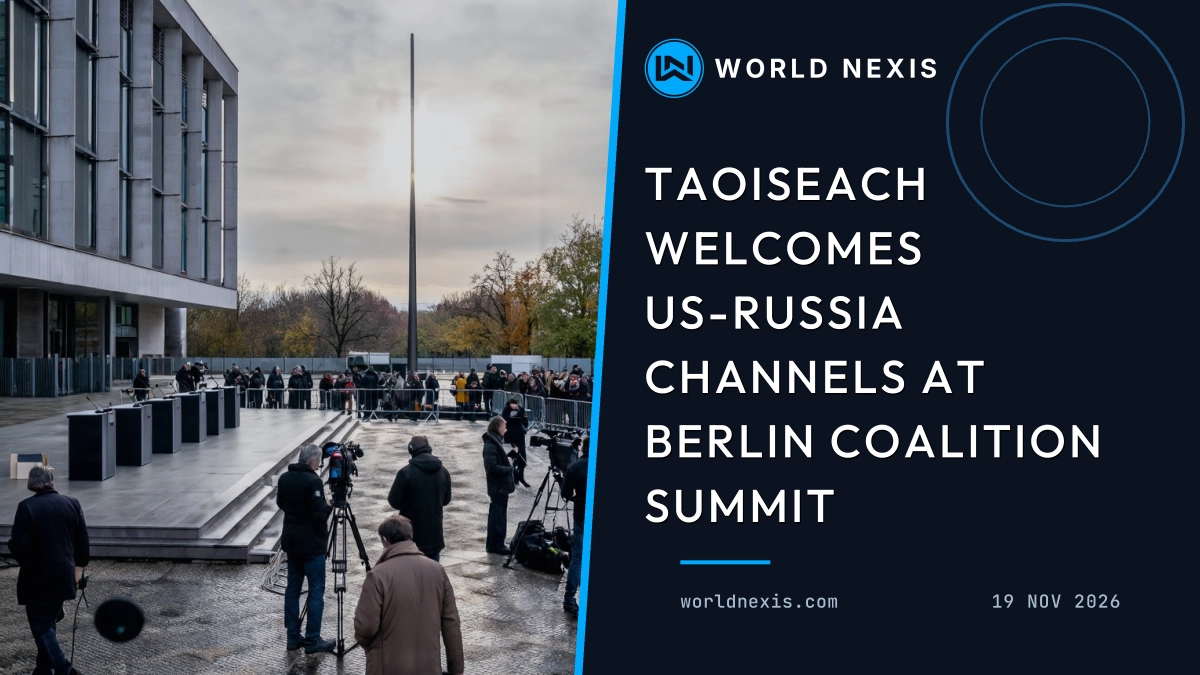
The Coalition of the Willing gathered in Berlin, where Taoiseach Micheál Martin welcomed the “channels of communication” opening between the United States and Russia and urged Europe to keep backing Ukraine. Four leaders attended: Martin, UK Prime Minister Andy Burnham, German Chancellor Friedrich Merz and French President Emmanuel Macron.
Speaking to reporters in the German capital, the Irish premier said a significant number of countries had come together to demonstrate support for Ukraine on multiple fronts, including financial backing and its bid to join the European Union. He also welcomed what he described as clarity over who will negotiate for Europe in any potential talks.
Key points
- Micheál Martin welcomed the “channels of communication” opened between the US and Russia during the Coalition of the Willing meeting in Berlin.
- He said a significant number of countries were demonstrating support for Ukraine financially and backing its accession to the European Union.
- The gathering was attended by Andy Burnham, Friedrich Merz and Emmanuel Macron, and took place during Donald Trump’s trip to China.
- Ireland is nearing the end of its six-month presidency of the Council of the European Union, a role in which Martin has made Ukraine a central issue.
What the Coalition of the Willing heard in Berlin
Martin used his appearance to frame European support for Kyiv as both a financial commitment and a political one. In his account, the number of countries in the room was itself a signal of intent.
“A very significant number of countries coming together to again demonstrate our support for Ukraine on multiple fronts, financial, and continuing to support Ukraine’s accession to the European Union.”
The Taoiseach then turned to diplomacy, welcoming the opening of US-Russia channels. He said Europe also had clarity about who would speak for the bloc if talks materialise.
“We welcome the channels of communication that have been opened up between the US and Russia, and we also welcome the clarity in terms of the European position and who will negotiate for Europe in any potential talks that may emerge.”
He finished by stressing that solidarity, rather than any single announcement, was the purpose of the meeting.
“But I think what is central today is the need to continue to demonstrate European strength and solidarity with Ukraine and I think that is the essence of today’s gathering.”
The grouping brings European allies together to discuss how to sustain the Ukrainian war effort. Its meetings have become a regular fixture for leaders coordinating that support.
Trump and Putin meet during China trip
The Berlin meeting took place in the shadow of Donald Trump’s trip to China, where he greeted Vladimir Putin warmly ahead of one-to-one talks. The US president called the Russian leader his “friend” as the two shook hands.
“We’ve had a great relationship for many years.”
It was their first meeting since discussions in Alaska last year failed to broker a peace deal. That history hangs over the Berlin gathering, where European leaders are trying to ensure their interests are represented in any future negotiation.
Why the timing matters
Washington and Moscow are talking again while European capitals are still working out how to speak with one voice. The Berlin meeting was designed to answer that question before it is settled elsewhere.
Ireland’s EU presidency draws to a close
Ireland is coming to the end of its six-month stint holding the presidency of the Council of the European Union. During that period Martin has sought to make Ukraine a central issue and has defended Europe’s response to the war.
The presidency puts a member state in the chair of ministerial meetings and gives it a platform to set the agenda. For a smaller country such as Ireland, it is one of the clearest opportunities to shape a debate dominated by larger partners.
Why it matters
For European taxpayers, the Coalition of the Willing is about where money and political capital go next. Martin’s emphasis on financial support and EU accession signals that Dublin wants the bloc’s commitments to Ukraine to hold steady rather than fade.
For Ukraine, the question of who negotiates for Europe is not abstract. If Washington and Moscow open a channel without a clear European seat at the table, decisions on security guarantees and reconstruction could be taken over the heads of the countries paying for them.
Analysis
Having covered European diplomacy for World Nexis News, I look first at the phrase “who will negotiate for Europe”, because that is where the real argument sits. Welcoming communication between Washington and Moscow costs European leaders nothing. Naming a single European voice, or agreeing how one is chosen, is the hard part, and Martin presented it as clarity already achieved rather than a problem still open.
In my view the facts support the line Martin took in Berlin: support for Ukraine should be sustained, and Europe should insist on a seat. The warmth of the Trump-Putin handshake is not evidence of a peace deal. The last round of talks, in Alaska, ended without one, and nothing in the new channel changes the underlying bargaining positions.
The strongest counter-argument is that European suspicion of US-Russian engagement could be self-defeating, because Washington carries leverage that Brussels cannot replicate, and a channel that produces a ceasefire is better than a principled one that produces none. That is fair, but it argues for European involvement rather than European silence, which is precisely what Martin said the meeting was about.
What happens next
Trump and Putin were expected to hold one-to-one talks after the greeting in China, and European capitals will be watching closely for any readout. Ireland’s EU presidency is also drawing to a close, so the task of steering the bloc’s Ukraine agenda will soon pass to another member state.
What we don’t know yet
It is not yet clear what, beyond the public statements, the Coalition of the Willing agreed in Berlin. There is no confirmed timetable for US-Russia negotiations, and no named figure has been put forward to represent Europe if they take place.
Related coverage
- Apec summit: Xi and Putin hold major talks as Trump lands
- Trump Xi Putin summit: 3 leaders vow peace in historic talks
- Trump Xi Putin meeting: first trilateral, major stakes
Further reading
- Irish Premier welcomes ‘channels of communication’ between US and Russia
- Irish Premier welcomes ‘channels of communication’ between US and Russia
About the author: Marcus Ellington is the International Correspondent at World Nexis News (WNN), covering world affairs. The analysis section reflects the writer’s view.

Marcus Ellington
Marcus Ellington is International Correspondent at World Nexis News, reporting on diplomacy, conflict and the political forces reshaping Europe, the Middle East, Asia and the Americas. Based in London, he focuses on explaining why events unfold as they do, using official statements, diplomatic documents and…



