COP31 talks risk collapse on day 2 as fossil fuels omitted
COP31 talks are in a second day of overtime after a final draft omitted fossil fuels, with no adaptation cash figure and warnings of a walkout.
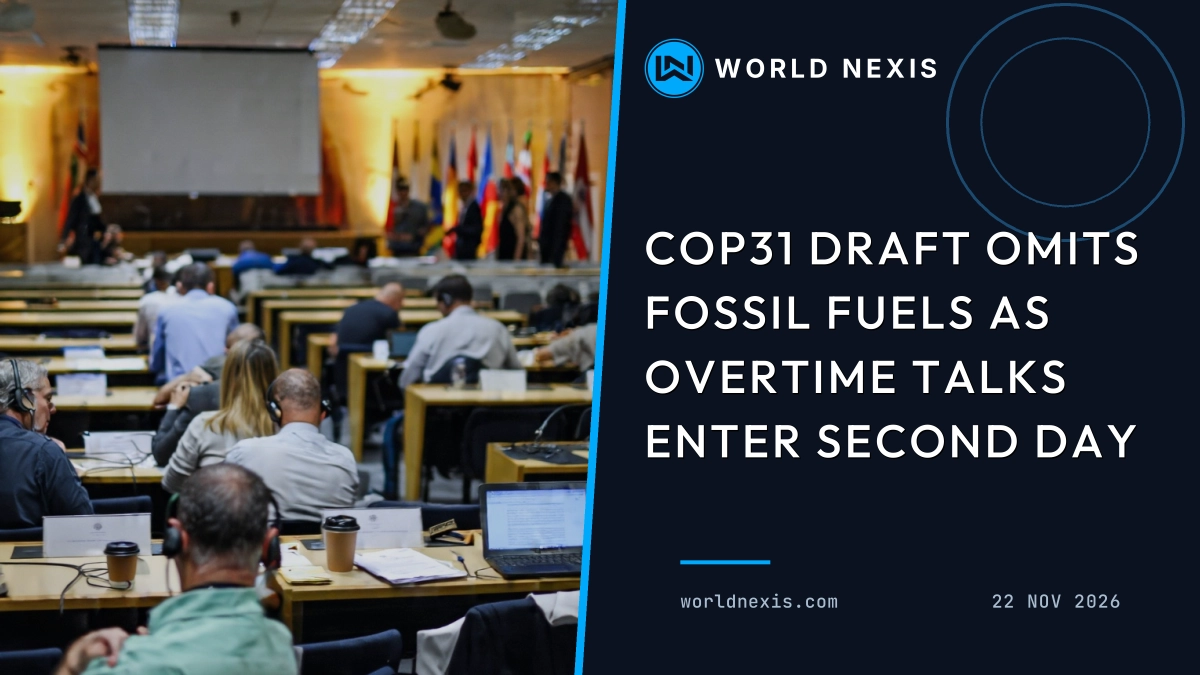
COP31 talks in Antalya are going into a second day of overtime after negotiators were handed a fresh draft agreement in the early hours of Sunday that still does not mention fossil fuels, the main cause of global warming. Delegations were due back at 09:00 local time (06:00 GMT) to decide whether to adopt a text that hosts Turkey and Australia hope can stop the summit from collapsing.
The draft contains no reference to coal, oil or gas and no call for a transition away from them, despite two weeks of argument and a deadline that passed on Friday night.
Key points
- The latest COP31 talks draft leaves out fossil fuels entirely, days after an earlier version called for a faster phase-out.
- Countries reconvene at 09:00 local time (06:00 GMT) and must adopt any deal by consensus.
- Panama, the Solomon Islands, Côte d’Ivoire and the EU are still fighting to restore a commitment to move away from fossil fuels.
- The text sets no specific figure for adaptation finance, deferring that decision to future meetings.
What the new COP31 talks draft leaves out
An initial, sprawling draft released earlier in the week contained strong calls to accelerate the phase-out of coal, oil and gas. A shorter version published on Thursday stripped out every mention of the three fuels, which triggered threats of walkouts and pushed the summit past its scheduled finish.
The text tabled overnight follows the same pared-back approach. It acknowledges, in general terms, commitments countries have already made, and it concedes for the first time that the world is on track to miss the goal of holding warming to 1.5C above pre-industrial levels.
References to carbon capture, use and storage have been trimmed but remain. France’s minister for ecological transition, Monique Barbut, said the technology risked becoming a licence for countries to keep burning oil and gas. “We cannot be announcing to the world that we are now getting to 1.5 increase in the temperature and do business like nothing was happening,” she said.
Who is holding the line in the COP31 talks
Ministers from Panama, the Solomon Islands, Côte d’Ivoire and the EU have spent the final hours of the COP31 talks trying to put a fossil fuel phase-out commitment back into the cover decision. They are up against producers led by Saudi Arabia, which has pushed for the language to be dropped.
Juan Carlos Navarro, Panama’s environment minister, said a deal that stayed silent on the fuels would not be accepted. “It is not acceptable to have a COP or a cover decision that does not even mention fossil fuels and we simply will not put up with it,” he said.
Tuvalu’s climate minister, Maina Talia, called the omission a “red line” for low-lying Pacific states. “We’re talking about the root cause of all of this,” he said. African ministers made the same argument at a press conference, with one telling reporters: “We didn’t come here to beg.” Campaign groups with a formal role in the process called it the “worst Cop ever”.
Late on Saturday the EU’s climate commissioner, Wopke Hoekstra, warned that a weak text was worse than none. If the bloc could not get “what is needed in terms of climate action… then there’s no deal,” he said. The UK’s energy secretary and chief negotiator, Miatta Fahnbulleh, said her team was still working for an agreement.
Money, adaptation and the fight the draft does not settle
The dispute goes beyond wording. The new text carries no specific figure for finance to help vulnerable countries adapt to floods, heat and rising seas, and hands that decision to future meetings. Campaigners also say a just transition mechanism agreed last year has not been carried forward.
That is why the mood has soured. “At this point, no one is happy,” said Aloisio Lopes Pereira de Melo, Brazil’s national secretary for climate change.
COP31 President Murat Kurum, Turkey’s environment minister, told delegates he believed concerns had been addressed. “We ask you to look at this decision carefully,” he said. “We are closer than ever to agreement on the remaining issues.” Australia’s climate change minister, Chris Bowen, said red lines are simply how negotiations work.
Why it matters
For households in the UK, the US and Europe, the COP31 talks outcome changes little this winter: energy bills, vehicle rules and power grids are set by national law, not by a UN cover decision. The cost shows up later, in slower and more expensive decarbonisation and a bigger bill for adapting to heat, floods and storms.
For poorer countries the effect is immediate. Without a firm adaptation finance number, governments already spending scarce budgets on flood defences and drought relief leave Antalya with promises and a timetable that runs into future summits. Formal recognition that 1.5C is slipping out of reach is, in effect, an admission that those costs will keep climbing.
Analysis
Having covered climate finance and the energy transition for World Nexis News, I look first at what a text like this does to the next round of national plans. The omission is not a drafting accident. Producers led by Saudi Arabia have spent two weeks testing whether the consensus rule can be used to delete a sentence, and so far the answer is that it can.
I think the countries refusing to sign a silent text have the stronger case, because a cover decision is the one place where the UN process states plainly what the science says about coal, oil and gas. The counter-argument deserves a hearing: a deal that keeps everyone in the room may deliver more real emissions cuts than a collapsed summit. But a text that concedes 1.5C is slipping and still cannot name the cause hands every laggard a ready excuse.
The likeliest outcome is a fudge, with a reference to an earlier commitment dressed up as progress. My worry is that the money is slipping in the same way. The COP31 talks will be remembered less for what they endorsed than for what they could not bring themselves to name, and deferring adaptation finance is itself a decision. It will be felt first in the countries least responsible for the problem.
What happens next
The COP31 talks were due to resume at 09:00 local time (06:00 GMT) on Sunday. Consensus is required, so a single objection can stop a deal. If none can be reached, the session could be suspended until next year, something that has happened only once since the first COP in 1995.
Even a successful gavel would close only this round. The adaptation finance decision moves to later meetings, and governments must return with updated national climate plans, which will be scrutinised against whatever language survives on Sunday.
What we don’t know yet
The EU had not reacted to the new draft when it was published. It is also unclear whether Panama, the Solomon Islands, Côte d’Ivoire and other like-minded states will accept a general reference to past commitments instead of an explicit phase-out. And with delegations rebooking flights, key teams could leave Antalya before a decision is taken.
Related coverage
- COP31 fossil fuels deadlock deepens as 200 nations stall
- Autonomous weapons talks collapse as 128 states delay rules
- Trump data centre tax: Australia warns of major AI risk
Further reading
- COP31: New draft deal aims to avert collapse of talks at climate summit
- Cop31 talks go into overtime as debate rages over lack of fossil fuels in draft deal
About the author: Hannah Lindqvist is the Climate & Environment Reporter at World Nexis News (WNN), covering climate & environment. The analysis section reflects the writer’s view.

Hannah Lindqvist
Hannah Lindqvist is Climate & Environment Reporter at World Nexis News, based in London. She covers climate policy, extreme weather, the energy transition, conservation and climate finance, grounding stories in scientific research, official data and documented commitments rather than slogans. She is interested in how…