COP31 fossil fuels deadlock deepens as 200 nations stall
COP31 fossil fuels talks in Antalya have gone to overtime as petrostates block the words from the final draft, with Panama threatening to walk out.
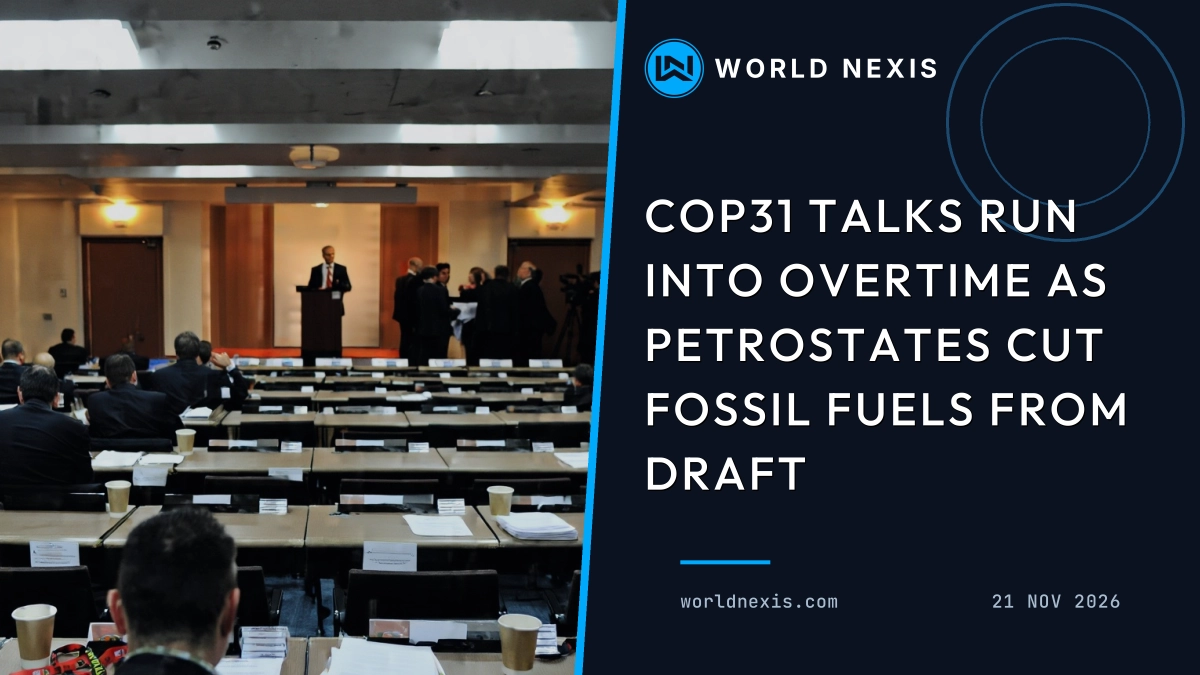
COP31 fossil fuels negotiations in Antalya, Turkey, have run into overtime after two weeks of argument among 200 countries, and the draft agreement published on Thursday contains no mention of phasing out the fuels that drive global heating. Australia is chairing the talks and is now trying to land a closing text that every delegation can accept.
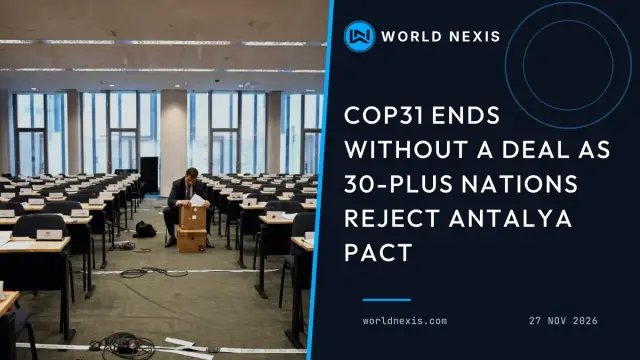
The COP31 Antalya summit has already gone past its scheduled close. Ministers and negotiators are still in the conference halls, and the central dispute is one of vocabulary as much as policy: whether the final document may use the words “fossil fuels” at all.
Key points
- COP31 in Antalya has gone into overtime with 200 countries still divided over how the final text treats fossil fuels.
- All references to phasing out fossil fuels were removed from Thursday’s draft after objections from Saudi Arabia and other petrostates.
- Panama has threatened to walk away, while Vanuatu’s climate minister said the emerging text is not “high-ambition”.
- Australia, the world’s third-largest fossil fuel exporter, says the transition will continue whatever the wording says.
How the COP31 fossil fuels fight went into overtime
For two weeks, delegations have argued over what the conference should say about the fuels behind rising temperatures. The fault line is simple enough. A large group of countries wants the final decision to name fossil fuels as the primary driver of heating and to commit governments to moving away from them.
Petroleum-producing states, led by Saudi Arabia, have resisted that language at every stage, and the COP31 fossil fuels dispute hardened as the deadline passed. Their objections prevailed on Thursday, when a draft agreement appeared with every reference to the fossil fuel phase-out taken out.
That leaves the Australian presidency with a narrow path. Negotiators must still produce a closing document that 200 governments can live with, and they must do it without the clause that most of the world’s most exposed countries came to Antalya to secure.
Island states and Panama warn of a low-ambition outcome
Ralph Regenvanu, the climate minister of Vanuatu, said the direction of the talks was already clear. “We can see where it’s going and it’s not going to be a high-ambition text,” he said.
Vanuatu is among the South Pacific nations threatened by sea level rise and worsening storms. For those countries, heating is not a distant scenario to be managed but an immediate existential risk, and the wording of the final text is the measure of whether the process takes that risk seriously.
Panama has gone further than complaint. Its environment minister, Juan Carlos Navarro, said earlier this week that the world was being held hostage by “the petroleum mafia”, and the country has threatened to walk away from the talks.
“It is not acceptable to have a COP or a cover document that does not even mention fossil fuels and we simply will not put up with it,” Navarro told a press conference.
Australia’s balancing act over COP31 fossil fuels
Australia’s position is uncomfortable. It holds the presidency of the conference, yet it is the world’s third-largest fossil fuel exporter, according to the International Energy Agency, and it is set to overtake Indonesia as the leading exporter of coal within a decade.
Prime Minister Anthony Albanese did not mention fossil fuels in his maiden address to the conference last week. The omission dismayed leaders of countries for whom global heating poses an immediate existential risk.
Chris Bowen, the minister for climate change and energy, argued on Friday that the direction of travel is set, whatever the document says. “I believe the work to transition away from fossil fuels can and will continue,” he said. “How that’s reflected is something that we’ll continue to talk to parties about.”
He rejected the suggestion that the process is coming apart. “There is still a spirit of making it work,” he said. “People have strong views, of course, I’m not stepping away from that. But no one has said to me, ‘Let’s give up and go home’. People are working. Sleeves are all up.”
Why it matters
The COP31 fossil fuels argument decides whether the shift away from oil, gas and coal is written into a shared international document or left to national governments and market forces. A final text becomes the benchmark that voters and investors can point to when the next round of energy pledges is drafted.
For low-lying island states, the wording carries more weight than any other part of the package. Their ministers have described the emerging text as lacking ambition, and their case rests on the gap between what the science implies and what a consensus document is willing to name.
The stakes are also institutional. A summit that closes without any reference to the main driver of heating would weaken the credibility of the process itself, at the very moment governments are being asked to trust it with harder commitments.
Analysis
Having covered energy transition and extreme weather for World Nexis News, I look first at what a text commits governments to do, not at how the closing speeches are framed. On that test, the COP31 fossil fuels draft that appeared on Thursday fails, and it fails in the most basic way: it will not name the cause of the problem it was convened to solve.
I think the vulnerable countries have the better of this argument. Chris Bowen is right that the transition can and will continue without permission from a conference hall, but that is precisely why the wording matters. A summit that cannot say “fossil fuels” hands every reluctant government a reason to move more slowly, and it leaves the countries carrying the physical risk with nothing to hold anyone to.
The strongest counter-argument is that consensus texts keep petrostates inside a process they might otherwise abandon, and that a deal forced through over their objections may never be implemented. That is a genuine risk. It is still a reason to keep negotiating rather than to delete the words and call the deletion realism.
What happens next
Negotiators remain in Antalya beyond the scheduled close, working toward a final text. Bowen said on Friday that no delegation has suggested going home, and that discussions with parties on the remaining language are continuing.
Whether the COP31 fossil fuels wording survives in any form is the question the presidency must now answer before the conference can close.
What we don’t know yet
- Whether the final document will contain any reference to fossil fuels at all.
- Whether Panama carries out its threat to leave the talks.
- Whether compromise language on fossil fuels can survive the objections that stripped it from the draft.
Related coverage
- Stock market correction deepens as Nasdaq erases 2026 gains
- Covid inquiry report: UK exposed as 93% of nations acted
- UK cold snap: temperatures to hit -10C on coldest night
Further reading
About the author: Hannah Lindqvist is the Climate & Environment Reporter at World Nexis News (WNN), covering climate & environment. The analysis section reflects the writer’s view.

Hannah Lindqvist
Hannah Lindqvist is Climate & Environment Reporter at World Nexis News, based in London. She covers climate policy, extreme weather, the energy transition, conservation and climate finance, grounding stories in scientific research, official data and documented commitments rather than slogans. She is interested in how…