Covid inquiry report: UK exposed as 93% of nations acted
The Covid inquiry report finds early border failures left the UK vulnerable, while test and trace delays let the virus spread virtually unchecked.
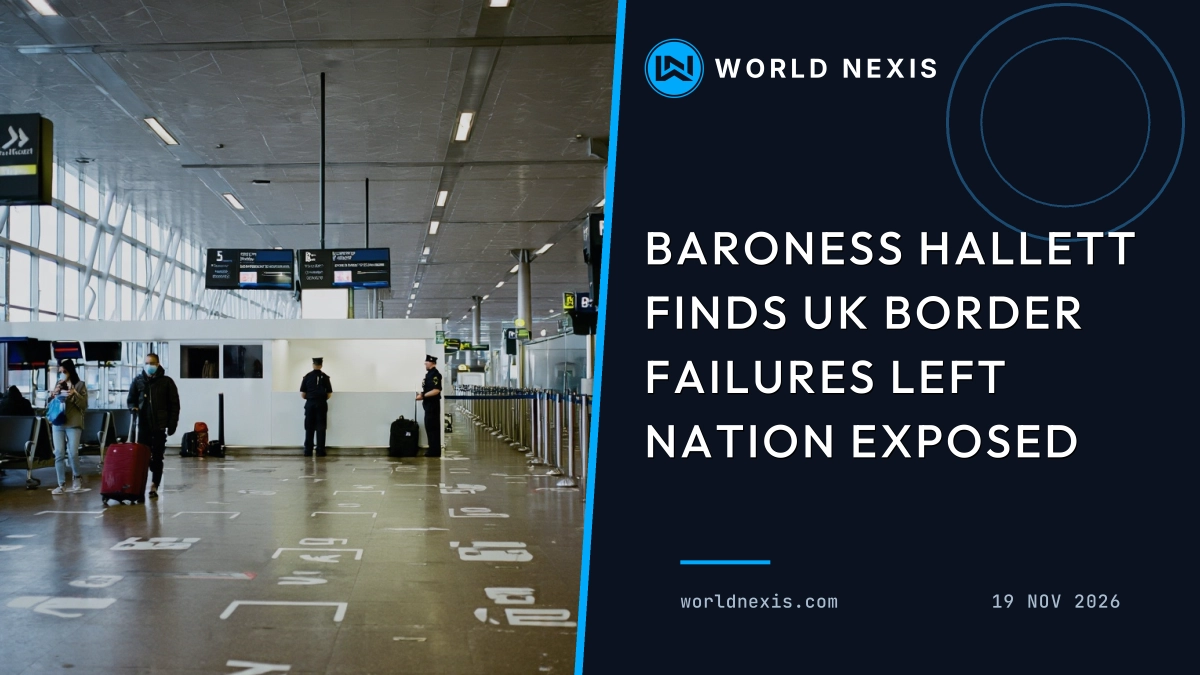
The Covid inquiry report, published on 19 November 2026, finds that early border failures left the UK extremely vulnerable to Covid-19. It also says delays to test and trace let the virus spread virtually unchecked, despite more than £25bn being spent on the NHS system in England.
Key points
- Baroness Hallett concluded that the lack of international border controls at the start of the pandemic left the UK in an extremely vulnerable position.
- The report says test and trace failures allowed the virus to spread with deadly speed across the country, virtually unchecked.
- By April 2020, 93% of countries had introduced border measures, while the UK asked only some high-risk arrivals to self-isolate until June.
- More than £25bn was spent on NHS Test and Trace in England; UK-wide testing, tracing and isolation cost more than £30bn, figures that vary by scope.
What the Covid inquiry report found on borders
The Covid inquiry report says UK Covid border controls were not guided by a clear strategy early in the pandemic. That gap, it concludes, left the country exposed when restrictions could have bought valuable time for hospitals and public health teams. The UK had no mass testing or widespread contact tracing when it allowed virtually unrestricted travel in the first six months of 2020.
By April 2020, 93% of countries had put measures in place, including flight suspensions, border closures and travel restrictions. The UK government initially asked travellers from high-risk areas to self-isolate for 14 days. It imposed no further border measures until June 2020.
Baroness Hallett described border controls as a critical gap in the UK’s ability to limit the spread of the virus. The Covid inquiry report recommends that international border control measures should be in place at the earliest stages of a future pandemic.
“Overall, the UK was left in an extremely weak position from which to face the rapidly rising rates of infection.” Baroness Hallett
Testing, tracing and the Covid inquiry report
The Covid inquiry report is equally critical of the failure to introduce a working test and trace system quickly. It says the UK entered the pandemic woefully ill-prepared, and that decision-makers were effectively blind to the scale of the virus.
The report says years of public health emergencies and preparedness exercises should have meant the UK was ready. Instead, a system had to be created virtually from scratch during a fast-moving emergency. By the time NHS Test and Trace was running, the virus had already spread widely.
Baroness Hallett said the UK had been “woefully ill-prepared to implement effective, nationwide test, trace and isolate systems”. She added that this left decision-makers “effectively blind to the scale of the highly contagious virus”.
The cost has been enormous. More than £25bn was spent on NHS Test and Trace in England, while UK-wide spending on testing, tracing and isolation passed £30bn. Baroness Hallett said the system had come too late and at a huge cost.
Covid-19 Bereaved Families for Justice said the report had “once again exposed lies and incompetence”. The group pointed to Boris Johnson’s statement on 3 March 2020 that Britain had “fantastic testing systems” and was “extremely well prepared”. It said that was a lie, noting that community testing stopped nine days later.
The group added: “Those responsible for failures that cost lives should be stripped of any honours they hold.”
Why it matters
For readers, the Covid inquiry report is not only a verdict on the past. It sets out how public money was spent, how decisions affected daily life and why trust in government guidance suffered. The £25bn bill for NHS Test and Trace in England alone makes this a question of value for money as well as public health.
The findings also shape future emergencies. The report recommends that border measures and test and trace systems be ready before the next pandemic, rather than assembled under pressure.
For families who lost relatives, the report is also a test of accountability. Covid-19 Bereaved Families for Justice wants honours removed from those it blames, showing how far the political argument extends beyond policy.
Analysis
Having covered public services for World Nexis News, I look first at whether the failure was one bad call or a system that was never built. The Covid inquiry report supports the second explanation. The UK did not simply choose the wrong border rule; it had no clear strategy, no mass testing and no widespread contact tracing when the virus arrived.
In my view, Baroness Hallett’s central judgment is correct. The facts support her conclusion that the UK was extremely vulnerable, and the bereaved families are right that the cost was measured in lives as well as money. Ministers did face genuine uncertainty in early 2020, and border closures are complex, but that counter-argument cannot explain why 93% of countries had acted by April while the UK waited until June for further border measures.
The strongest criticism is not that every decision was avoidable. It is that the UK had run preparedness exercises and still had to build test and trace from scratch. That is why I side with Hallett’s conclusion over the argument that ministers were simply overtaken by events. Readiness is not a document, it is a working system tested before a crisis.
What happens next
The Covid inquiry report recommends that international border measures be ready at the earliest stages of a pandemic. It also calls for test, trace and isolate systems to be prepared nationwide, rather than assembled during an emergency.
Those recommendations are now the benchmark against which ministers and public health bodies will be judged. The report’s findings will also feed into the wider debate about how the UK pays for and maintains emergency readiness.
What we don’t know yet
It is not yet clear whether the government will accept the recommendations in full, how quickly it will respond, or whether the findings will lead to changes in law or Whitehall structures.
Related coverage
- Bayesian sinking report: crew never warned of wind risk
- London mayor candidate: Cleverly wins 86% in landslide vote
- Food bank donations critically low at 43% of Trussell sites
Further reading
- Covid inquiry report: key findings on testing, tracing and ‘the pingdemic’
- Lack of early border controls made UK ‘extremely vulnerable’ to Covid, inquiry finds
About the author: Liam O’Connor is the UK Politics Reporter at World Nexis News (WNN), covering uk politics. The analysis section reflects the writer’s view.

Liam O'Connor
Liam O'Connor is UK Politics Reporter at World Nexis News, covering Westminster, devolved politics and the issues that matter to voters across England, Scotland, Wales and Northern Ireland. Based in London, he reports from primary sources — Hansard, official statements, published data — and explains…



