Food bank donations critically low at 43% of Trussell sites
Food bank donations are critically low at 43% of Trussell's Scottish sites, the charity warns, as it braces for its busiest winter with demand still high.
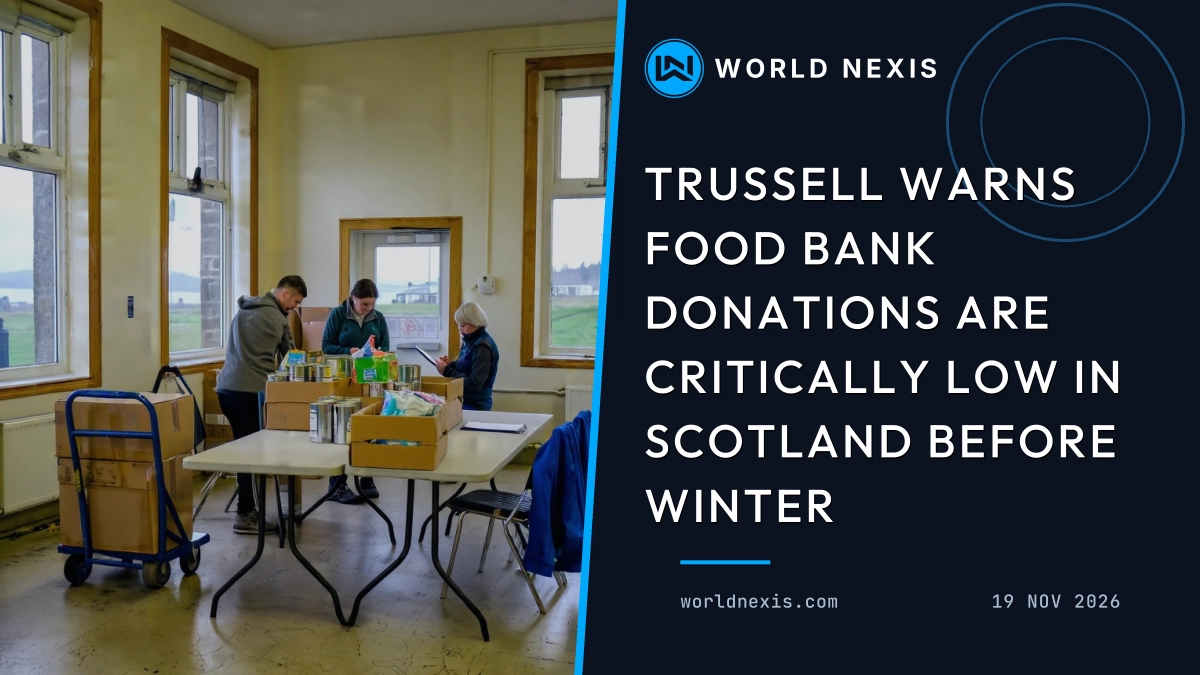
Food bank donations in Scotland have fallen to critically low levels as the busiest weeks of the year approach, Trussell has warned, with 43% of its food banks reporting a critical shortage in a new survey.
The charity, which runs the UK’s largest network of food banks, said its services face a squeeze from three directions at once: shrinking donations, rising operating costs and persistently high need. Almost half of its food banks in Scotland, 46%, said preparing for this winter is harder than in previous years.
Key points
- 43% of Trussell food banks in Scotland report critical levels of food bank donations, and 46% say this winter is harder to prepare for than last year.
- Donations last winter were 36% lower than in 2022, a decline Trussell calls sustained.
- More than 55,000 emergency food parcels were provided in Scotland last winter, the equivalent of one every two and a half minutes.
- More than 400 tonnes of food was bought in Scotland in 2025, almost seven times the 2021 total.
Food bank donations at critical level as demand builds
The warning arrives at the point in the year when Trussell’s network is traditionally at its busiest. Last winter the charity distributed more than 55,000 emergency food parcels in Scotland alone, a rate of one parcel every two and a half minutes.
Meanwhile food bank donations have been shrinking. Trussell said giving last winter was 36% lower than in 2022, and it described that as a sustained decline rather than a one-off dip. The gap between what communities need and what they supply has widened since the start of the cost-of-living crisis.
As a result, its food banks are increasingly forced to buy stock to keep emergency support flowing. More than 400 tonnes of food was purchased in Scotland in 2025, almost seven times as much as in 2021 and roughly the weight of 35 double decker buses. In 2021, food banks bought just 3% of the food needed to support the people who came to them.
Volunteers describe a harder winter
With food bank donations thinning, managers say the cost of simply staying open has become a second pressure. Heating halls and keeping storage lit adds to bills at the same moment that demand climbs.
“Food banks continue to see people forced to skip meals, go without heating and sitting in the dark because they can’t afford the essentials like toiletries, rent and household bills,” said Cara Hilton, Trussell’s senior policy and public affairs manager for Scotland.
She said one food bank had recently described people putting on coats and getting into bed to keep warm because they cannot afford to heat their homes. Another person who turned to a food bank had less than £1 in their bank account and no food in the cupboards.
“Our food banks are a lifeline to people facing hunger and hardship across our communities – but they shouldn’t have to exist in the first place,” she said.
Ken Linton, manager of Dundee and Angus Foodbank, said staff and volunteers provide emergency food parcels and practical support every week. “It’s not right that anyone in Scotland doesn’t have enough money to live on,” he said. “But the rising cost of food and energy will make it even harder for us to keep services running.”
Why it matters
Trussell says more than half a million people in Scotland are at risk of needing to use a food bank over the next year. For those households, a shortfall in food bank donations does not arrive as an abstract statistic: it can mean a thinner parcel, fewer tins, or a referral turned away at the door.
The squeeze also lands on the volunteers and small charities that keep local provision running. When giving falls, the network has to spend money on food that donors once supplied, which eats into the funds that pay for advice services and the practical support wrapped around a parcel.
Analysis
Having covered devolution and public services for World Nexis News, I look first at where the levers actually sit, and this story points in two directions at once. The immediate cause of the alarm is a collapse in food bank donations, but the underlying cause is that household incomes no longer stretch to essentials. The sevenfold rise in food bought by food banks since 2021 is the clearest evidence: generosity has not failed, need has outgrown it.
I think the facts support Cara Hilton’s framing better than the quieter argument that this is a seasonal appeal problem which will resolve itself in December. If giving alone could fix it, the decline would not have run from 2022 into 2025 while need stayed high. The strongest counter-argument is that Holyrood holds limited fiscal power and that benefit levels are largely set in Westminster, so blaming either government alone misreads the system – which is precisely why Trussell is pressing both.
What I would watch now is whether the response stays at the level of collection points and photo calls. Food bank donations matter enormously to the person receiving the parcel this month, and I would not dismiss the value of a tin in a crate. But a country that answers a 400-tonne shopping bill with an annual appeal has decided to manage a crisis rather than solve it.
What happens next
Trussell is asking supporters to give food or funds this winter, and to check a local food bank’s website first so that donations match what is most needed. A Tesco Winter Food Collection runs from November 26 to 28 for anyone who wants to donate in store.
What we don’t know yet
It is not clear whether donation levels will recover before December, or whether either the Scottish or UK government will announce extra support. Trussell has also not said whether it expects to buy more food this winter than last.
Related coverage
- Overdose deaths at 10-year low as White House claims credit
- Circular Bioeconomy Alliance: King hosts 15 food giants
- West Bank sanctions: UK names all eight firms hit by asset freezes
Further reading
- Food banks facing critically low donations ahead of winter, report warns
- Food banks facing critically low donations ahead of winter, report warns
About the author: Liam O’Connor is the UK Politics Reporter at World Nexis News (WNN), covering uk politics. The analysis section reflects the writer’s view.

Liam O'Connor
Liam O'Connor is UK Politics Reporter at World Nexis News, covering Westminster, devolved politics and the issues that matter to voters across England, Scotland, Wales and Northern Ireland. Based in London, he reports from primary sources — Hansard, official statements, published data — and explains…



