West Bank sanctions: UK names all eight firms hit by asset freezes
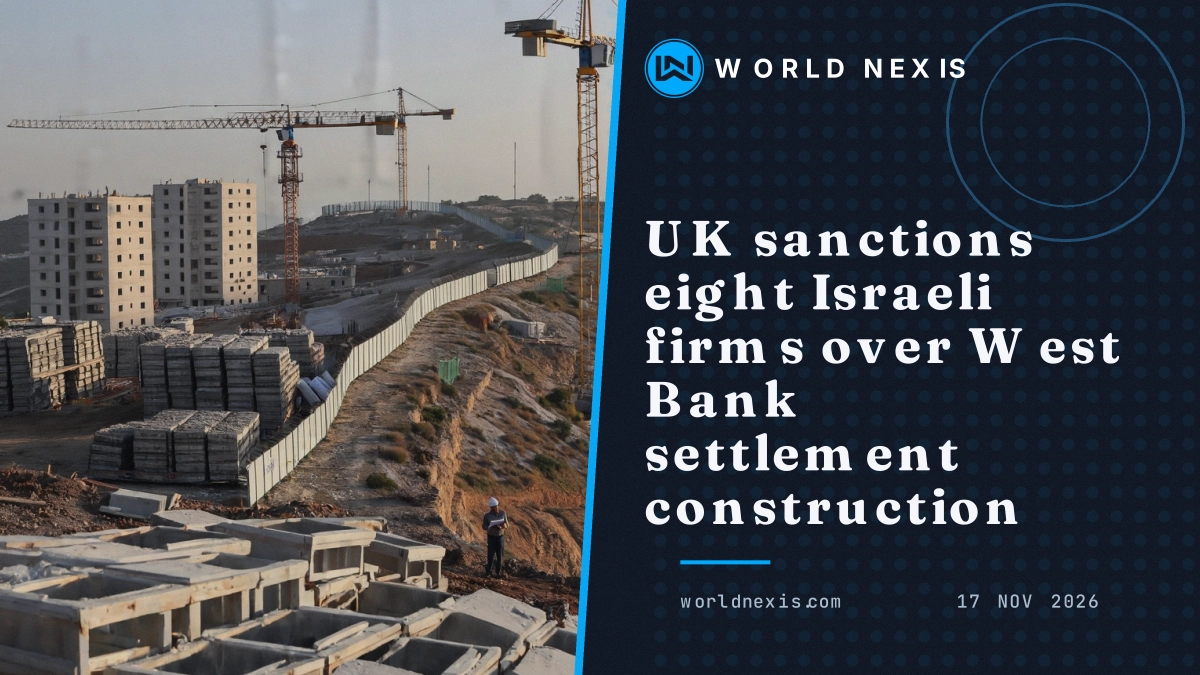
The UK has imposed its first West Bank sanctions on eight Israeli settlement construction firms and Tzav 9, days before E1 tender reviews begin.
Updated 17 Nov 2026, 14:56 (UK time): The UK published the full list of all eight sanctioned settlement firms and confirmed they face asset freezes and director bans, prompting Israeli officials to denounce the move and urge retaliation.
The UK has now named all eight Israeli companies covered by its first West Bank sanctions, confirming that each faces an asset freeze and that people associated with them will be barred from serving as directors of UK-registered companies. Alongside the three firms previously identified — Har Hevron Development, Hemdat Shomron and S.A.G. (Velvel) Construction and Development — the list includes Lev HaHar Yazamut, Harey Zahav, Ariel Residential Judea & Samaria, Ami Gvirtzman Architects 2021 and Z.F. Building Co., the Associated Press reported.
In a video posted on X, Foreign Secretary Ed Miliband said illegal settlement expansion was destroying the prospects of a two-state solution and warned firms considering involvement in projects such as E1 that Britain would “clamp down on you”. The AP reported that Israel’s outgoing government has sought bids for 1,200 homes in the E1 corridor east of Jerusalem, and that Miliband has said the wider package, including a settlement goods trade ban, should be fully in place within six to nine months.
Israeli officials responded angrily, accusing London of hypocrisy and antisemitism and calling on the Israeli government to take retaliatory measures, Israel National News reported. The AP noted that after Miliband’s September speech Israel barred several British MPs from entering the country and downgraded its Jerusalem consulate, forcing 20 staff to leave; Foreign Minister Gideon Saar said at the time that a “hostile Labour government” had left Israel no choice.
My take: the designations now have names, teeth and a diplomatic price tag attached, which makes them harder for London to quietly shelve once a new Israeli government takes office.
The UK has announced its first West Bank sanctions, targeting eight Israeli construction and property firms involved in settlement expansion, Foreign Secretary Ed Miliband said on Tuesday. The package also designates Tzav 9, an Israeli activist movement that has blocked humanitarian aid convoys heading into Gaza. It was published two days before Israel begins reviewing tenders for homes in the E1 development.
Key points
- Eight Israeli construction, property and architecture firms face finance restrictions under the first West Bank sanctions package.
- Three are named publicly: Har Hevron Development Company Ltd, Hemdat Shomron Ltd and SAG (Velvel) Construction and Development Ltd.
- Tzav 9 is sanctioned for stopping aid convoys bound for Gaza as recently as October.
- The West Bank sanctions land before the E1 tender review, which critics say would sever the West Bank from East Jerusalem.
Why the West Bank sanctions were timed around E1
Miliband announced the West Bank sanctions just before the Israeli government was due to allocate tenders for the large E1 settlement. Critics say the project, in a land corridor outside Jerusalem, would effectively separate the occupied West Bank from East Jerusalem. The Foreign Office said the current Israeli government had “not only refused to clamp down on illegal settlement, but has facilitated and encouraged them”.
According to the Foreign Office, more settlements were approved during the four years of this Israeli government than in the previous 20 years. Miliband has said settler terrorism in the West Bank is “rampant”, and that the UK now views the occupation as a whole as unlawful. That goes beyond the previous British stance, which described only the settlements themselves as illegal.
“That is why my message on E1 is clear: do not bid, do not build, and do not profit from the destruction of the two-state solution.” — Ed Miliband, Foreign Secretary
He added that protecting the two-state solution was the “north star” of the government’s approach, and called the status quo in the West Bank and Gaza “unacceptable”. Miliband also said he wanted to work productively with a new Israeli government and the Palestinian Authority.
Who the West Bank sanctions target and what they do
The eight companies are Israeli construction, property development and architectural businesses. They have helped to plan, build, supply or market housing and public infrastructure in settlements in the occupied West Bank. The Foreign Office said the designations limit their access to finance and their ability to support further building.
Three firms were named publicly: Har Hevron Development Company Ltd, Hemdat Shomron Ltd and SAG (Velvel) Construction and Development Ltd. In practice, the extent to which any of the eight depends on British finance is yet to be tested, the Guardian reported. The sanctions are designed to stem the flow of money into settlement construction.
The measures build on a September 8 announcement, when Miliband expanded the Global Human Rights sanctions regime and set out plans to ban trade in goods from illegal settlements. Those trade measures are yet to be implemented. The Foreign Office said it welcomed trade with “green line Israel” and drew a firm distinction with settlement activity.
PA reported that the reset in the UK’s approach under Prime Minister Andy Burnham had already triggered a backlash from Donald Trump’s White House and Benjamin Netanyahu’s government. Netanyahu’s government may be ousted following last month’s Israeli elections.
Gaza aid and the Tzav 9 designation
The package also hits Tzav 9, a right-wing Israeli activist movement that has prevented humanitarian aid convoys from entering Gaza as recently as October. Miliband said: “We will not stand by while those blocking desperately needed aid deepen the intolerable suffering of civilians in Gaza.”
The Foreign Office said civilians in Gaza desperately need winter supplies. Catastrophic floods have left nearly 4,000 households without shelter, and 1.4 million people are living in tents or makeshift shelters. According to the UN, more than 150,000 tents and 300,000 tarpaulins bought by humanitarian partners and donors are outside Gaza.
Miliband and his Middle East minister, Stephen Doughty, have repeatedly highlighted Israel’s refusal to let a variety of dual-use goods into Gaza. The Guardian described the package as the first set of sanctions against Israeli companies planning to build illegal settlements in the West Bank.
Analysis
Having covered sanctions and conflict for WNN, I look first at whether a designation actually bites. On that test, the West Bank sanctions are a sharper instrument than September’s announcements, because they land at a specific commercial moment: the E1 tender review. Cutting eight firms off from British finance will not stop settlement construction on its own. But it does put a price on the paperwork that makes E1 bankable, and it forces banks and insurers with UK exposure to decide something they had previously avoided.
I think the government has the better of this argument. Foreign Office figures show more settlement approvals in four years than in the previous two decades, which suggests years of quiet concern achieved little. The strongest counter-argument is that these firms may hold little British finance to lose, making the measure largely symbolic. That is a real risk, and the trade ban promised in September is still not in force.
Where I would watch next is the Israeli side. Gadi Eisenkot, the possible new prime minister, has said he would take a tougher line than Benjamin Netanyahu on settler violence. If that holds, the West Bank sanctions give him something to work with rather than something to push against. The test is whether London keeps them on the table instead of trading them away in the first friendly phone call.
What happens next
The review of tenders for homes for Israelis in the E1 development is due to begin two days after the announcement. Miliband has said the UK will work with a new Israeli government and the Palestinian Authority on lasting peace and security for Israelis and Palestinians alike.
Eisenkot has said that, if appointed, he would take a tougher approach than Netanyahu to settler violence. The wider trade ban on goods from illegal settlements, promised in September, is still to be implemented.
Related coverage
- Bank outages hit 3 major US banks in Monday disruption
- Kerch bridge attack severs Crimea link in 7-stage raid
- Megaspeed investigation: US tightens chip rules in 5 nations
Sources
- Ed Miliband announces first sanctions on Israeli firms working in West Bank (theguardian.com)
- UK hits firms building West Bank settlements with sanctions (chesterstandard.co.uk)
- UK hits firms building West Bank settlements with sanctions (gazetteandherald.co.uk)
- UK sanctions firms building West Bank settlements and group blocking Gaza aid (lynnnews.co.uk)
- UK hits firms building West Bank settlements with sanctions (sthelensstar.co.uk)
About the author: Marcus Ellington is World Nexis News’s International Correspondent, covering world affairs. The analysis section reflects the writer’s view.

Marcus Ellington
Marcus Ellington is International Correspondent at World Nexis News, reporting on diplomacy, conflict and the political forces reshaping Europe, the Middle East, Asia and the Americas. Based in London, he focuses on explaining why events unfold as they do, using official statements, diplomatic documents and…



