Circular Bioeconomy Alliance: King hosts 15 food giants
King Charles hosted the Circular Bioeconomy Alliance at St James's Palace, where 15 food companies signed the Regen Compact to back farmers.
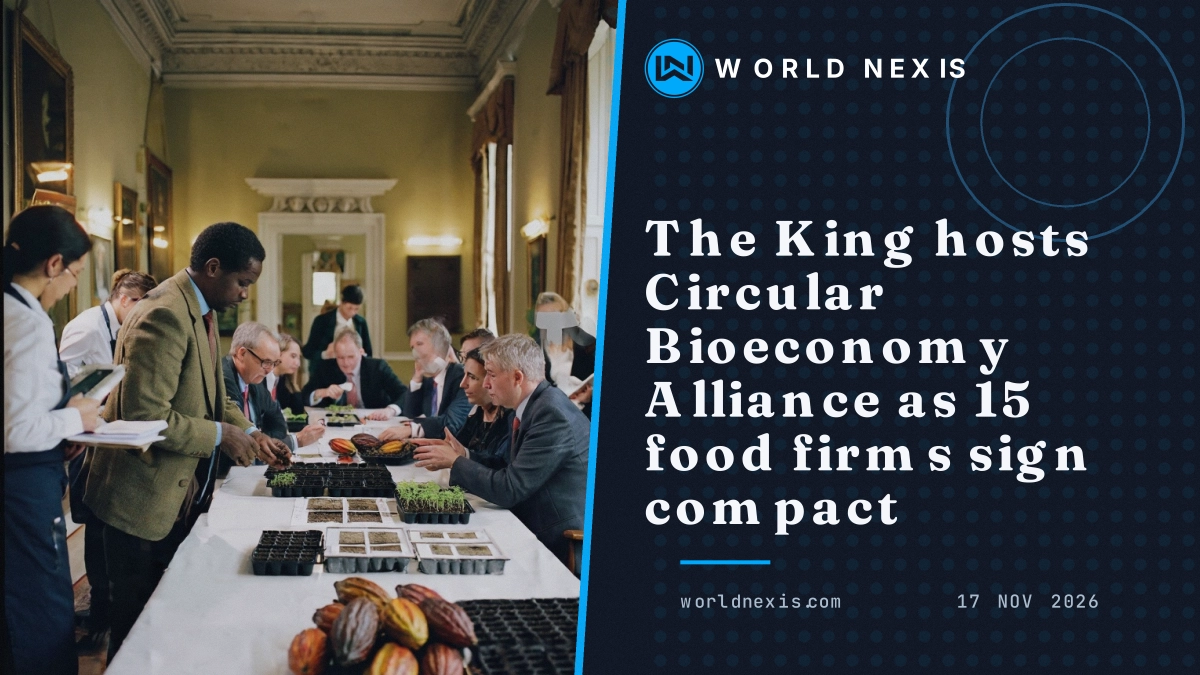
The King hosted the Circular Bioeconomy Alliance at St James’s Palace on Tuesday evening, where 15 food companies and retailers signed a compact to support farmers, and Ecuador’s ambassador used the reception to invite the monarch back to his country. Luis Vayas Valdivieso told Charles that President Daniel Noboa sends “greetings and gratitude” for the King’s work with the alliance, the Press Association reported.
Key points
- The King hosted the Circular Bioeconomy Alliance at St James’s Palace on Tuesday evening.
- McDonald’s joined 14 major companies and retailers in signing the alliance-led Regen Compact.
- The Ecuador ambassador said Charles would be offered a tour of the Amazon and the Galapagos.
- The King was shown Living Labs that use science and indigenous knowledge to regenerate landscapes.
Circular Bioeconomy Alliance brings food giants to St James’s Palace
The Circular Bioeconomy Alliance urges organisations to centre nature in their economic decisions. It works on more sustainable approaches to food production, land use, health and industry, and was set up by Charles when he was Prince of Wales.
Representatives from Aldi, Waitrose, Gail’s Bakery and McDonald’s attended the reception in central London. McDonald’s had that day joined 14 major companies and retailers in signing the Regen Compact, which aims to support farmers and build more resilient food supply chains in the wake of a year of extreme weather.
The compact is led by the Circular Bioeconomy Alliance. Signatories include Nestle, Yeo Valley, Aldi, Waitrose and Gail’s Bakery.
The King also spoke with McDonald’s senior director of international sustainability, Pete Garbutt, whom he first met in 2009 when Mr Garbutt was a young farmer. Mr Garbutt, who is based in Bedfordshire, was meeting the monarch for the third time.
“I’m from a farm and my wife’s a farmer… a lot of my family, friends are all farmers and it’s great to work in a position to try to help us to farm better, to address some of the challenges in farming.”
He added: “We know it’s something that’s close to the King’s heart and so we’re delighted to play a part in it and to also at the same time, be investing in strengthening the resiliency of our business as well.”
During the reception, the King was shown examples of the alliance’s Living Labs, which use science and indigenous knowledge to regenerate landscapes and support communities.
Ecuador ambassador offers the King a tour of the Amazon
Mr Valdivieso later told PA that Charles would be offered a tour through Ecuador’s Amazon jungle, as well as the “quite attractive” Galapagos, where the King has visited before. On Tuesday the two men discussed work at organic cacao farms in Ecuador through the Circular Bioeconomy Alliance.
He said of the monarch:
“Always he has so much energy and he transmits that energy, but also the knowledge of the topics that you discuss with the King is quite good, and he has a wonderful memory too.”
“He remembers everything and actually comes with questions sometimes, you know, that I have to find the answers (to),” Mr Valdivieso added. “It would be great to see him once again in my country,” he said.
The ambassador pointed to the monarch’s welcome for President Noboa at Buckingham Palace in May last year and said the two are in contact. He argued that backing from the two heads of state was helping the work.
“But also it’s not just giving support for giving support – they see the potential, they see the opportunity in this, they see that it’s working. With his vision of His Majesty, you know, about nature – that it will work, and it’s working, and it could be a good example.”
As Prince of Wales, Charles flew to Ecuador’s capital, Quito, and toured the Galapagos Islands, which were studied by the 19th century scientist Charles Darwin and helped him develop his theory on the evolution of life.
Analysis
Having covered climate and energy for WNN, I look first at what a reception like this actually changes on the ground. The number that matters is 15 companies signing the Regen Compact, yet a signature is not a purchasing contract, and the motive one signatory described was strengthening the resilience of its own business. That is a perfectly sound commercial reason; it is not, by itself, evidence that farming practice is shifting at scale.
In my view, the facts here support the sceptical reading better than the celebratory one. The alliance’s case, put by Mr Valdivieso, is that the King’s vision of nature “will work, and it’s working”, but the only outcome confirmed this week is a set of names on a document. The strongest counter-argument, and Mr Garbutt makes it well, is that a network which keeps farmers and multinational buyers in the same room year after year can shift practice faster than a rule nobody enforces. I accept that point, while still wanting farm-level numbers before I call voluntary pledges a result.
What I would watch most closely is the part of the work that is hardest to brand: the Living Labs that pair science with indigenous knowledge, and the cacao farms in Ecuador that the King and the ambassador discussed. Those are specific, local and testable. If the Regen Compact’s signatories publish what changed on the farms they buy from, my scepticism weakens. If they do not, this week will read as a photograph of good intentions.
What happens next
The King is to be offered a tour of Ecuador’s Amazon jungle and the Galapagos Islands, according to the Ecuador ambassador, who said it would be great to see the monarch in his country once again. No date for any visit has been given.
The Regen Compact’s 15 signatories, brought together by the Circular Bioeconomy Alliance, now move towards delivery: supporting farmers and building more resilient food supply chains after a year of extreme weather. The King, meanwhile, continues to convene the network he created to put nature at the centre of economic decisions.
Related coverage
- Met Office snow warning brings rush hour travel disruption
- California surf warning: 50ft waves close iconic piers
Sources
- Ecuador ambassador praises King’s energy after inviting monarch to nation (thurrockgazette.co.uk)
- Ecuador ambassador praises King’s energy after inviting monarch to nation (readingchronicle.co.uk)
- Ecuador ambassador praises King’s energy after inviting monarch to nation (sthelensstar.co.uk)
- Ecuador ambassador praises King’s energy after inviting monarch to nation (yorkpress.co.uk)
- Ecuador ambassador praises King’s energy after inviting monarch to nation (eadt.co.uk)
About the author: Hannah Lindqvist is World Nexis News’s Climate & Environment Reporter, covering climate & environment. The analysis section reflects the writer’s view.

Hannah Lindqvist
Hannah Lindqvist is Climate & Environment Reporter at World Nexis News, based in London. She covers climate policy, extreme weather, the energy transition, conservation and climate finance, grounding stories in scientific research, official data and documented commitments rather than slogans. She is interested in how…