Trump data centre tax: Australia warns of major AI risk
Trump data centre tax threat draws a sharp rebuke from Australia, where ministers say offshore AI capacity is vital to American security as well.
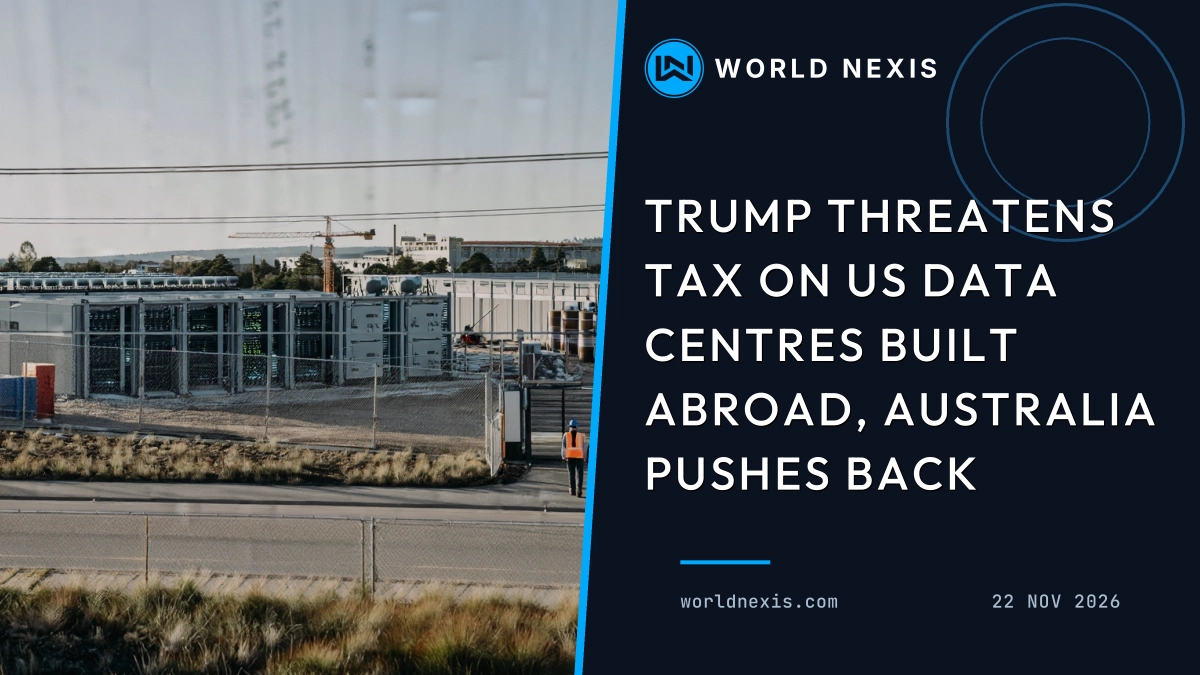
Australia has pushed back on the Trump data centre tax, after the US president said American technology companies would face “a tremendous tax” for building artificial intelligence facilities outside the United States. Deputy Prime Minister Richard Marles said on Sunday that hosting AI infrastructure in allied countries such as Australia serves Washington’s own interests. Trump’s warning, issued on his return from the APEC summit in China, came with no rate, no start date and no stated legal authority.
Key points
- Trump said US firms that build AI data centres abroad would face “a tremendous tax”, warning that otherwise “China will take all of them”.
- Richard Marles said the Trump data centre tax would weaken, not strengthen, American security by concentrating all capacity in one country.
- Home Affairs Minister Tony Burke said there is “a national security interest” in hosting data centres in Australia.
- ASIO director-general Mike Burgess has called data centres “hype, opportunity and threat” in equal parts, and draft national rules are expected before the end of the year.
Marles leads the pushback on the Trump data centre tax
The deputy prime minister used a Sunday morning interview to argue that the Trump data centre tax works against the alliance Washington assembled to keep AI supply chains out of Chinese hands. “If all of that infrastructure is in one place, in other words, if it remains solely in the United States, right there, there’s a vulnerability,” Marles told ABC’s Insiders.
“What’s in the interests of the United States itself is that they do build redundancy beyond the United States in respect of this tech, and Australia, we think, has a significant role to play,” he said.
Trump framed the levy as a way of stopping US capital and expertise draining abroad. “We’re not going to allow our companies to build data centres outside of our country,” he said, adding that “we’re going to put a tremendous tax on them”, because otherwise “China will take all of them”. He also said Washington would “fight very hard for the data centres” to stop Beijing winning the race to build what he calls “super intelligence”.
Inside the pax silica declaration
Marles anchored his case in the pax silica declaration, signed in December 2025 by the United States, Australia, the European Union and 24 other countries, with China notably absent. Signatories committed to reducing excessive dependencies and to building a trustworthy supply chain for the technology.
“In the fullness of time, the importance of being able to have redundant infrastructure outside of the United States, the imperative of that is going to become clear,” he said. That argument now sits at the centre of the wider debate over AI data centre investment in Australia.
Security warnings cut across the data centre debate
The Trump data centre tax has landed in the middle of an argument Australia was already having about hosting large-scale compute. Home Affairs Minister Tony Burke said the government is alert to the risks. “Whenever you get that sort of capability onshore, it also becomes a magnet for people who would want to conduct foreign interference,” he told News24, adding that ownership structures would need careful scrutiny.
Burke also said that “having data centres in Australia, there’s a national security interest in being able to do it”. His remarks sit alongside a warning from ASIO director-general Mike Burgess, who said data centres are “hype, opportunity and threat” in equal parts because foreign powers could use the infrastructure to control sensitive technology and information.
Public opinion has soured in parallel, over water use, electricity demand and carbon emissions. A report released on Thursday found that nine proposed data centres could produce as much pollution as the country’s three dirtiest coal-fired power stations if they operate without renewable energy requirements.
Trinidad and Tobago weighs the uncertainty
The Trump data centre tax threat is landing well beyond Australia. Prof Andy Knight, an international relations expert, warned that Trinidad and Tobago risks becoming “collateral” in the US-China contest for AI investment. “If Washington is going to tax its own companies for building abroad, Port-of-Spain needs to know for certain, before it gives away power and water, whether those U.S. companies will be there at all,” he told Guardian Media.
Why it matters
The Trump data centre tax is not an abstract trade dispute. Data centres underpin the AI tools people already use, and where they are built decides who carries the cost of the power, water and land they consume, and whose laws protect what is stored inside them.
If Washington penalises overseas construction, governments courting AI investment face a harder calculation: offer land, energy and tax breaks to companies that may now be discouraged from arriving. Canberra is trying to attract that money and regulate it at the same time, with draft legislation promised before the end of the year.
Analysis
Having covered trade and alliance politics for World Nexis News, I read this as a test of whether Washington can hold a coalition together while threatening the industrial plans of its own members. On the evidence, Marles has the stronger argument. The pax silica declaration, signed barely a year ago, rested on the premise that trusted AI capacity should be spread among partners. A levy that punishes US firms for doing precisely that contradicts the strategy the United States designed to keep China out of the chain.
The case for the Trump data centre tax deserves a hearing. The president’s fear that capital and know-how leak abroad with every overseas build is not imaginary, and Burgess’s warning shows that distributed infrastructure creates real counter-intelligence exposure. Even so, a blanket penalty is a blunt answer to a problem better handled through ownership screening and export controls, which Australia says it is already preparing.
I side with Marles on the substance, because the security case for redundancy is stronger than the revenue case for a penalty, and because a threat issued without a rate, a date or a legal basis gives allies nothing to plan against. What worries me most is that this levy, if it ever acquires detail, could chill exactly the allied investment that gives the United States its back-up.
What happens next
No rate, commencement date or legal authority has been published for the Trump data centre tax. Australia’s draft rules for data centre development are expected before the end of the year, and ministers say talks with technology companies are continuing regardless.
What we don’t know yet
Whether the levy would cover existing facilities or only new ones remains unclear. So does how it would interact with US tax law, and whether partners such as Australia could negotiate carve-outs.
Related coverage
- Data center tax: Trump threatens firms building AI abroad
- Data center tax: Trump threatens firms building AI abroad
- Credit card cap: Trump backs 10% limit in major shift
Further reading
- Trump says he plans to penalize companies that build data centers in other countries
- Labor pushes back on Trump data centre tax threat
About the author: Marcus Ellington is the International Correspondent at World Nexis News (WNN), covering world affairs. The analysis section reflects the writer’s view.

Marcus Ellington
Marcus Ellington is International Correspondent at World Nexis News, reporting on diplomacy, conflict and the political forces reshaping Europe, the Middle East, Asia and the Americas. Based in London, he focuses on explaining why events unfold as they do, using official statements, diplomatic documents and…



