Autonomous weapons talks collapse as 128 states delay rules
Autonomous weapons talks in Geneva collapsed on Saturday, with 128 states agreeing only to keep talking until 2028 and no binding rules on AI warfare.
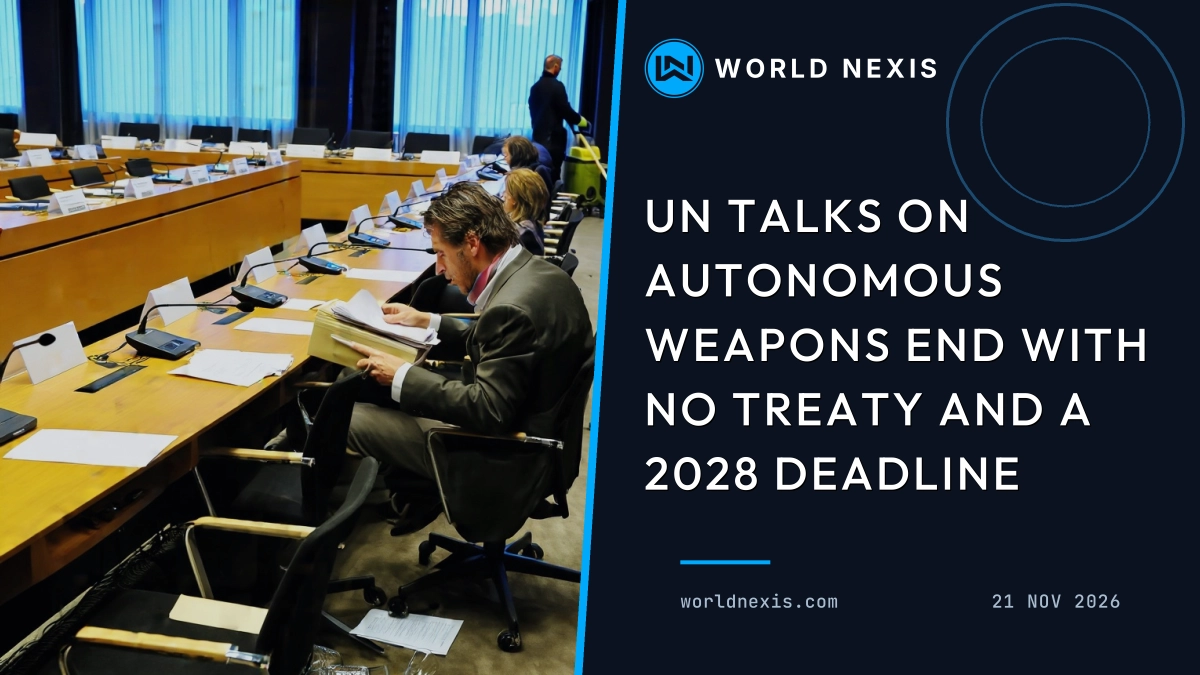
The autonomous weapons talks at the United Nations in Geneva ended in the early hours of Saturday without a binding treaty, without a negotiating mandate and with only an agreement to keep talking until 2028. Delegates had spent the week at a review conference of the Convention on Certain Conventional Weapons, which 128 states have ratified. The final text asks governments only to “elaborate by consensus” a possible accord, a formula that may carry no legal obligations at all.
Key points
- The autonomous weapons talks ended on Saturday with no mandate to negotiate a legally binding treaty.
- States agreed only to “elaborate by consensus” possible rules, with 2028 set as the target date.
- Russia led the objections through the week, and the United States also refused to accept binding limits.
- Most states backed a new law, and campaigners say AI-enabled weapons are now moving faster than diplomacy.
How the autonomous weapons talks ran out of time
Negotiations ran through the night and broke down in the early hours of Saturday. Because consensus applies to every decision, each of the convention’s 128 parties holds an effective veto. This week, that rule decided the outcome.
Russia was accused of filibustering from the opening day rather than negotiating in good faith. The United States, which has invested heavily in AI-enabled warfare, was also reluctant to sign a protocol binding it to keep human control over armed drones and other autonomous systems. American diplomats told the conference that the issue had come up in this week’s meeting between President Xi Jinping and Donald Trump, but Washington stopped short of accepting a treaty.
Most states in the room wanted a mandate to start negotiating. They had the numbers and lost on procedure, which is why the autonomous weapons talks produced a text about future discussion rather than about limits.
What the final text actually commits to
The agreed mandate asks countries to “elaborate by consensus” an instrument on lethal autonomous weapons systems by 2028. It sets no negotiating conference, no legal standard and no obligation to reach a treaty. In effect, the killer robots UN talks have been extended by two more years with the destination left blank.
Consensus has one obvious consequence: the least willing delegation sets the pace. A majority that wants a treaty cannot outvote a minority that does not, so the final wording has to satisfy the most reluctant government in the chamber. That is how a mandate for law becomes a mandate for more meetings.
Most states had pushed for a new law, arguing that these weapons raise challenges existing rules were never written to handle. What they secured instead was a date, and a date is not a safeguard.
Reactions in Geneva and beyond
Izumi Nakamitsu, the UN’s high representative for disarmament affairs, called the result a “significant achievement” but conceded it was a glass half full or half empty, pointing to the secretary-general’s hope for a binding deal this year. Campaigners were blunter, describing a watered-down mandate that pushes the problem two more years down the road.
Max Tegmark, who leads the Future of Life Institute, said states had now agreed it was sufficient simply to talk about the issue for a 14th year while such weapons enable atrocities. The former US national security adviser John Bolton, speaking at a separate event, warned that warfare is moving towards being almost entirely unmanned.
“The boundaries western civilisation tried to draw between war and civilian life are disintegrating.” — John Bolton, former US national security adviser
Why it matters
Activists say armed drones able to strike targets with limited human involvement have already been used in a small number of cases in conflict zones, and that a wider rollout is a matter of years rather than decades. With the collapse of the autonomous weapons talks, the only restraints left are national procurement rules, export licences and the internal policies of defence companies.
For ordinary people, the consequence is accountability. If a machine kills civilians, there is no agreed mechanism to establish who answers — a commander, an engineer or a state. The longer the rules wait, the more that question is settled by practice rather than by law.
Analysis
Having covered AI policy for World Nexis News for four years, I have watched this file travel from think-tank papers to procurement contracts. What I look for after a week like this is not the language of the final text but who was prepared to be bound by it. This time, almost nobody with a serious autonomous weapons programme was.
In my view the consensus rule is the real failure here, not Russian tactics alone. A forum where one delegation can hold 127 others to ransom has now delivered a 14th year of discussion and not one legal standard. I side with the campaigners who want willing states to open a separate negotiating track and stop treating Geneva as the only door.
The strongest counter-argument is that a treaty without the United States and Russia would be a paper promise, and that keeping the biggest military powers at the table is worth more than a clean text. That is a serious objection, and it is why I would not abandon the convention altogether. But the cost of waiting is now measurable: two more years in which the rules are written by defence ministries rather than by law.
What happens next
The extended mandate gives governments two more years of formal discussion, with 2028 as the date for elaborating a possible accord. Whether that accord binds anyone remains entirely open, and the first test will be whether any state tables a fresh negotiating mandate.
What we don’t know yet
- Whether any delegation will propose binding rules again before 2028.
- Which governments would sign a protocol if one were drafted outside the convention.
- How widely autonomous systems will spread in active conflicts before then.
Related coverage
- AI killer robots: UN talks end with two-year delay, no rules
- Ukraine security guarantee: Europe ready for major talks
- Coalition of the Willing: Martin backs major US-Russia talks
Further reading
- International talks on controlling use of autonomous weapons collapse
- Nations at UN talks on AI killer robots agree to more talks but no firm commitment to rein them in
About the author: Priya Nair is the Technology Correspondent at World Nexis News (WNN), covering technology. The analysis section reflects the writer’s view.

Priya Nair
Priya Nair is Technology Correspondent at World Nexis News, covering artificial intelligence, cybersecurity, consumer devices and the companies building them. Based in London, she explains how new technology works, who it affects and what the evidence actually shows, with attention to privacy, competition and the…