COP31 talks collapse as EU and UK reject fossil fuel deal
COP31 talks in Antalya ended without a deal as the EU, UK and island states rejected a text that never mentioned fossil fuels, leaving finance plans open.
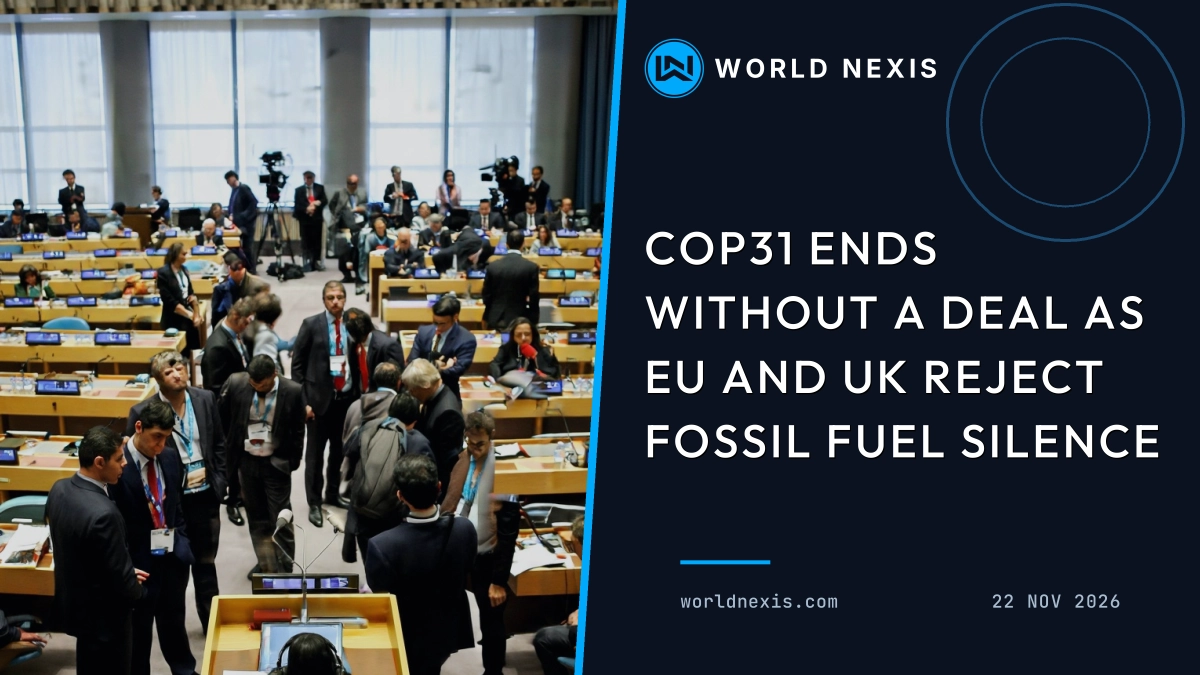
COP31 talks in Antalya ended without an agreement on Sunday after the European Union, the United Kingdom and allies in the developing world rejected a final text that never mentioned fossil fuels. Close to 200 countries attended the summit on Turkey’s Mediterranean coast, which was meant to finish on Friday. More than 130 governments had asked for a clear commitment to move away from coal, oil and gas.
Key points
- The COP31 talks collapsed on Sunday 22 November when the proposed “Antalya pact” failed to win consensus.
- The main outcome text did not endorse a transition away from fossil fuels, which more than 130 countries had demanded.
- The EU refused to back a deal that “does not even mention fossil fuels”, and the UK called the failure “immensely disappointing”.
- COP31 president Murat Kurum confirmed there was no consensus, so the cover decision was not adopted.
Why the COP31 talks failed over fossil fuels
The rejected document, known as the Antalya pact, was drafted by the Turkish and Australian joint presidencies of the summit. It invited countries to electrify their economies and asked rich nations to fund adaptation in poorer ones. It also urged governments to limit the “overshoot” of the 1.5C warming limit set by the Paris agreement.
Yet it stopped short of endorsing the “transition away from fossil fuels” that more than 130 countries wanted written into the text. Instead it leaned on carbon capture and storage, a technology that critics say extends the life of coal, oil and gas. That gap between what the science demands and what the draft offered became the fault line of the final hours.
Applause in the plenary hall
Ireland’s environment minister, Darragh O’Brien, spoke for the EU and drew applause as he rejected the text. “It fails to meet the moment,” he said. “We will not endorse a cover decision or an Antalya pact that does not even mention fossil fuels, which is the key driver of climate change.”
He added that the EU would not accept a decision “that greenwashes fossil fuels”. Several other delegations, including small island states, raised objections of their own, and the presidency conceded that consensus was out of reach.
Murat Kurum, Turkey’s COP president, told the hall that he had not imposed the text on anyone. “It is clear that there are parties in this hall who oppose this text,” he said. “We recognise that there is no consensus on this document. Therefore, these decisions have not been adopted.”
Britain joins the objections as COP31 talks stall
The UK’s energy secretary, Miatta Fahnbulleh, said Britain had worked tirelessly to build consensus before joining the objections. In a statement, she called the outcome “immensely disappointing”.
“This Cop sought to confront hard truths – that global warming is set to overshoot 1.5C and that we must act with ever more urgency to address it,” she said. “The moment required bold ambition.”
She said the failure only strengthened the UK’s resolve to work with partners on the progress made in Antalya. Bill Hare, chief executive of the advisory group Climate Analytics, described the refusal as a line in the sand. “Countries are standing up to fossil fuel interests and saying no,” he said.
Why it matters
A summit that closes without a cover decision gives no fresh signal to investors, utilities or governments weighing clean energy projects. It also leaves the promised money for adaptation, the funding that helps poorer countries cope with floods, heat and failed harvests, without a new political mandate. Those gaps do not stay inside the negotiating hall.
The 1.5C threshold shapes decisions far beyond diplomacy, from flood defence budgets to the cost of insuring a home. The collapse of the COP31 talks means that benchmark now rests on older promises rather than a fresh one. For British households, the practical effect is slower but real, because the case for insulation, heat pumps and grid upgrades rests on international direction as much as domestic policy.
Analysis
Having covered climate finance and the energy transition for World Nexis News, I look first at what disappears when a cover decision disappears. Delegations fly home without a shared benchmark to cite when they defend carbon taxes, grid spending or coal closures. That vacuum is not neutral, because it favours the governments and industries that prefer delay.
In my view, Darragh O’Brien and the EU, backed by the UK, were right to refuse the Antalya pact. A cover decision is the one document where nearly 200 governments name the cause of the crisis. A text that stays silent on fossil fuels while promoting carbon capture would have given producers something to cite for another year, and the word “greenwashing” would have been fair.
The strongest counter-argument is that refusal costs the vulnerable most. Small island states and the poorest countries came to Antalya for adaptation finance, and they leave with less than they expected. That trade-off is real. Even so, a deal that omits the driver of warming would not have delivered the money either; it would have postponed the argument at the expense of the science.
What happens next
No new text is being negotiated in the immediate term, and the summit has closed without an overarching political outcome. The presidencies did avert a total collapse by adopting separate decisions on related matters, including a “just transition” to help workers in high-carbon industries move into low-carbon jobs.
Attention now turns to COP32, where governments will try again to settle a cover decision. Negotiators and campaigners will spend the coming months on the same three arguments: fossil fuel language, the treatment of overshoot, and the scale of finance for adaptation.
What we don’t know yet
It is unclear whether a cover decision can be revived before the next summit, or whether the ideas inside the Antalya pact can be carried forward without a formal mandate. The timetable for new finance commitments is also unsettled.
Related coverage
- COP31 talks risk collapse on day 2 as fossil fuels omitted
- COP31 fossil fuels deadlock deepens as 200 nations stall
- Autonomous weapons talks collapse as 128 states delay rules
Further reading
- Cop31 climate talks break down as key deal rejected
- Countries react as COP31 climate talks collapse – AOL
About the author: Hannah Lindqvist is the Climate & Environment Reporter at World Nexis News (WNN), covering climate & environment. The analysis section reflects the writer’s view.

Hannah Lindqvist
Hannah Lindqvist is Climate & Environment Reporter at World Nexis News, based in London. She covers climate policy, extreme weather, the energy transition, conservation and climate finance, grounding stories in scientific research, official data and documented commitments rather than slogans. She is interested in how…