M&S franchise talks: major shift for 42 European stores
M&S franchise talks could see its 42 wholly owned stores in the Czech Republic and Greece run by partners, as the retailer pushes a capital-light model.
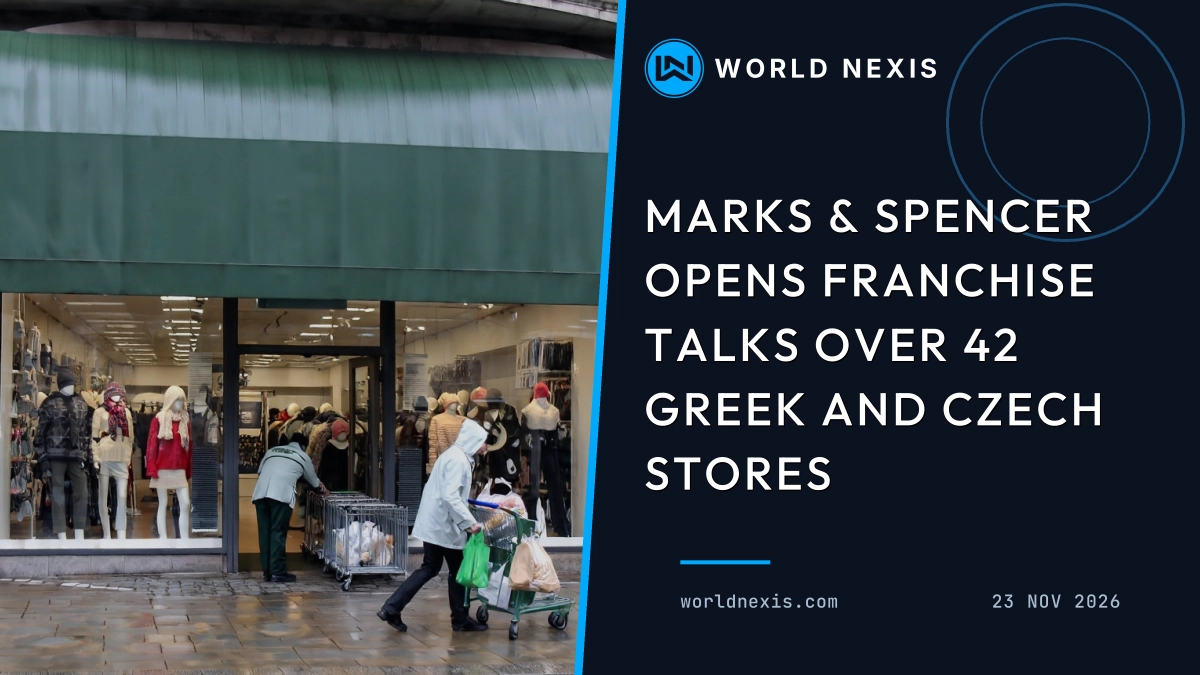
M&S franchise talks are under way for the retailer’s last remaining wholly owned international shops, with 42 stores across Greece and the Czech Republic in line to move to partner operators. Marks & Spencer said on Monday that it is in discussions with potential franchise partners for both businesses, a step that would end direct ownership of its overseas estate.
The group has traded in Greece since 1990 and runs 27 stores there. It launched in the Czech Republic in 1996 and operates 15. Together those two countries make up what the company calls its last wholly owned international operations.
M&S franchise talks: key points
- The M&S franchise talks cover its retail businesses in Greece and the Czech Republic.
- The two markets hold 42 stores: 27 in Greece and 15 in the Czech Republic.
- The group floated a more capital-light global model at its capital markets day this month.
- Half-year adjusted pre-tax profit rose to £403.2 million from £184.1 million a year earlier.
What the M&S franchise talks cover
The discussions concern two long-established European markets rather than a retreat from them. Management has stressed that it sees growth potential in both countries and wants partners with the money to fund it.
In its statement, the group said:
“M&S is in discussion with potential franchise partners for its businesses in Czech Republic and Greece.”
“This is in line with our well documented strategy to reshape the M&S business for global growth through simpler, capital-light, partnership models in markets where we see potential for the brand.”
It added that it is “seeking committed partners with the ambition and investment to unlock the full potential of the brand” in both countries. No bidders, timetable or financial terms have been disclosed.
The two markets at stake
Greece is the older of the pair. M&S arrived there in 1990 and now trades from 27 shops, making it a familiar sight in Greek cities for more than three decades. The Czech business is slightly younger, opened in 1996, and runs 15 stores.
Both operations sit inside the M&S franchise talks, and both carry the same promise of clothing, food and home ranges under one roof. That consistency is what a partner would be buying into, and what the group would be trusting somebody else to deliver.
A capital-light strategy after a costly year
The announcement follows the retailer’s capital markets day earlier this month, where it set out the option of reshaping its global business around simpler partnership models. Under that structure a partner absorbs local property, payroll and running costs, while the brand owner collects fees.
Money sits behind the logic. Adjusted pre-tax profit for the half-year to September came in at £403.2 million, against £184.1 million a year earlier. The group described that as a rebound from the impact of a major cyber attack last year, but said it remained under pressure from an “onslaught of costs”.
Franchising would take fixed costs off the group’s books without pulling the brand out of central Europe or the eastern Mediterranean. For a business that has spent a year fighting disruption and rising overheads, that combination is attractive.
Why it matters
For shoppers in Greece and the Czech Republic, the practical question is whether the ranges, prices and service they know survive a change of operator. Nothing in Monday’s announcement points to closures; the company presents the plan as a route to growth rather than an exit.
If the M&S franchise talks produce a deal, the effect for British readers is financial. Less capital tied up in foreign leases and fewer fixed costs abroad leave more room to invest at home, in stores and supply chains where most of the group’s revenue is earned.
Analysis
On the corporate strategy beat at World Nexis News, I look first at what a company is trying to stop paying for. Here the answer is clear: leases, payroll and local overheads in two markets that are small beside the UK. In my view the M&S franchise talks are the right call. The group has just posted a profit rebound, so it can negotiate from strength, and 42 shops spread over two countries cannot command the management attention they need to grow.
The strongest counter-argument is control. A partner facing the same “onslaught of costs” that M&S has described may protect its margin by trimming service, staffing or the breadth of ranges. Shoppers would blame the label above the door, not the operator. That risk is real, which is why the terms of any deal matter far more than the headline.
I still side with management, provided the contracts carry hard commitments on investment, training and brand standards. Franchising has carried plenty of retail brands into new markets; it has also produced tired stores. The difference is almost always what the brand owner insists on before signing.
What happens next
The M&S franchise talks continue with no named counterparties and no deadline attached. Any agreement would convert the Greek and Czech businesses into partner-run operations, leaving the group without wholly owned shops outside the UK.
Investors will now watch for detail on fee structures, investment pledges and timing. Store estates and staffing in both countries are the obvious places where that detail will matter most to customers and employees.
What we don’t know yet
- Who the potential partners are, and whether talks cover all 42 stores or only part of the estate.
- Whether staff terms would transfer unchanged under a franchise agreement.
- How quickly any deal could be signed and completed.
Related coverage
- Credit card cap: Trump backs 10% limit in major shift
- Medicare open enrollment 2027: 4 million face major shift
- Poundland rescue talks: 11,000 jobs at risk before deadline
Further reading
- M&S in talks with potential franchise partners for Czech and Greek stores
- M&S in talks with potential franchise partners for Czech and Greek stores
About the author: Daniel Whitmore is the Business & Markets Editor at World Nexis News (WNN), covering business & markets. The analysis section reflects the writer’s view.

Daniel Whitmore
Daniel Whitmore is Business & Markets Editor at World Nexis News, based in New York. He leads coverage of companies, economies, markets and the forces that move them, from central bank decisions to corporate earnings and the cost-of-living pressures facing households on both sides of…



