Amazon drone crash prompts FAA probe as 500-city push looms
The Amazon drone crash in Michigan has triggered an FAA investigation, with none injured but shingles damaged as the company plans a 500-city rollout.
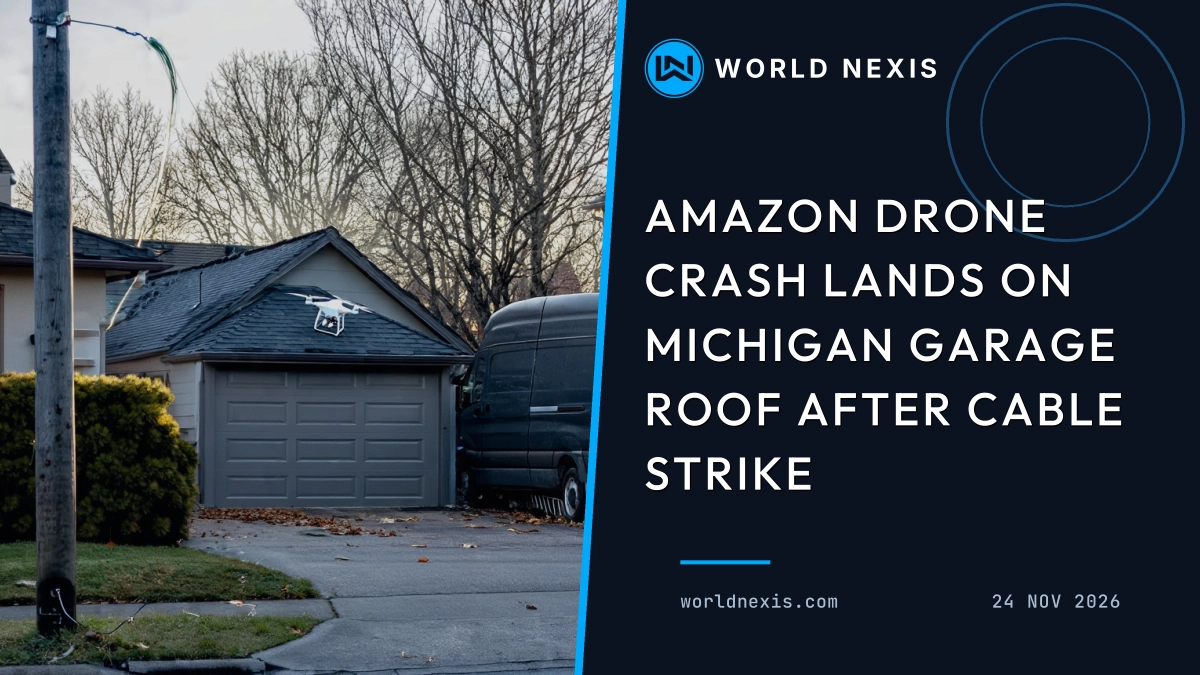
The Amazon drone crash in Huntington Woods, Michigan, is now under federal scrutiny, with the Federal Aviation Administration confirming it is investigating how a delivery aircraft struck a fiber-optic cable and came down on a garage roof on Friday. Nobody was injured, and Amazon says the damage amounted to a few lifted shingles. The real test is what the case does to a rollout the company wants in 500 American towns by the end of the year.
Amazon has removed the MK30 aircraft and says it is in contact with the resident. The National Transportation Safety Board is gathering information, but it has not decided whether to open its own inquiry.
Key points
- The FAA is investigating the Amazon drone crash in Huntington Woods, a suburb north of Detroit, after the aircraft caught a fiber cable on takeoff.
- The Amazon drone crash damaged one propeller and left the aircraft on a garage roof; Amazon reports no injuries.
- Amazon still plans drone delivery in 500 US cities and towns by the end of the year.
- The NTSB is monitoring the case but has not launched a formal investigation.
Amazon drone crash: a shampoo bottle, a cable and a broken propeller
The Huntington Woods drone crash unfolded in front of a resident with a phone camera. James Brennan’s household had ordered shampoo, and he said they expected a van until a notification told them the parcel would arrive by drone in seven minutes.
“I just thought it would make amusing, amusing conversation over Thanksgiving or at work or whatever,” he said. “And I was just going to get a shot of it. I never expected this to happen.”
The aircraft dropped the parcel in the yard and began to climb. It then clipped an overhead fiber-optic cable, which damaged a propeller. “Like a sick bird, it tried to get out of here, but it couldn’t,” Brennan said.
Video shows the drone swaying, tipping sideways and settling on a neighboring garage roof. “It kind of laid down and died,” Brennan said. “And as soon as it laid down, the motors shut off, and that was it.”
Amazon staff retrieved the machine promptly. The damage was described as minor, with shingles lifted at the peak of the roof.
What the FAA drone investigation means for the 500-city plan
The company’s first response was to stress rarity. “Safety is our top priority and incidents are extremely rare,” said Amazon spokesperson Jack Stelzner. “Anytime a delivery does not go as planned we investigate what happened and use the findings to further improve the service.”
A preliminary FAA incident report records that the aircraft struck a fiber cable and a residential garage, and the agency has confirmed its investigation is live. The Amazon drone crash gives the FAA a live test case as it weighs how far to let the industry expand.
Volume is Amazon’s strongest argument. The company says its Prime Air drones have delivered hundreds of thousands of packages this year and that roughly 6,000 flights take place every day. Its MK30 aircraft are described as highly autonomous and carry items weighing five pounds or less.
Ambition sits on the other side of the ledger. Amazon is targeting a launch in 500 US cities and towns by the end of the year, which leaves only a few weeks. Each new city adds more yards, driveways and overhead cables to the airspace the aircraft must read in real time.
Why it matters
The Amazon drone crash is a small event with a wide footprint. Low-altitude airspace above backyards is turning into a commercial route, and residents have little say over what flies above their roofs or which cables cross their land.
The regulatory stakes are just as practical. If investigators conclude the aircraft failed to spot a cable it should have seen, the correction has to be designed, tested and installed across a growing fleet, and that takes time the expansion timetable does not have.
Analysis
Having covered corporate strategy and market structure for World Nexis News for five years, I look first at how a company’s incentives shape its safety culture. Amazon is being asked to prove reliability at scale before regulators have finished writing the rules of the road. That is a hard position, and it is one the company chose by promising 500 towns in a matter of weeks.
In my view, the facts of the Amazon drone crash support the regulators’ caution more than the company’s confidence. Nothing about this incident was dangerous; a scuffed roof is a lucky outcome. The sequence, though, is the problem: the aircraft delivered, then failed to clear a static object that was in the same place before it arrived. A van driver would have seen that cable. A machine reading a new street has to be taught.
The strongest counter-argument is volume, and it deserves respect: nearly 6,000 flights a day with no injuries is a serious operating record, and grounding a service over a damaged shingle would be a disproportionate response. Even so, the burden should sit with the operator. I expect the FAA to press for evidence on cable detection before it waves through the next wave of launch towns, and I think that is the right trade.
What happens next
The FAA investigation into the Amazon drone crash will continue, though the agency has not set out a timetable. The NTSB must decide whether to open a parallel inquiry, and Amazon has said it will use its own findings to improve the service.
Commercially, the deadline is the one to watch. Amazon’s stated target of 500 cities and towns falls at the end of the year, and the company has not published where those flights will operate.
What we don’t know yet
Investigators have not said why the drone failed to avoid the cable, or whether the answer lies in software, sensor placement or airspace mapping. It is also unclear whether the FAA will require changes across the fleet before further launches, and who meets the cost of small repairs on private homes.
Related coverage
- Civil Service pension: Capita boss quits as shares crash 70%
- Delta flight delays hit 3,500 flights as Atlanta hub stalls
- Met Police knife crackdown: 266 arrests, 500 knives seized
Further reading
- Amazon drone delivering shampoo snags on wire and tumbles onto Michigan man’s garage roof
- Amazon faces FAA probe after delivery drone strikes Michigan fiber cable, garage
About the author: Daniel Whitmore is the Business & Markets Editor at World Nexis News (WNN), covering business & markets. The analysis section reflects the writer’s view.

Daniel Whitmore
Daniel Whitmore is Business & Markets Editor at World Nexis News, based in New York. He leads coverage of companies, economies, markets and the forces that move them, from central bank decisions to corporate earnings and the cost-of-living pressures facing households on both sides of…



