Delta flight delays hit 3,500 flights as Atlanta hub stalls
Delta flight delays hit 1,160 flights by midday after a weight and balance system outage forced a brief ground stop into Atlanta, days before Thanksgiving.
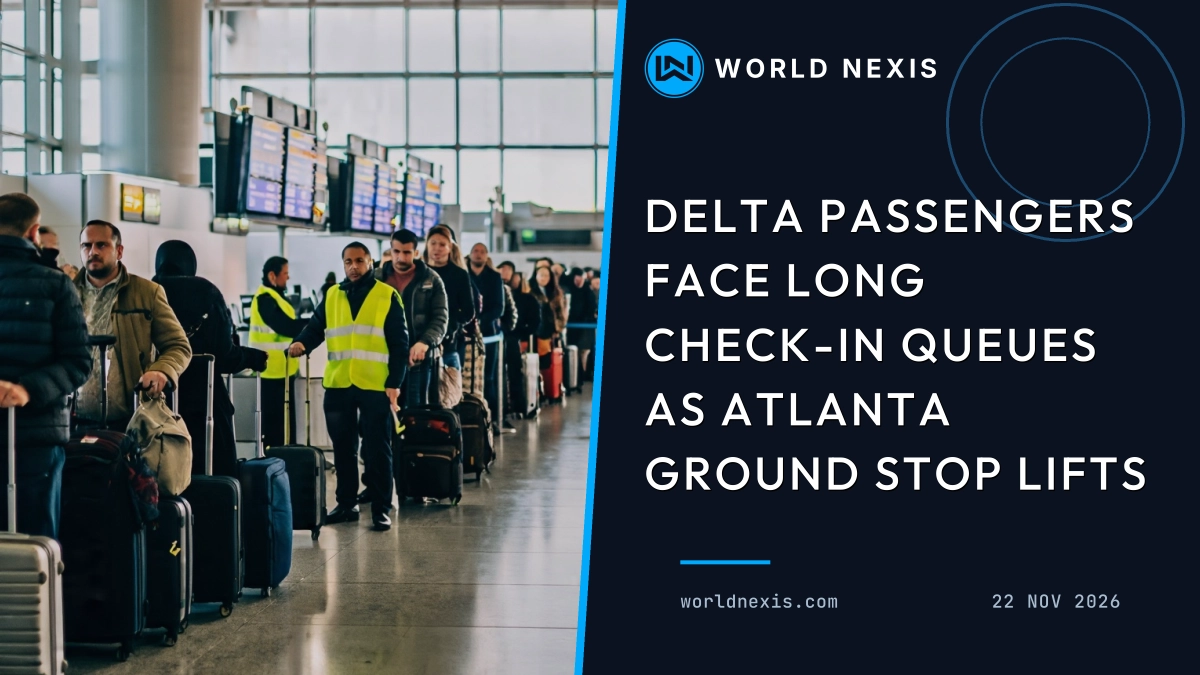
Updated 24 Nov 2026, 01:31 (UK time): Delta said the fault behind Sunday’s disruption has been resolved and flights resumed on Monday, though delays and cancellations carried into the morning as storm forecasts threaten the Thanksgiving travel week.
Delta flight delays began easing on Monday after the airline said the cause of Sunday’s disruption had been resolved, with flights resuming and ground teams returning to normal processing. Delays and cancellations still carried into Monday morning, and travellers at airports including Albuquerque described rebooked flights and long waits after a weekend that affected more than half of Delta’s Sunday schedule.
The recovery arrives at the start of the heaviest flying week of the year. Forecasters are tracking two storm systems that could reach the East and West coasts later in the week, with flooding concern in the San Francisco area raising questions about airports and roads there. AAA still expects about 6 million Americans to fly over the Thanksgiving period.
What this changes is the shape of the story: the outage has moved from an open-ended failure to a recovery and cleanup, and the schedule now has a few days to heal before Thursday. What it does not change is the margin. A weather shock later this week would land on a network with almost no spare seats to absorb it.
I would resist the framing that this is fully behind passengers. A resolved fault tells you the software came back, not that the manual fallback is adequate for a peak week.
Delta flight delays spread across the United States on Sunday after the airline’s weight and balance automation system failed, forcing a brief ground stop on arrivals into Atlanta and leaving ground teams to work out aircraft loads by hand. FlightAware data showed 1,160 Delta flights delayed by noon ET, 712 of them in or out of Hartsfield-Jackson Atlanta International Airport, the carrier’s largest hub.
The failure struck four days before Thanksgiving, early in one of the heaviest travel weeks of the year, and less than two weeks after a nationwide ground stop halted US flights on 13 November. Delta said staff were using manual workarounds to keep aircraft moving while engineers restored the software.
Key points
- The FAA issued a Delta ground stop for flights heading to Atlanta on Sunday morning, then replaced it with restrictions covering Delta departures only.
- Delta said teams were processing flights by hand while work continued to restore its weight and balance automation system.
- Early estimates of the disruption ran above 3,500 delayed flights; the airline has not confirmed a total.
- The FAA said the fault was not related to any of its air traffic control systems.
How the Delta flight delays moved through the network
Hartsfield-Jackson, where Delta runs its biggest connecting operation, became the pinch point within hours. The airport said the restriction applied to Delta departures and was not airport-wide. “Based on our latest information, the ground delay applies to Delta departures only. It is not airportwide,” it said in a statement. “Delta is managing the issue with its operations team.”
The FAA confirmed the sequence on X, saying Delta was working to resolve the fault and that the delays were “not related to any FAA air traffic systems.” The agency pointed passengers to the airline for flight-level information, and the Delta ground stop was lifted after roughly an hour.
Atlanta’s role as a connecting hub is what turned one airline’s software problem into a national schedule. Delta flight delays of this kind rarely stay local: aircraft held at the hub miss their departure slots, and each late arrival pushes the problem into the next rotation, so a morning bottleneck in Georgia surfaces as afternoon trouble in California and New York.
Why a weight and balance failure stops departures
No commercial jet can leave the gate until its crew confirms two numbers: total weight and where the aircraft’s center of gravity sits. Both must fall inside strict safety limits, and both depend on baggage, cargo and fuel data compiled by the automated system that failed.
With the system offline, Delta staff calculated the figures themselves for each departure. “Delta teams are using manual workarounds this morning to safely get flights departed while work continues to restore automation,” the airline said. It added: “We thank our customers for their patience and our people for their professionalism.”
Manual loading is safe but slow. Each aircraft takes longer to close out, so departures bunch up and gates fill, which is why air traffic flow measures outlasted the outage itself. The Delta flight delays land in the middle of the holiday rush: AAA projects that nearly 6 million people will take domestic flights this Thanksgiving week.
Why it matters
For anyone flying in the next few days, the Delta flight delays mean missed connections and long hours in departure lounges rather than canceled holidays. Atlanta flight delays feed short-haul links into long-haul departures, and peak Thanksgiving days carry almost no spare seats to absorb the overflow.
The wider stakes are financial and political. Delta is carrying the cost of manual processing and extra staffing at the worst possible moment, while Washington argues over who pays to modernize the systems that airlines and regulators both depend on.
President Donald Trump said on Friday that US air traffic systems are “ancient” and “obsolete” and backed his transportation team’s request for $50bn to rebuild them, far above the $12bn the department has been allotted. He accused Congress of holding up the money, saying: “We need to have new air traffic control, and to do that we have to get the money now.” Of the run of recent technology failures, he said: “They’re all separate events.”
Analysis
Having covered airlines and market structure for World Nexis News, I watch days like this for what they reveal about the systems passengers never see. Weight and balance software is invisible, unglamorous and completely load-bearing: every departure depends on it, and the fallback is people, printed load sheets and phone calls to the ramp. That fallback worked on Sunday. It also put a hard ceiling on how many aircraft Delta could turn.
In my view the evidence supports the argument that US aviation needs genuine capital spending rather than another round of patching, and Trump’s description of a system that runs slowly because it is old is the strongest part of that case. Where I part company with the administration is the diagnosis. A national air traffic control rebuild would not have prevented Sunday’s Delta flight delays, because the fault sat in the airline’s own commercial software.
The fairest counter-argument is that manual workarounds are exactly what redundancy looks like, that no safety breach has been reported, and that one carrier’s system fault says little about national infrastructure. I accept the first two points. But a historic ground stop followed, days before the holiday rush, by an airline’s load control dropping out, both ending in manual processing, tells me the margin is thinner than the industry’s public messaging suggests.
What happens next
Delta says work continues to restore automation and that customers should check with the airline for the latest information on their own flights. The Delta flight delays will not clear until that system is back, and the airline has not said when that will be. At one stage the FAA’s ground delay for Atlanta was set to run until at least 1 p.m. local time, and the airport says Delta is managing the issue with its own operations team.
Attention then shifts to Congress, which Trump said “seems to be very receptive now” to funding new air traffic control after the 13 November ground stop. His administration wants $50bn; the transportation department holds $12bn. That gap is now the central question in Washington.
What we don’t know yet
- What caused the weight and balance automation to fail, and whether the repair is permanent or a patch.
- How many Delta flight delays and cancellations will build up across the Thanksgiving peak.
- Whether the Delta outage and the earlier FAA ground stop share any technical root; Trump has said they are separate events.
Related coverage
- Marine Band donation: Trump and White’s $500,000 Grammy boost
- GTA 6 sales hit record $3.79 billion on launch day
- James Blunt name change: Queen greets record-hit Ryan Air
Further reading
- Trump says US flight systems are ‘ancient’ but ‘safe’ after ground stop
- Delta Air Lines experiencing nationwide delays amid baggage network system issue
About the author: Daniel Whitmore is the Business & Markets Editor at World Nexis News (WNN), covering business & markets. The analysis section reflects the writer’s view.

Daniel Whitmore
Daniel Whitmore is Business & Markets Editor at World Nexis News, based in New York. He leads coverage of companies, economies, markets and the forces that move them, from central bank decisions to corporate earnings and the cost-of-living pressures facing households on both sides of…



