Met Police knife crackdown: 266 arrests, 500 knives seized
The Met Police knife crackdown brought 266 arrests and more than 500 knives off London's streets in a week, as knife-enabled robbery fell 16.6% in a year.
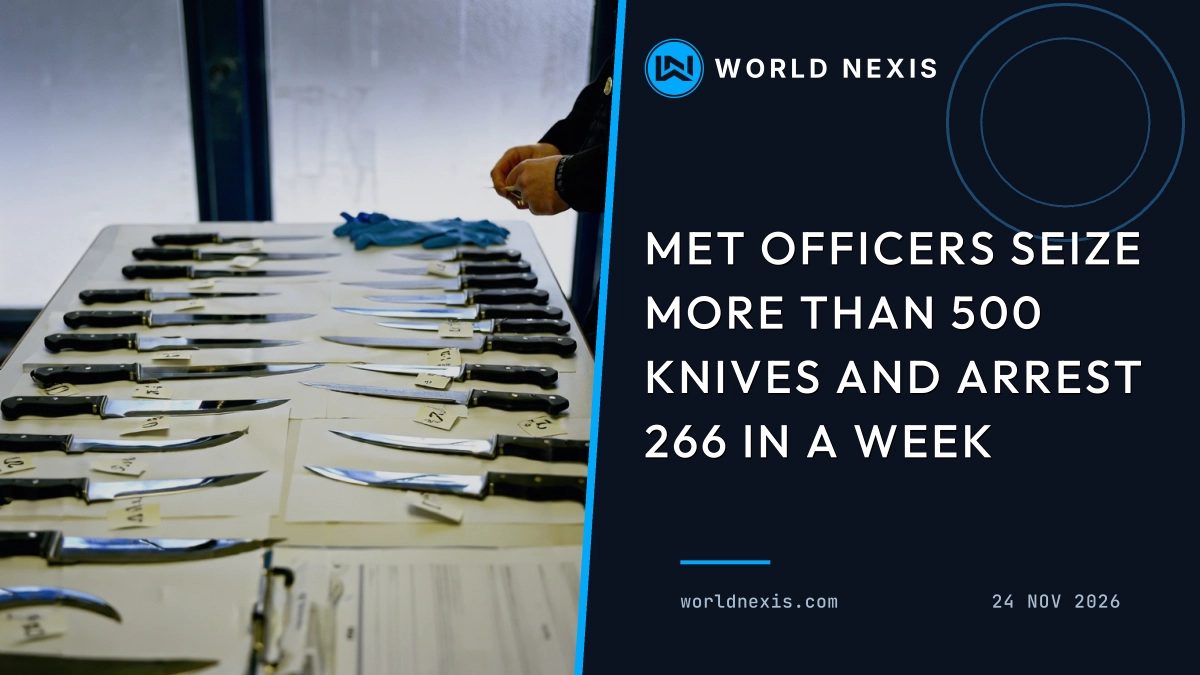
The Met Police knife crackdown has taken 266 suspects into custody and removed more than 500 knives from London’s streets in a single week, the force has said, with 82 of those arrested expected to be brought before the courts. The operation ran from 16 to 23 November and focused on some of the capital’s most dangerous offenders.
Commander James Conway, the Met’s lead for knife crime, said each blade seized was a weapon that could no longer be used to hurt someone. Officers also recovered a machete, a hunting knife, a zombie-style knife and a locking flick knife after stopping a stolen car in south London.
Key points
- 266 arrests were made during the Met Police knife crackdown, which ran from 16 to 23 November.
- More than 500 knives were seized, including 175 found at two addresses in east London.
- 82 of those arrested are expected to appear before the courts.
- Knife-enabled robbery in London is down 16.6% over the past 12 months, and overall knife crime offences have fallen 8.1%.
What the Met Police knife crackdown recovered
The single largest find came in east London, where one suspect was arrested and later charged with possession offences after 175 knives were discovered during searches of two addresses. That haul alone represents roughly a third of the total the force says it took off the streets during the week.
The Met Police arrests included four men aged between 18 and 27, charged with possessing offensive weapons after officers stopped a stolen vehicle in south London. One suspect tried to run before being detained and was found with a machete, while the hunting knife, zombie-style knife and locking flick knife were recovered at the same scene.
Why import routes are part of the picture
Conway said the force was targeting knife crime at every level, from people carrying weapons on the street to those bringing dangerous blades into the country. The mix of weapons found in one car stop is the practical reason commanders say supply routes sit alongside patrols in their planning.
Robbery and hospital admissions fall
Beyond the enforcement numbers from the Met Police knife crackdown, the force pointed to longer-term movement in its own data. Knife-enabled robbery has fallen by 16.6% over the last 12 months, while overall knife crime offences are down by 8.1%. The force also said the number of young people admitted to London hospitals after a knife attack has more than halved since 2019.
“Our work is seeing results,” Conway said. “Knife-enabled robbery is down by nearly 17 per cent over the last year and the number of young people admitted to London hospitals following a knife attack has more than halved since 2019.”
He added that officers were using data, intelligence and technology to target offenders and prevent violence. “But we’re not complacent,” he said. “We’ll keep doing everything we can to drive down knife crime and keep Londoners safe.”
Why it matters
For Londoners, the practical measure of a week like this is whether the streets they walk home on feel different. Knife-enabled robbery is the offence most likely to touch an ordinary commuter or shop worker, so a sustained annual fall would be felt in evening routines and in how safe people feel waiting at a bus stop after dark.
Knife crime in London is measured in recorded offences, not in seizures, and the 8.1% fall in overall offences is the figure that should anchor the debate. For the force, the operation is also a test of whether aggressive enforcement can win back confidence. Every arrest that ends in a charge builds that case; every arrest that quietly fades does the opposite.
Analysis
I look first at what happens after the handcuffs go on. Having covered breaking crime stories and verification for World Nexis News, I have learned that the top-line figure from any Met Police knife crackdown is the easiest number to announce and the hardest to interpret. Five hundred knives sounds enormous, and it is a lot of metal off the street, but on its own it says nothing about whether violence fell during those seven days.
In my view the numbers that matter here are the 16.6% fall in knife-enabled robbery and the halving of hospital admissions among young people since 2019. Those are outcomes rather than outputs, and they are what I would hold the Met to. The 82 of 266 expected to reach court is the weakest part of the announcement, because it suggests most of those arrested will not face a charge, and the force should explain that gap rather than leave the ratio to speak for itself.
The strongest counter-argument is that a charge is not the only win: intelligence gathered during a disruptive week, weapons taken out of circulation and warnings delivered can all prevent violence without producing a prosecution. That is fair, and it is why I would not write the operation off. I simply think the Met should lead with the outcomes and defend the charge rate, rather than lead with the tonnage of blades.
What happens next
The 82 cases expected to reach court will move through the justice system over the coming weeks, and the four men charged in south London will face proceedings on offensive weapon offences. The Met says it will keep the same enforcement approach, with Conway insisting officers will target supply as well as possession.
What we don’t know yet
The force has not published a breakdown showing where in London the arrests and seizures took place, or how the week compared with the same period a year earlier. It has also not said how many of the 266 arrests led to charges beyond the 82 figure, or whether violence fell during the operation itself. The Met Police knife crackdown will ultimately be judged on those answers, not on the headline total.
Related coverage
- Parma shooting: victims named as police weigh self-defence claim
- Delta flight delays hit 1,500 ahead of Thanksgiving surge
- Delta flight delays hit 3,500 flights as Atlanta hub stalls
Further reading
- Met Police make more than 260 arrests and confiscate 500 knives in crackdown
- Met Police make more than 260 arrests and confiscate 500 knives in crackdown
About the author: Tariq Al-Mansoori is the Breaking News Reporter at World Nexis News (WNN), covering breaking news. The analysis section reflects the writer’s view.

Tariq Al-Mansoori
Tariq Al-Mansoori is a Breaking News Reporter at World Nexis News, covering major incidents, official statements and developing stories across the UK, US and internationally. Based in London, he works to confirm details before publication, attributes information to named sources where possible and updates stories…



