Delta flight delays hit 1,500 ahead of Thanksgiving surge
Delta flight delays hit more than 1,500 flights as an automation issue disrupts Atlanta travel before Thanksgiving, with crews using manual workarounds.
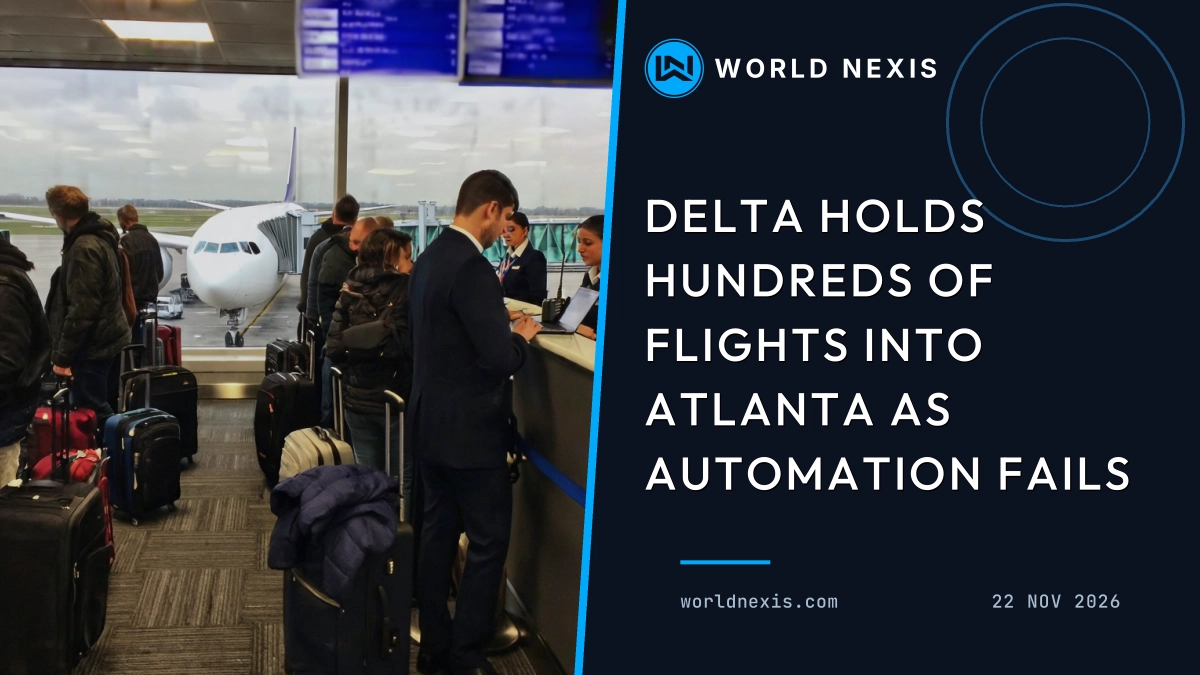
The Delta flight delays spreading across the United States on Sunday trace back to an automation failure at the airline’s busiest hub, with hundreds of flights held at the start of the Thanksgiving travel week. The disruption centered on Hartsfield-Jackson Atlanta International Airport, where the Federal Aviation Administration, at Delta’s request, imposed a ground stop before converting it to a ground delay shortly after 9:30 a.m. By mid-afternoon, tracking firm FlightAware had counted 1,518 delayed Delta flights, and the total was expected to rise.
Key points
- Delta reported an automation issue on Sunday morning that delayed flights nationwide, hitting arrivals and departures at Atlanta’s Hartsfield-Jackson hardest.
- At Delta’s request, the FAA issued a ground stop at Atlanta, later converted to a ground delay that held inbound flights for about an hour on average.
- The airline said its teams were using manual workarounds to get aircraft away while engineers worked to restore automation.
- FlightAware put the Delta flight delays at 1,518 by 2:50 p.m. ET, in the middle of one of the year’s heaviest travel weekends.
Delta flight delays ripple out from Atlanta
The fault appeared in the automated systems Delta relies on to process and dispatch aircraft at scale. The airline said teams were working through manual procedures to keep departures moving while engineers chased the problem.
“Delta teams are using manual workarounds this morning to safely get flights departed while work continues to restore automation,” the airline said. “We thank our customers for their patience and our people for their professionalism.”
The Atlanta airport delays were the most visible symptom. Because the FAA’s program applied to flights bound for the hub, the queue formed at departure gates across the country rather than only in Georgia.
Atlanta is Delta’s largest hub, and the airline’s connecting model means a single morning hold there can strand passengers booked through the Southeast from cities far outside it. The Delta flight delays also landed in the airline’s worst possible week of the year.
The distinction between the two FAA measures matters for travelers. A ground stop means nothing leaves for Atlanta at all, however close an aircraft is to departure; a ground delay instead meters traffic, with the FAA setting an average hold of about an hour for flights heading to the hub.
The FAA said the delays were not related to any FAA air traffic systems.
Thanksgiving travel peaks as Delta flight delays mount
AAA projects nearly 6 million people will take domestic flights this week for Thanksgiving, and the Sunday before the holiday is traditionally one of the heaviest departure days. Terminals were already filling with families traveling early when the first holds went in.
Manual workarounds keep an airline moving, but they are slow. Each aircraft has to be released by hand, and every extra minute on the ground erodes the cushion that protects tight connections later in the day.
Delays of that kind rarely stay contained. An hour lost on an inbound flight to Atlanta can push a connecting passenger onto a later bank of departures, and the backlog tends to grow through the afternoon rather than shrink.
Holiday volumes leave little slack. Airlines schedule their densest flying of the year into the days around Thanksgiving, so the spare aircraft and spare crews that normally absorb a morning fault are already committed elsewhere.
Why it matters
For anyone flying this week, the practical effect is missed connections and longer waits at the gate. Passengers heading to Atlanta should expect inbound holds of roughly an hour and check their flight status before leaving for the airport.
The Delta flight delays also expose a broader dependency. One automation failure at one hub reached airports across the country within hours, in the week when millions of Americans rely on that system to get home. Backup capacity is not a technical nicety; it is what stands between a routine morning and a national disruption.
Analysis
Having covered live disruption for World Nexis News for two years, I look first at how quickly a carrier contains a fault, and Delta’s decision to ask the FAA for a ground stop at Atlanta looks like the right call. Holding aircraft on the ground is expensive and unpopular, but it is safer than pushing departures into a system that cannot reliably process them. Delta flight delays on this scale are rare at a single hub, and the recovery usually matters more than the outage itself.
In my view, though, the outage is not the real story. Delta moved to manual workarounds quickly, and that deserves credit, but an airline handling this volume should not lose this much capacity when one automated chain drops out. Critics will argue, fairly, that a hub hold in Thanksgiving week is exactly the scenario carriers are paid to rehearse.
My reading favors the redundancy argument: the early ground stop limited the damage, while the dependence on automation with no seamless substitute created it. Those are two separate failures, and only one of them can be fixed with better scheduling.
What happens next
Delta’s priority is restoring automation across its network and clearing the delayed aircraft before the peak Thanksgiving days. The airline has said that work is continuing, and the FAA has confirmed the fault sits with the carrier rather than the air traffic system.
Delta flight delays should ease as automation returns, but knock-on effects usually outlast the original fault by a full day. Passengers with connections through Atlanta this evening should plan for a longer journey than their booking suggests.
What we don’t know yet
Delta has not said how many flights will ultimately be affected, how long full automation will take to return, or whether manual processing can keep pace with demand through Wednesday. Travelers should watch for schedule changes rather than assume the first delay is the last.
Related coverage
- Delta flight delays hit 3,500 flights as Atlanta hub stalls
- Thanksgiving travel alert: 12 inches of rain floods Florida
- California king tides: urgent flood warning for Thanksgiving
Further reading
- Delta Air Lines experiencing nationwide delays amid baggage network system issue
- Delta flights to Atlanta impacted by automation issue as holiday travel starts
About the author: Tariq Al-Mansoori is the Breaking News Reporter at World Nexis News (WNN), covering breaking news. The analysis section reflects the writer’s view.

Tariq Al-Mansoori
Tariq Al-Mansoori is a Breaking News Reporter at World Nexis News, covering major incidents, official statements and developing stories across the UK, US and internationally. Based in London, he works to confirm details before publication, attributes information to named sources where possible and updates stories…



