Thanksgiving travel alert: 12 inches of rain floods Florida
Thanksgiving travel plans face disruption as a storm that dumped more than a foot of rain on Florida pushes up the East Coast toward the Northeast.
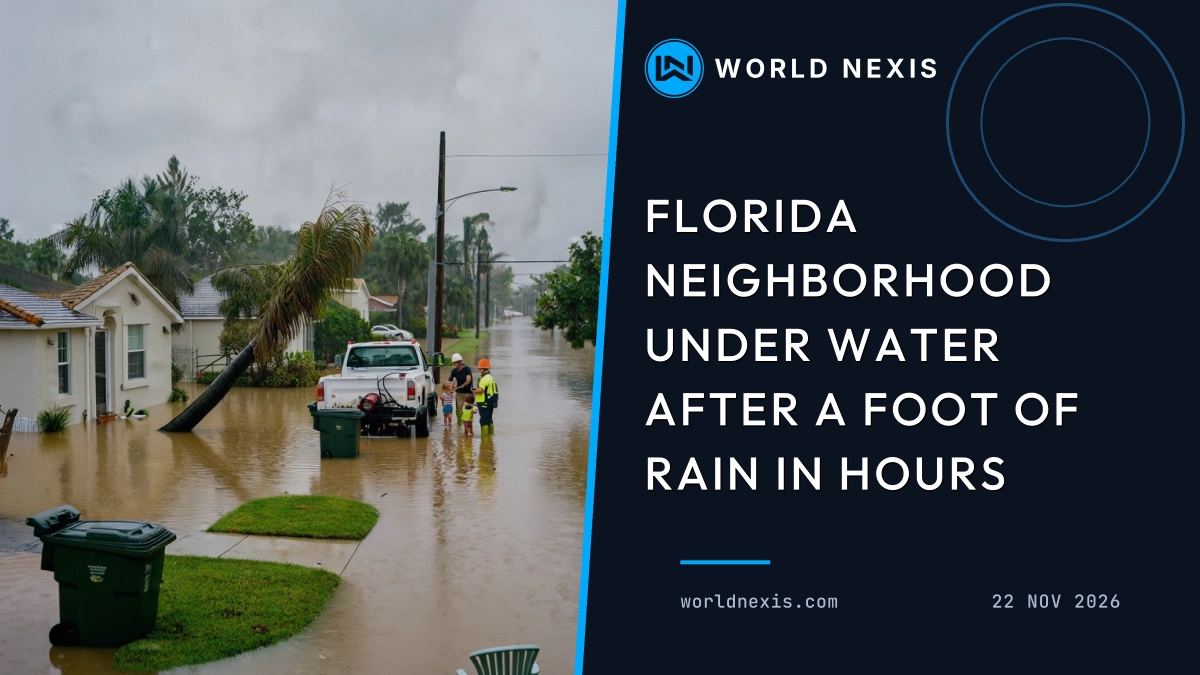
Thanksgiving travel along the US East Coast faces a major test this weekend as a slow-moving storm that has already dumped more than a foot of rain on South Florida begins to push north toward the Mid-Atlantic and Northeast. Millions of people are due on the roads and at airports in the coming days, and forecasters warn the timing could hardly be worse.
The heaviest rain hit Broward County, north of Miami, where more than a foot fell in hours around Hollywood — more than three Novembers’ worth — and some places were battered by rates above 5 inches an hour, the National Weather Service in Miami said.
Key points
- More than a foot of rain fell in hours around Hollywood, Florida, with some locations hit by more than 5 inches an hour, the National Weather Service in Miami said.
- Hollywood’s mayor declared a state of emergency and urged residents to shelter in place as parts of Interstate 95 and Florida’s Turnpike were closed.
- Police logged 64 flood-related calls in roughly three hours and water rescues ran through the night; the roof of Temple Sinai collapsed, with no injuries reported.
- The East Coast storm is forecast to track into the Mid-Atlantic and Northeast, putting Thanksgiving travel at risk in the busiest week of the year.
Florida flooding shuts highways, homes and schools
Streets across southern Broward County turned into rivers as the rain stalled over the coast. The Hollywood Police Department said it received 64 calls for flood-related help between about 3 p.m. and 6 p.m., and first responders carried out water rescues through Tuesday night and into Wednesday morning.
Broward County and the city of Fort Lauderdale both declared states of emergency. Fort Lauderdale sent out its full fleet of vacuum trucks, a team of emergency contractors and 11 portable pumps, keeping crews working overnight in case they were needed again.
All Broward County Public Schools closed for two days, and several Keiser University campuses also shut. The downpour caused the roof of Temple Sinai in Hollywood to collapse; nobody was hurt.
How the East Coast storm threatens Thanksgiving travel
The system has lingered off the southeast coast and is expected to push farther north into the Mid-Atlantic and Northeast by Sunday evening. Some of the heaviest rain was forecast for the Carolina coast before the band swung up the seaboard.
Thanksgiving travel is unusually exposed to even modest weather, because a single closure or delay cascades through packed schedules. “It doesn’t usually take too much to cause things to start to have delays,” said Dan Hoffman, a meteorologist at the National Weather Service in Baltimore.
Florida’s Atlantic coast faced three consecutive days of a Level 3 out of 4 flood risk, with a widespread 3 to 6 inches of rain expected and 8 to 12 inches or more possible in places. Attention is shifting north to the Space Coast, where rivers are still high after historic rainfall earlier in November and the ground has little room left to absorb more water. Onshore winds and heavy surf are also expected to bring dangerous rip currents and the risk of significant beach erosion.
The disruption is unlikely to end with the weekend. A second storm is forecast to hit New England after Thanksgiving, and forecasters say it could prove more significant than the current system. “That could be more impacts for people coming back home,” said Andrew Loconto, a meteorologist at the National Weather Service in Norton, Massachusetts.
A second front builds on the West Coast
The East Coast storm is not the only threat to Thanksgiving travel this week. An atmospheric river — a narrow band of water vapor driven by the wind — is expected to reach the West Coast on Monday, with the Center for Western Weather and Water Extremes forecasting 2 to 4 inches of precipitation across northern California and southern Oregon through Wednesday.
Coastal flood advisories run through Monday morning in the Bay Area, on top of historic high tides known as King tides. San Francisco’s mayor, Daniel Lurie, told residents to use the weekend to prepare and asked them to rethink their plans. “I’m going to ask you all to consider not traveling unless it is absolutely essential,” he said.
Why it matters
For anyone with Thanksgiving travel booked, the practical lesson is to build slack into the plan and check conditions before leaving. Delays compound in a holiday week, and a flooded stretch of interstate or a single closed runway can strand families for a day or more.
The deeper cost falls on the communities in the path. Flooded homes, shuttered schools and a collapsed synagogue roof in Hollywood are the visible damage, but the strain on work, childcare and small business outlasts the water.
Analysis
Having covered emergency response for World Nexis News, I look first at what cities report while the rain is still falling. Hollywood’s 64 flood calls in about three hours is a telling figure: it suggests the drainage network was overwhelmed almost at once rather than gradually, and that rescue crews were stretched across a very short window.
In my view, framing this mainly as a Thanksgiving travel story undersells what happened on the ground. Hoffman is right that small disruptions cause outsized delays, and travelers should act on that. But the more consequential story is a stretch of Atlantic coastline that has absorbed repeated extreme rainfall in a single month, with rivers still high and soils saturated — the conditions in which the next downpour does more damage than the last.
The strongest counter-argument is that travel warnings reach far more people than flood warnings, and that a family deciding whether to drive on Tuesday needs a forecast more urgently than a debate about drainage. That is fair. I still think the balance should tilt toward the communities taking the water, because a foot of rain in hours and three straight days at Level 3 of 4 points to a pattern, not a one-off.
What happens next
Forecasters will spend the next 24 to 48 hours refining the storm’s track, which will decide which cities see the worst of the rain and wind. Thanksgiving travel through the Mid-Atlantic and Northeast remains the immediate concern, with conditions on the roads and at airports likely to shift quickly.
A second system is then expected to arrive in New England after the holiday, making the return leg — including Black Friday — a fresh test for airlines and highway authorities.
What we don’t know yet
Exactly which communities see the highest rainfall totals, because that depends on where storm cells form and stall for several hours. How much more rain the rivers of Florida’s Space Coast can absorb before flooding returns is also an open question.
Related coverage
- Thanksgiving travel fears spike after nationwide ground stop
- California king tides: urgent flood warning for Thanksgiving
- Macy’s Thanksgiving parade: major Fiona tribute at 100th
Further reading
- Storms expected on both coasts threatens Thanksgiving travel
- Intense flooding, developing storm could snarl Thanksgiving travel on the East Coast
About the author: Tariq Al-Mansoori is the Breaking News Reporter at World Nexis News (WNN), covering breaking news. The analysis section reflects the writer’s view.

Tariq Al-Mansoori
Tariq Al-Mansoori is a Breaking News Reporter at World Nexis News, covering major incidents, official statements and developing stories across the UK, US and internationally. Based in London, he works to confirm details before publication, attributes information to named sources where possible and updates stories…