Kalshi Utah charges: state drops 14 felony counts as Kalshi exits
Utah asked a court to drop the Kalshi Utah charges, moving to dismiss 14 felony counts after the prediction market halted trading in the state.
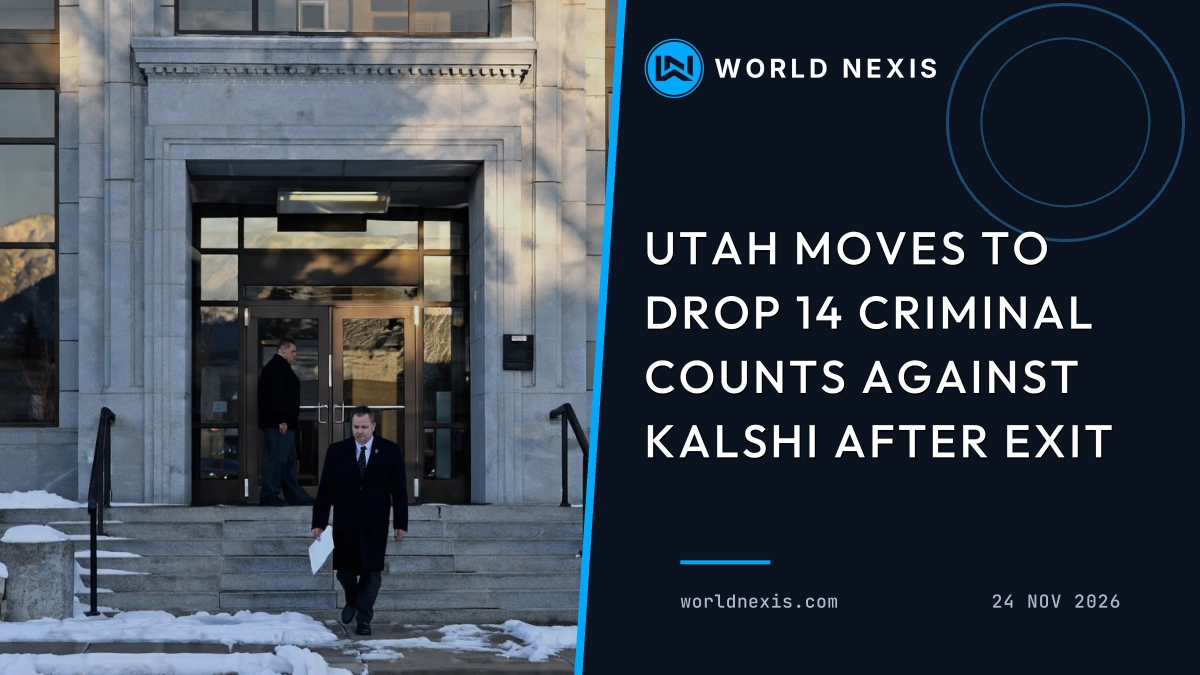
Updated 24 Nov 2026, 23:51 (UK time): Utah dismissed the 14 felony counts against Kalshi and its two co-founders a day after the platform halted new trading in the state, with the charges able to be refiled if it returns.
Utah dismissed the 14 felony counts against Kalshi and its co-founders on Tuesday, a day after the prediction market stopped taking new trades from state residents. The attorney general’s office announced the dismissal and stressed it is without prejudice, meaning the same counts can be refiled if the platform comes back.
Attorney General Derek Brown framed the outcome as a warning to the wider sector: “Every company in this space should take note. If they promote, support, or enable gambling, we will hold them accountable.” Kalshi general counsel Yaakov Roth said good faith jurisdictional disagreements should never be criminalized, adding that the company stands ready to work with state attorneys general on interim measures while courts decide who regulates event contracts.
The dismissal removes the Dec. 4 appearance that chief executive Tarek Mansour and chief operating officer Luana Lopes Lara faced in a Salt Lake City court. It does not touch the state’s separate civil claim for the profits Kalshi generated in Utah, and it settles nothing about which regulator governs prediction markets.
The lesson here is procedural rather than legal. A single criminal filing took a market offline in roughly a month without any court finding of wrongdoing, and the state has said plainly it would file again. That is a cheap tool other attorneys general can now copy.
Utah asked a state court on Tuesday to drop the Kalshi Utah charges, filing a one-sentence motion to dismiss 14 criminal counts against the prediction market operator and its two co-founders. The request landed a day after Kalshi stopped accepting new trades in the state, which had accused the company of running an illegal gambling enterprise.
The motion was lodged in a Salt Lake City court by Attorney General Derek Brown and cited a “change in circumstance.” Brown’s office said the case could be refiled if Kalshi resumes offering trades to Utah residents.
Chief executive Tarek Mansour and chief operating officer Luana Lopes Lara had been scheduled to appear in the same court on Dec. 4. That hearing will go ahead unless a judge grants the dismissal.
Key points
- Utah brought 14 felony counts on Oct. 28 against Kalshi, Mansour and Lopes Lara, including 13 counts of violating the state’s ban on gambling.
- Kalshi blocked new positions in Utah on Monday, saying a federal judge would not immediately stop the state’s enforcement action.
- The dismissal is without prejudice, so the Kalshi Utah charges can be revived if the platform returns.
- A separate civil case seeking the profits Kalshi earned in Utah is unaffected by Tuesday’s filing.
How the Kalshi Utah charges collapsed in one sentence
The state’s motion runs to a single sentence pointing at the company’s exit. “Kalshi has pulled out of Utah, and if it returns, so will the charges,” Brown said in a statement.
He also used the announcement to warn rivals. “Every company in this space should take note,” Brown said. “If they promote, support, or enable gambling, we will hold them accountable.”
Kalshi’s general counsel, Yaakov Roth, said in a post on X that “good faith jurisdictional disagreements should never be criminalized.” He added that the company stands ready to work with state attorneys general on reasonable interim measures until courts settle who regulates prediction markets.
The platform did not void contracts or close open positions when it stopped taking new ones. Utah customers were allowed to close out their positions and withdraw their money, Kalshi said, and a spokesperson described the halt as an “unfortunate outcome for the more than 177,000 Utahns who use Kalshi.”
Even so, the company said it will keep fighting in court for the right to operate in the state. The retreat is tactical rather than final.
Why states and Washington disagree over event contracts
Utah gambling law bans betting of all kinds, and the attorney general’s office classifies prediction markets as a form of it. The Kalshi Utah charges were therefore a test of a simple question: who decides where these markets can operate?
Kalshi argues, as does the Commodity Futures Trading Commission, that its event contracts are swaps. Federal law gives the commission exclusive authority over that category of derivative, which the CFTC says makes it the only rule-maker for the industry.
Utah and at least 42 other states reject that reading. Many of them say the platforms’ sports trading amounts to flouting their own betting and casino laws.
The procedural history is messy. Kalshi sued Utah in February to block enforcement of the state’s restrictions; a federal judge refused, and an appeal is pending at the 10th U.S. Circuit Court of Appeals, which has declined to freeze the state’s rules. Litigation now stretches across more than 20 states, a patchwork that analysts expect the U.S. Supreme Court to resolve eventually.
Kalshi pulled back from Utah only after it became clear that the federal judge handling the commission’s own case would not step in quickly to stop the state.
The civil claim keeps running
Criminal dismissal does not end the dispute in Utah. Brown’s office is still asking a state court to order Kalshi to hand over the profits it generated there, a claim that does not depend on the felony counts.
Why it matters
For the 177,000 Utah users Kalshi cites, the practical effect is immediate: no new trades, only the ability to close positions and take money out. For everyone else, the Kalshi Utah charges set a template. If a state can force an exit with a felony filing, other attorneys general have a cheap and fast tool.
The company also loses revenue from a market it had been building. Its rivals learn that a federal regulator’s backing does not automatically shield them from local prosecutors, and investors in the sector must now price in the risk that access can vanish state by state.
Analysis
Having covered market structure for World Nexis News, I read this as a jurisdiction fight that was always going to be settled by attrition rather than argument. Utah never had to win in federal court to hurt Kalshi; it only had to make operating there expensive and personally risky for two executives. The Kalshi Utah charges did that in a month, and Tuesday’s motion is a recognition of leverage, not of principle.
On balance, I side with the company and the CFTC on the legal question. One federal framework is better for traders than 50 state regimes, and criminalising a good-faith disagreement about which regulator has authority is an overreach no founder should face. The counter-argument deserves a hearing: states have a real interest in shielding residents from gambling products dressed up as financial instruments, and Utah’s ban is unusually strict by design.
What troubles me is the precedent, not the outcome. A one-sentence criminal filing extracted a market exit in weeks without any court finding of wrongdoing, and Brown has said plainly that he would refile if Kalshi comes back. Until the Supreme Court speaks on prediction market regulation, every operator trades on the sufferance of the least friendly attorney general.
What happens next
A judge must decide whether to grant the dismissal before the Dec. 4 hearing, when Mansour and Lopes Lara would otherwise have to appear. The Kalshi Utah charges disappear only if that request is approved. The 10th Circuit appeal over Utah’s ability to enforce its rules continues regardless, and the civil claim for Kalshi’s Utah profits is still live.
More than 20 states are in litigation with the industry, and the CFTC’s case against Utah remains before a federal judge. Kalshi has said it will keep fighting for the right to operate in the state.
What we don’t know yet
It is unclear whether other states will copy Utah’s criminal approach. Kalshi has not said when, or under what terms, it might return.
Related coverage
- Fred Nile state funeral call dropped after LGBTQI backlash
- Molly Meldrum dies aged 83 as Australia plans state funeral
- Molly Meldrum state funeral announced as Australia mourns Countdown host
Further reading
- Utah drops criminal charges against Kalshi founders after company suspended operations in state
- Utah asks to drop charges against Kalshi and its founders after Kalshi halts trading there
About the author: Daniel Whitmore is the Business & Markets Editor at World Nexis News (WNN), covering business & markets. The analysis section reflects the writer’s view.

Daniel Whitmore
Daniel Whitmore is Business & Markets Editor at World Nexis News, based in New York. He leads coverage of companies, economies, markets and the forces that move them, from central bank decisions to corporate earnings and the cost-of-living pressures facing households on both sides of…



