Trump tariffs: Nasdaq jumps 544 points as Wall Street shrugs off new duties
Trump tariffs: new US duties push China's rate to 45% and hit the EU and 12 other partners, as AI stocks slide and shoppers face holiday price rises.
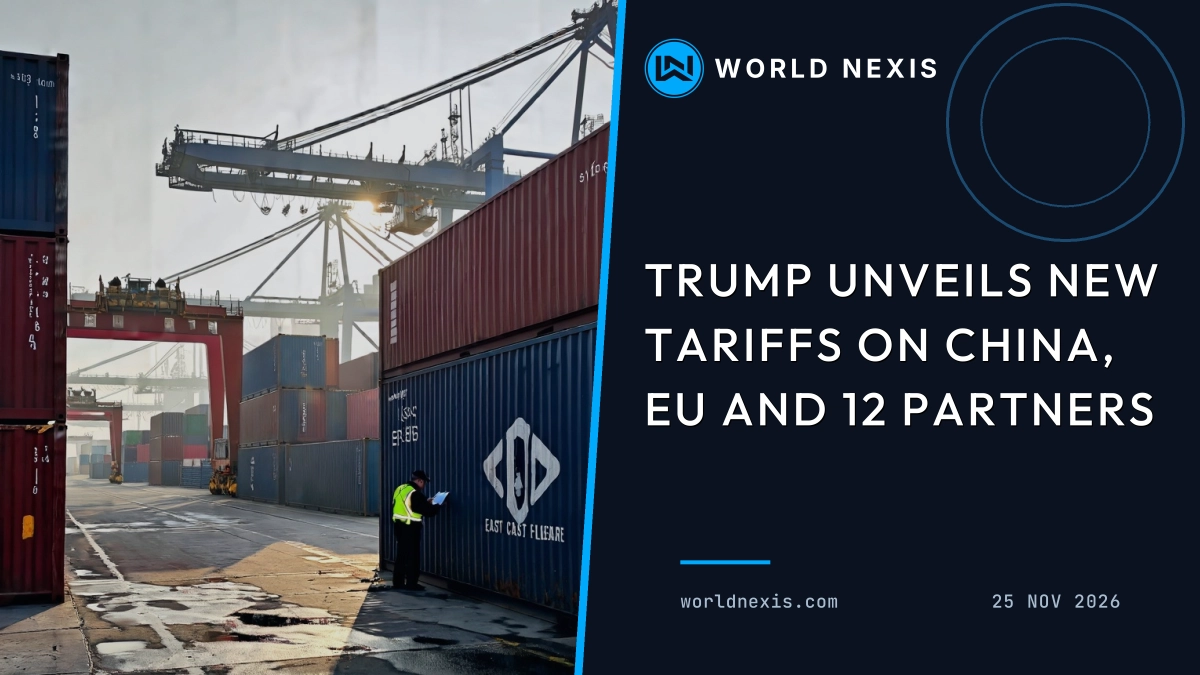
Updated 27 Nov 2026, 18:26 (UK time): Wall Street reversed the tariff-driven sell-off, with the Nasdaq climbing 544 points in a holiday-shortened Friday session as traders shrugged off the new Trump tariffs, while Wednesday’s close confirmed the earlier plunge was contained.
Wall Street has swung the other way on the Trump tariffs. US markets closed at 1pm on Friday for the Thanksgiving holiday with the Nasdaq up 544 points, as traders shrugged off the latest tariff salvo instead of treating it as a fresh shock to the system.
Wednesday’s closing numbers back that up. The Nasdaq ended down 148 points, or 0.6%, at 23,586 after shedding more than 1,000 points early in the session, the S&P 500 slipped 0.2% and the Dow gained 0.3%. Anthropic closed 7.6% lower at $75.66, now below its $83 initial public offering price, which keeps AI valuations rather than trade at the centre of this sell-off.
Nothing in the tariff file itself has moved. Senior administration officials say the countries involved have been informed of the proposed duties, but the levies on China, the EU and 12 other partners are still proposals, so the 45% headline on Chinese goods describes a plan rather than a tax anyone is paying yet.
My reading holds: the market’s trouble this month has been AI valuations, and trade headlines are the excuse rather than the cause. The honest test comes when these duties stop being proposals and shoppers see them on a receipt.
New Trump tariffs will push the total rate on Chinese imports to 45% and hit the European Union and 12 other trading partners. The administration announced the move on Wednesday, jolting a stock market already retreating from its bet on artificial intelligence. The duties remain proposals, and officials gave no date for them to take effect.
The new Trump tariffs land as the holiday shopping season heats up. They also arrive months after the Supreme Court blocked a sweeping set of emergency tariffs, with consumer prices rising at 3.8%.
Key points
- Chinese goods face an extra 20 percentage points of duty, taking the total rate to 45%.
- The EU, Singapore, Switzerland, Indonesia, Malaysia, Cambodia, Thailand, Korea, Vietnam, Taiwan, Bangladesh, Japan and India face new duties on selected products.
- Brazil is among the hardest hit, with higher levies on raw and refined sugar and a new 10% tariff on aircraft.
- The S&P 500 fell as much as 3.2% and the Nasdaq composite 4.6% before both recovered most of the loss.
What the Trump tariffs cover
The Trump tariffs follow months of investigations by the Office of the United States Trade Representative into the practices of 12 countries, the 27-member European Union and Taiwan. The China tariffs carry the biggest headline number, but the package reaches far wider. Mexico and Norway are also under investigation, though no new duties were announced against them.
Jamieson Greer, the US trade representative, built the case around manufacturing. “For decades, many of our trading partners have adopted industrial strategies built on targeting manufacturing, wage and labor suppression, financial and other support, non-market economy inputs, and other market-distorting practices that tilt the trade balance in their favor while eroding America’s manufacturing base,” he said in a statement.
The legal basis is Section 301 of the Trade Act of 1974, which allows action against foreign practices that breach existing deals or discriminate against American goods. A senior administration official said the duties target specific products and will not stack on top of earlier measures.
Stephen Brown, chief North American economist at Capital Economics, called the announcement “not as alarming as it looks,” noting that the new levies largely replace existing Section 301 tariffs rather than adding to them.
The legal ground under the new duties
In February the Supreme Court blocked a sweeping set of tariffs imposed in 2025 under the International Emergency Economic Powers Act, forcing refunds to thousands of businesses. The administration has since leaned on narrower authorities, including Section 232 national security powers, and this wave fits that pattern. The average statutory US tariff rate is now 11.2%, according to the Yale Budget Lab.
That history helps explain why the Trump tariffs are narrower than the first headlines suggested. They are product-specific, they largely replace earlier measures, and they have not been finalized.
Wall Street slides as AI doubt returns
On Wednesday the market’s problem was technology more than trade. The S&P 500 dropped 3.2% early before paring its loss to 0.2% in afternoon trading. The Dow Jones Industrial Average turned positive, up 324 points, or 0.7%, while the Nasdaq composite was down 0.9% after falling 4.6%.
Nvidia fell 4.9%, Broadcom 3.2% and Microsoft 1.3%, and those weights dragged the indexes lower. About three quarters of S&P 500 stocks were rising, so the damage was concentrated in the largest companies rather than spread across the market.
The trigger was the fading of Monday’s rally over the surprise reinstatement of Jensen Huang as Nvidia’s chief executive. Trump has said he “made the deal” that encouraged the board to bring Huang back. Investors are now questioning whether AI profits can justify current valuations, and concern about Nvidia’s governance has deepened the doubt.
Anthropic rose 2.8% on the day but trades about 27% below the $115 a share it hit on its first day. The S&P 500 is down roughly 5.5% for November after falls in September and October.
“At this point, between the AI angst and the newly announced tariffs, it doesn’t look like the Santa Claus Rally is in store for us this year,” said Chris Zaccarelli, chief investment officer for Northlight Asset Management.
Why it matters
The Trump tariffs are taxes on imports, and companies pass much of the cost to shoppers. A coalition of small businesses, We Pay the Tariffs, warned the duties could lift prices just as the holiday season peaks. Two thirds of respondents in post-midterm polling said the president’s tariffs had hurt the national economy.
Borrowing costs are the second squeeze. The Federal Reserve’s preferred inflation measure showed prices up 3.8% in October from a year earlier, after 3.6% in September, while growth was revised up to a 4.3% annual rate. The Fed is expected to raise its benchmark rate in December, making credit cards, car loans and mortgages more expensive.
Analysis
Having covered market structure and central banking for World Nexis News, I look first at what a headline is actually pricing. In my view Wednesday’s slide was an AI valuation story that borrowed the tariff news as a reason to sell, and the breadth proves it: about three quarters of S&P 500 stocks rose while the index fell.
On the Trump tariffs themselves, the evidence supports the calmer reading. These are product-specific duties that mainly replace earlier Section 301 levies, they remain proposals, and there is no start date. The louder claim, that a 45% rate on China is a fresh shock to the system, ignores how much of that structure was already standing.
The strongest counter-argument is about timing. Floating new import taxes as holiday shopping peaks, with inflation at 3.8%, teaches households that prices only go one way, and that can change spending before a single duty is collected. I still think the bigger threat to readers’ finances is the Fed raising rates into a 4.3% growth economy, not the sugar and aircraft lines aimed at Brazil.
What happens next
The Trump tariffs stay in the proposal phase while the trade representative finalizes product lists, and no implementation date has been set. Investigations into Mexico and Norway continue and could produce further measures.
The Federal Reserve meets in December, with markets expecting an increase. Retail sales over the coming weeks will show whether shoppers absorb the news or pull back. The administration’s tariff authority has faced repeated legal challenges, so court action remains a live risk.
What we don’t know yet
Which products fall under each country’s list, when the duties take effect, and whether exemptions will be offered. The size of any price increase passed to consumers is also unclear.
Related coverage
- New US tariffs proposed: 20% on China, up to 25% on India
- Trump tariffs target 14 partners with sweeping new levies
- Jensen Huang reinstatement sparks backlash over Trump role
Further reading
- Watch: A comeback for the ages – Trump’s influence on Huang’s return to Nvidia
- Trump administration to introduce new tariffs on China, EU and 12 other major trading partners
About the author: Daniel Whitmore is the Business & Markets Editor at World Nexis News (WNN), covering business & markets. The analysis section reflects the writer’s view.

Daniel Whitmore
Daniel Whitmore is Business & Markets Editor at World Nexis News, based in New York. He leads coverage of companies, economies, markets and the forces that move them, from central bank decisions to corporate earnings and the cost-of-living pressures facing households on both sides of…



