Chloe Mitchell murder trial: jury sworn in over 2023 death
The Chloe Mitchell murder trial opens at Belfast Crown Court as a jury is sworn in. Brandon Rainey, 30, is accused over the 21-year-old's death in 2023.
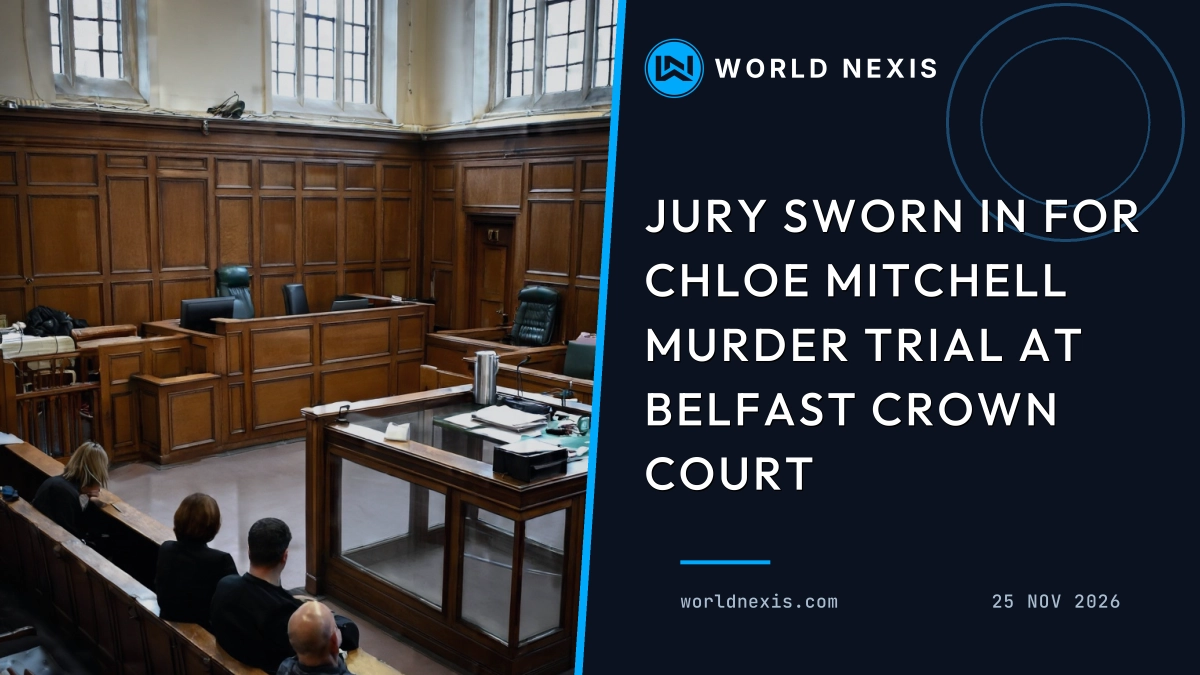
A jury has been sworn in for the Chloe Mitchell murder trial at Belfast Crown Court, more than three years after the 21-year-old was found dead in Ballymena. Brandon Rainey, 30, whose address was given in court as HMP Maghaberry, is charged with murdering Ms Mitchell and with attempting to prevent the burial of her body.
Key points
- Brandon Rainey, 30, faces two charges over the death of Chloe Mitchell: murder and attempting to prevent the burial of her body.
- Ms Mitchell, 21, was found dead in Ballymena days after going missing in June 2023.
- A jury was sworn in at Belfast Crown Court on Wednesday as the Chloe Mitchell murder trial opened.
- Mr Justice Fowler told the panel to decide the case only on the evidence they hear in court.
Inside court as the Chloe Mitchell murder trial opens
Final preparations were completed on Wednesday before the jury was formally sworn in. Rainey stood in the dock wearing a white and grey Adidas tracksuit as the panel took its seats.
A large number of Ms Mitchell’s family and friends attended the hearing in Belfast. They sat in the public gallery during the last procedural steps before the evidence begins.
Mr Justice Fowler told the jurors they were performing a “very important public service”. He said: “It is a very grave responsibility but it is also a privilege to be asked to decide such an important case.”
The warning given to the jury
The judge warned the panel that they must decide the case only on the evidence they hear in the courtroom during the trial. He told them not to carry out their own research, saying that doing so could put them in contempt of court.
That direction reflects how serious criminal trials are conducted in Northern Ireland. A verdict must rest on material that the prosecution and the defence can both see, test and challenge in open court.
Contempt rules exist to protect the fairness of the hearing rather than to shut the public out. Fair and accurate reporting of what is said in open court remains permitted, so the case can still be followed as it unfolds.
Background to the Chloe Mitchell murder trial
Ms Mitchell was 21 when she went missing in June 2023. Her body was found in Ballymena, in Co Antrim, days later.
The case has taken more than three years to reach the point of a sworn jury. Rainey, now 30, faces two charges: the murder of Ms Mitchell and attempting to prevent the burial of her body.
The burial allegation is separate from the murder charge, and the jury will consider both as the hearing proceeds. Once the case opens, the panel will hear the prosecution’s account of the events of June 2023 and the evidence called by both sides.
Why it matters
A sworn jury turns a prosecution from paperwork into public argument. The evidence now has to be heard in open court, where it can be tested and weighed by people with no stake in the outcome.
For her family and friends, the Chloe Mitchell murder trial is where the court’s account of what happened will finally be set out. For everyone else in Co Antrim, it is a test of how a serious case is handled long after the event.
It is also a reminder that jury service falls on ordinary members of the public rather than on lawyers or officials. That duty is what gives a verdict its authority.
Analysis
Having reported on Northern Ireland and its public services for World Nexis News, I read the start of the Chloe Mitchell murder trial as the point where accountability actually lands. Everything before it is preparation; the verdict belongs to people who sit through the evidence and decide.
That is why I think Mr Justice Fowler’s direction was the most important thing said in court this week. He set out the weight of the task and then closed off the shortcuts: no outside research, no reading around the case, no conclusion formed from anything but the courtroom.
The facts support that approach better than any argument that jurors should be free to look things up. A verdict built on untested material cannot be challenged by either side, and it is the accused who carries that risk, not the public.
The strongest counter-argument is that long waits are sometimes the price of a thorough investigation, and that rushing complex cases produces worse outcomes. I accept that in principle. Even so, a gap of more than three years between a death and a sworn jury is a long time for a family to sit with an unresolved case, and that delay is the part of this story I would examine most closely.
What happens next
The Brandon Rainey trial will continue before Mr Justice Fowler, with the jury hearing the evidence in the case. A verdict will follow once the panel has heard the full case and the judge has given his legal directions.
What we don’t know yet
How long the hearing will last, and what the defence case will be, have not been set out. The evidence itself has still to be opened to the jury.
Related coverage
- Ian Huntley murder: Anthony Russell pleads guilty to Frankland killing
- Kelsey Hunter: man, 21, charged with murder as hunt continues
- Ilhan Omar search warrant: federal grand jury empaneled in fraud inquiry
Further reading
- Jury sworn in for trial of man accused of murder of Chloe Mitchell
- Jury sworn in for trial of man accused of murder of Chloe Mitchell
About the author: Liam O’Connor is the UK Politics Reporter at World Nexis News (WNN), covering uk politics. The analysis section reflects the writer’s view.

Liam O'Connor
Liam O'Connor is UK Politics Reporter at World Nexis News, covering Westminster, devolved politics and the issues that matter to voters across England, Scotland, Wales and Northern Ireland. Based in London, he reports from primary sources — Hansard, official statements, published data — and explains…