Colin Smyth trial: ex-MSP, 53, faces drink-driving charges
Colin Smyth trial: former MSP, 53, due at Edinburgh Sheriff Court over drink-driving and multiple crashes in central Edinburgh. He denies the charges.
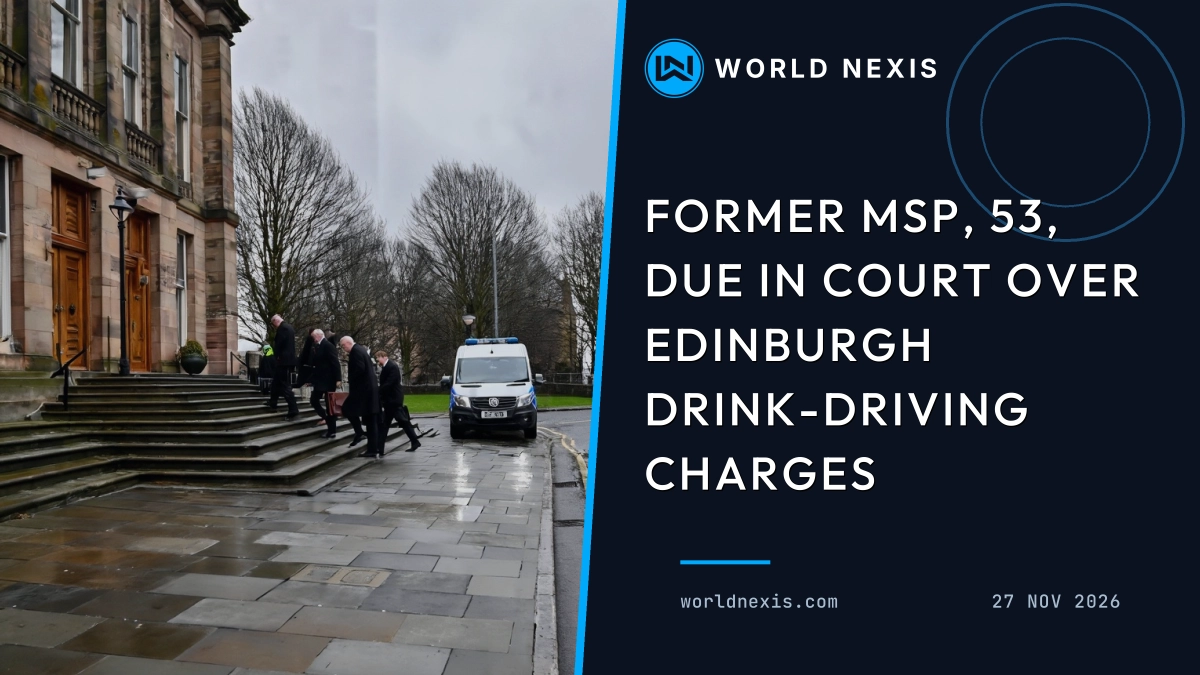
The Colin Smyth trial is due to open at Edinburgh Sheriff Court on Friday, where the former MSP faces dangerous driving and drink-driving allegations after a series of crashes in central Edinburgh. Smyth, 53, is accused of driving on the city’s High Street and elsewhere on 2 November last year while at more than double the legal alcohol limit.
He is also accused of failing to report the incident to police “as soon as reasonably practicable”. Smyth denies the charges, so the Colin Smyth trial will turn on evidence tested in open court rather than on the allegations themselves.
Key points
- Colin Smyth, 53, a former MSP, is due to stand trial at Edinburgh Sheriff Court on Friday.
- Prosecutors allege he drove dangerously in central Edinburgh on 2 November last year at more than double the legal alcohol limit.
- The charges allege he mounted a pavement, narrowly missed a pedestrian, hit a parked car and crashed into electric bollards outside City Chambers.
- He is also accused of failing to report the incident to police promptly, and he denies the charges.
What the Colin Smyth trial will examine
The case rests on an alleged sequence of collisions in one of the busiest parts of Scotland’s capital. The charges state that he drove at excessive speed on the High Street and elsewhere in the city centre on 2 November last year.
Prosecutors allege that the vehicle mounted a pavement and narrowly missed a pedestrian before colliding with a parked car. It is further alleged that it crashed into electric bollards directly outside City Chambers.
City Chambers stands in the middle of the capital’s civic quarter, yards from streets that fill with pedestrians, shoppers and office workers every day. An allegation that a pedestrian was nearly struck is likely to be the most closely watched element of the case.
The allegations set out in the charges
The charges describe a vehicle driven at excessive speed, then leaving the carriageway where people were walking. It is alleged that Smyth repeatedly got in and out of the car and revved the engine.
Each element must be proved before any conviction can follow. Nothing has been established yet, and the sheriff will hear the evidence in open court.
A second charge to answer
Separately, Smyth is accused of failing to report the matter to police as soon as reasonably practicable. The wording leaves the court to weigh what was reasonable in the circumstances rather than applying a fixed clock.
Edinburgh drink-driving case puts city centre safety in focus
For anyone who walks through the centre of Edinburgh, the charges describe a familiar vulnerability. A car that leaves the road at speed leaves pedestrians with nowhere to go, and bollards outside civic buildings exist precisely to keep vehicles away from crowded paving.
The Colin Smyth trial is also unusual because of who is in the dock. Smyth is a former member of the Scottish Parliament, so proceedings that would normally be covered in a few lines will draw attention from well beyond the courtroom.
The court will hear evidence about speed, the condition of the road and the driver’s conduct, then apply the criminal standard of proof to each charge in turn. Until then, the allegations remain allegations.
Why it matters
Drink-driving is one of the few areas of road law where a single decision behind the wheel can put strangers at risk with no warning at all. If the allegations are proved, the people most exposed were those walking on a city-centre street on a November evening.
The Colin Smyth trial also tests how the justice system handles a former elected representative. Readers who care about accountability will want to see that public office brings no protection; others will worry that heavy publicity makes a fair hearing harder to secure.
Analysis
Having covered devolution and local democracy for World Nexis News, I tend to read a story like this through accountability rather than spectacle. The charge that stands out to me is not the alcohol allegation, serious as it is, but the claim that the incident was not reported to police as soon as reasonably practicable. That speaks to a duty owed to every other person using the road.
In my view the facts as charged support the argument that driving allegations should be pursued in the same way whoever the defendant once was. A former MSP holds no office now and answers to no constituents, but the pedestrians on the High Street had no protection beyond the law itself. The strongest counter-argument is that the glare around a former parliamentarian is a penalty of its own, and that a defendant trailed by cameras may struggle to be judged on evidence alone.
That is precisely why I would rather the Colin Smyth trial, and not the surrounding coverage, decides what happened. I side with those who say the standard should be identical for everyone, and I would add one caveat: identical standards only mean something if the court is allowed to do its work quietly.
What happens next
The Colin Smyth trial is scheduled to begin at Edinburgh Sheriff Court on Friday. Evidence is expected on the dangerous driving charge, the allegation of driving while over the alcohol limit and the failure to report the incident.
What we don’t know yet
No findings have been made and the court has not yet heard the evidence. It is not known how long the trial will run or when a verdict will be delivered.
Related coverage
- Chloe Mitchell murder trial: jury sworn in over 2023 death
- Gregor Smith resigns: Scotland’s chief medical officer quits
- Billy Dunlop release recommended by Parole Board, aged 63
Further reading
- Former MSP due to stand trial over drink-driving charges
- Former MSP due to stand trial over drink-driving charges
About the author: Liam O’Connor is the UK Politics Reporter at World Nexis News (WNN), covering uk politics. The analysis section reflects the writer’s view.

Liam O'Connor
Liam O'Connor is UK Politics Reporter at World Nexis News, covering Westminster, devolved politics and the issues that matter to voters across England, Scotland, Wales and Northern Ireland. Based in London, he reports from primary sources — Hansard, official statements, published data — and explains…