Billy Dunlop release recommended by Parole Board, aged 63
The Billy Dunlop release has been recommended by the Parole Board, 37 years after Julie Hogg's murder. Her family say the board is not fit for purpose.
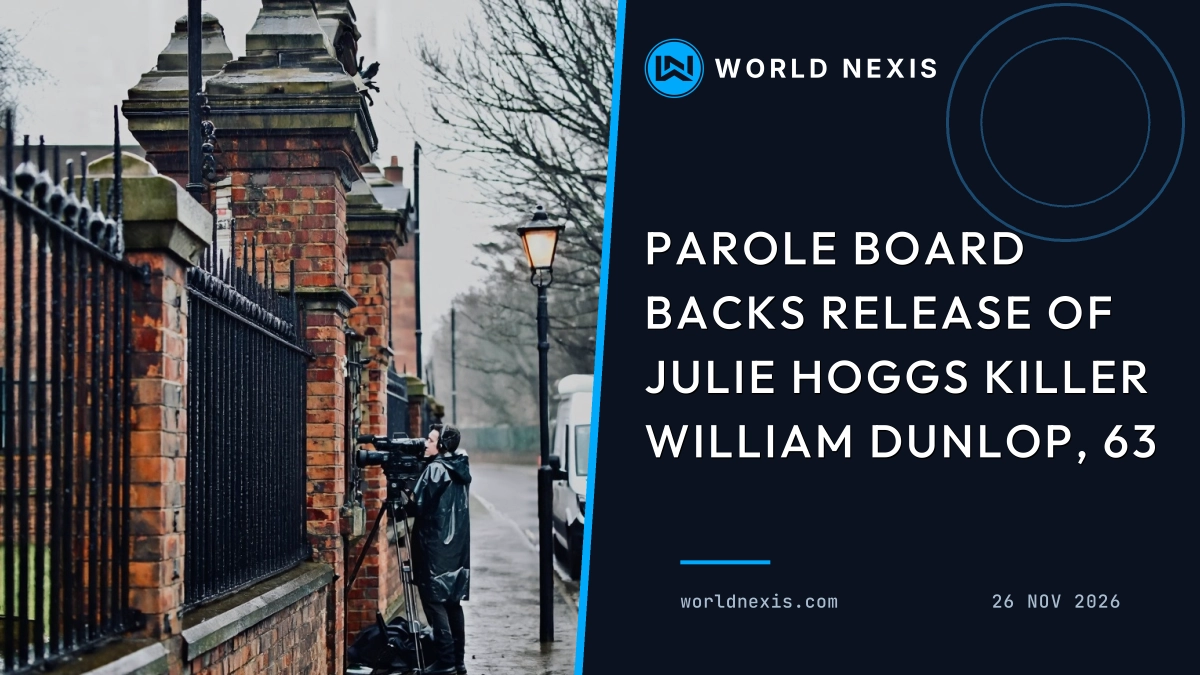
Updated 26 Nov 2026, 17:12 (UK time): Justice Secretary Alex Norris has asked officials to examine whether there are grounds to reconsider the Parole Board’s recommendation to release Billy Dunlop, the first official move since the decision.
Justice Secretary Alex Norris has asked officials to examine whether there are grounds to reconsider the Parole Board’s recommendation that Billy Dunlop be released, the Ministry of Justice has confirmed. It is the first official response since the panel concluded on Thursday that the killer, now 63, should leave prison.
The department said the Lord Chancellor’s “first priority is keeping the public safe”, and stressed that offenders freed from life sentences stay on licence for the rest of their lives and can be recalled immediately. The reconsideration mechanism lets a minister intervene only in exceptional circumstances, where a decision is judged legally irrational or the correct process was not followed, and ministers can separately ask the board to refer some cases to the High Court.
The same reporting brought detail from earlier reviews: past panels found “a serious possibility” that allegations of sexual activity with children between 1985 and 1992 “may be true”, though members gave no weight to claims linking Dunlop to two other murders. He has also accepted beating a partner with a pickaxe handle.
Kevin Hogg, who was three when his mother was killed, said he had expected the recommendation and repeated that the board is “not fit for purpose”. A named minister finally owning the file is something. But asking whether there are grounds to reconsider is the softest lever available, and if the statutory test is untouched this ends as every previous round did: in delay.
The Billy Dunlop release has been recommended by the Parole Board, clearing the way for the killer who became the first person retried under the reformed double jeopardy rule to leave prison at 63. Dunlop strangled Julie Hogg, 22, in Billingham, County Durham, in 1989, then hid her mutilated body behind a bath panel that her mother found more than two months later.
The recommendation follows his fourth application to review his case and comes 37 years after the killing. The decision has not yet been published, and the Justice Secretary may still seek to review it.
Key points
- The Billy Dunlop release recommendation came after his fourth application to the Parole Board.
- A panel concluded there was “no more than a minimal risk” he would commit a further offence causing serious harm.
- Julie Hogg’s son, Kevin Hogg, called the Parole Board “not fit for purpose” in response.
- His transfer to open prison was recommended more than once, but three justice secretaries intervened.
Billy Dunlop release: what the panel decided
The Billy Dunlop release turned on risk rather than on the gravity of the original crime. In its decision, the panel concluded there was “no more than a minimal risk” that he would go on to commit a further offence causing serious harm.
The panel said that after the time he has spent in custody and the rehabilitation he has “steadfastly pursued”, freeing him would not undermine public confidence in the parole system. It also said it was “mindful of the feelings” of Julie Hogg’s mother, Ann Ming, who believes Dunlop should never be released.
However, if a prisoner presents as a person who, on the totality of the evidence available to the Panel, meets the statutory test for release then the Panel is obliged by law to conclude that his release must be directed.
The panel acknowledged that the Secretary of State may still seek to review the outcome. It added, however, that it had the advantage of seeing and hearing the witnesses and Dunlop himself.
The murder that changed the double jeopardy law
Dunlop was tried twice over the 1989 killing and both juries failed to reach a verdict. Three years later, while in jail for another crime, he confessed and admitted lying in court, boasting that the double jeopardy rule meant nothing could be done.
Julie Hogg’s family, including her mother, campaigned for 15 years to change the law so a suspect could be charged twice with the same crime. Dunlop became the first person tried under the new rules, admitted murder and was jailed for life in 2006 with a minimum term of 17 years.
At sentencing, the judge said the killing was “accompanied by the brutal sexual degradation of [her] body”. Psychiatrists have previously found that Dunlop has “psychopathic traits” and “severe personality problems”. He has now served five years beyond his minimum term.
Family say the board is ‘not fit for purpose’
Kevin Hogg responded to the Billy Dunlop release recommendation by attacking the parole process itself. “You know them victim personal statements? They mean absolutely nothing – nothing whatsoever and that’s been proven time and time again,” he said.
He asked when the board would listen to ministers and to victims’ families, and said its members should be held to account. In his victim impact statement he described “hearing screaming and shouting in the home with the pungent smell of my mother’s decomposing body” as his grandmother found her.
“I can say categorically that time isn’t the great healer it’s purported to be,” he said. “As the years pass, the pain of losing my mother to this murder remains acute.”
Ann Ming, now 80, said the following day that she “wanted to scream” when Dunlop told the hearing he had come to empathise with the family after his own son died last year.
Inside the fourth parole hearing
Dunlop’s prison offender manager told the panel that his ability to cope had improved. She said she saw that last year as he dealt with his son’s death, an intervention by the then justice secretary Shabana Mahmood to keep him in prison, and the dramatisation of his case in the ITV series I Fought the Law.
Dunlop told the panel he now empathised with the family. “I was struggling when (Mr Hogg) was talking about it, from what it was bringing back for me,” he said. He spoke with his back to the camera at his own request.
Why it matters
For victims’ families, this case has become the test of whether the parole system can be trusted with the most serious sentences. Successive justice secretaries used their powers to keep Dunlop behind bars, yet the underlying legal test for release has not changed.
For the wider public, the Billy Dunlop release raises a simpler question about honesty in sentencing. If ministers repeatedly block a panel’s recommendation without altering the law, the system offers families hope it cannot deliver, and the delays become the only answer they get.
Analysis
Having covered crime and justice for World Nexis News, I look first at what this panel was actually able to do. The Parole Board was not asked whether Dunlop deserves mercy or whether his crime was monstrous; both are beyond argument. It applied a statutory test, and on the evidence before it, it found the risk minimal.
My view is that the family’s anger is aimed at the right emotion but the wrong target. Kevin Hogg’s complaint that victim statements mean nothing is, in practice, a complaint about Parliament. If ministers believe a man who hid a body behind a bath panel should never walk free, the honest course is to change the release test for the most serious murders, not to override panels one case at a time.
The strongest counter-argument is that ministerial intervention is the last lever left to families when a decision looks wrong, and that removing it would leave them with nothing. That deserves respect, but repeated interventions here have produced delay rather than a different answer, and each one raises expectations it cannot satisfy.
What happens next
The Billy Dunlop release depends now on whether the Justice Secretary seeks to review the recommendation. Unless that happens, the panel’s decision stands and arrangements for his release would follow.
What we don’t know yet
It is not yet clear whether the current Justice Secretary will intervene, or how quickly any release would take place. The family has not said what action, beyond public criticism of the board, it intends to take.
Related coverage
- Mandelson files: major release of 1,500 pages due to MPs
- UK net migration falls to 77,000, lowest level since 1997
- Defence spending: major £8bn boost for UK ‘cuts war risk’
Further reading
- William Dunlop recommended for release by Parole Board
- Killer jailed after double jeopardy law change recommended for release
About the author: Liam O’Connor is the UK Politics Reporter at World Nexis News (WNN), covering uk politics. The analysis section reflects the writer’s view.

Liam O'Connor
Liam O'Connor is UK Politics Reporter at World Nexis News, covering Westminster, devolved politics and the issues that matter to voters across England, Scotland, Wales and Northern Ireland. Based in London, he reports from primary sources — Hansard, official statements, published data — and explains…



