Defence spending: major £8bn boost for UK ‘cuts war risk’
Defence spending will grow to cut the risk of war, Wes Streeting says, as the UK puts £8bn into nuclear submarine maintenance and checks on reservists.
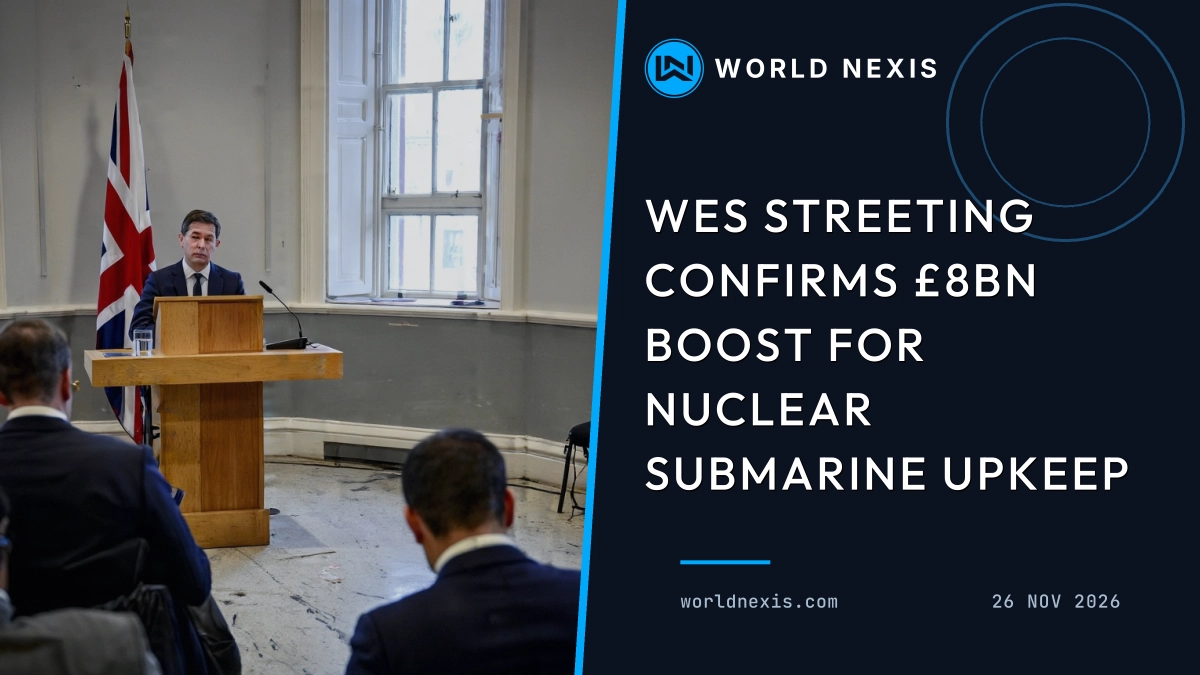
Defence spending will rise because a stronger military makes war less likely, the Defence Secretary has said, as the government announced an £8 billion investment in nuclear submarine maintenance. Wes Streeting said the money, confirmed on Thursday, is the “single biggest procurement decision of this Parliament” and is designed to cut how long the UK’s submarines spend at sea. He argued that better capability, a stronger domestic industry and firmer alliances all reduce the risk of conflict with Russia.
Key points
- The Ministry of Defence has committed £8 billion to maintaining the UK’s four nuclear submarines, aiming to shorten their spells at sea.
- Wes Streeting said higher defence spending lowers the chance of war with Russia “or anyone else”.
- He described the Russian threat as the worst since the Cold War, citing a missile incursion into Polish and Nato airspace last week.
- The department has written to former service personnel to check their contact details and skill levels, which Streeting called a “necessary precaution”.
Streeting says defence spending is the strongest deterrent
Speaking to BBC Radio Scotland, Streeting set out the case that defence spending is itself a form of diplomacy. “The deterrent effect is so strong that our adversaries wouldn’t want to test us, so that’s the goal,” he said.
He went further, arguing that investment and restraint move in the same direction: “With defence, the more capable you are, the more you invest in your defence, the less likely the worst is to happen.”
The Defence Secretary placed the announcement against a darker threat picture. He said Russia now poses the most serious danger to Europe since the Cold War, and pointed to a Russian missile entering Polish, and therefore Nato, airspace last week.
“I was in Poland last Friday. That was a serious incursion by Russia into Polish, and therefore Nato, airspace in a way that would have been unthinkable five years ago, and we shouldn’t tolerate it anymore now than we would have then.”
He called this “a difficult time for Europe” and said the threat is “material”, which is why the UK has to “invest more in our defence, in our capability, in our industry, in our alliances”.
What the £8bn covers, and the letter to veterans
The defence spending announced on Thursday covers maintenance of the existing fleet rather than new vessels. The government hopes the work will cut the time each submarine is tied up in dock, keeping more of the four-boat fleet available.
The strain on that fleet was underlined earlier this month, when one of the four submarines returned from a record seven-month deployment.
Separately, the Ministry of Defence has written to former military personnel asking them to confirm their contact details and skill levels. Streeting described the exercise as a “necessary precaution” rather than a signal of imminent mobilisation.
Defence spending and the North Sea dispute
Scotland’s First Minister, John Swinney, has claimed the north coast of Scotland has been left undefended. UK ministers have consistently rejected the charge, and Streeting called it “unfounded and therefore irresponsible”.
He said the North Sea is “integral to our homeland security” and compared that sea border with Russia to the land borders that preoccupy the Baltic states and Poland. “That is a huge border we have with Russia,” he said, adding that the UK has been active in exercises with Nato allies and the UK-led Joint Expeditionary Force.
“All of that should give Scotland and the wider United Kingdom comfort and security,” he said.
Why it matters
For households, the immediate question is money. Ministers have already accepted that defence spending must rise, and Streeting repeated on Thursday that the UK will have to “spend more” — a clear signal that pressure on other public budgets will not ease.
For communities in the north of Scotland, the argument over North Sea defence is about whether the sea and airspace around them are properly watched. That matters to the offshore energy workforce and to fishing crews who operate far from any base.
Analysis
I think Streeting’s core claim about defence spending survives scrutiny. Capability and alliance depth do change an adversary’s calculations, and a record seven-month deployment shows the deterrent is being worked hard rather than parked. Having covered devolution and public services for World Nexis News, I also watch where this money lands on the map, and the North Sea framing is a deliberate attempt to answer Swinney on his own ground.
Where I part company with the government’s presentation is in billing a maintenance programme as a strategic leap. Maintenance buys availability, not new reach, and it does little by itself about the hybrid and undersea activity that worries northern communities most. The fairest counter-argument is that ministers are being candid about a backlog rather than overselling new kit, and the letters to former personnel suggest they are quietly preparing for a wider call on the public.
In my view the deterrence case is better supported than the charge that the north coast has been abandoned — but only if the availability gain is real and visible. If the boats are still alongside in two years, the rhetoric will look hollow.
What happens next
The nuclear submarine maintenance programme now shifts to delivery, with the Ministry of Defence responsible for turning the funding into shorter turnaround times. The department is also waiting on replies from former personnel asked to confirm their details and skills.
Politically, the First Minister is expected to keep pressing the case on northern defences, while at Westminster the wider question of how much more defence spending is affordable remains open.
What we don’t know yet
Ministers have not published a timetable for the work or said how many of the four submarines will be out of service at any one time. Nor have they set out what the contact exercise with former personnel will lead to.
Related coverage
- Babcock submarine deal: major £8bn boost for 3,000 jobs
- Tube strike: major 24-hour RMT walkout begins across London
- Ann Widdecombe memorial service: major Westminster farewell
Further reading
- More investment in defence means less chance of war, says Streeting
- More investment in defence means less chance of war, says Streeting
About the author: Liam O’Connor is the UK Politics Reporter at World Nexis News (WNN), covering uk politics. The analysis section reflects the writer’s view.

Liam O'Connor
Liam O'Connor is UK Politics Reporter at World Nexis News, covering Westminster, devolved politics and the issues that matter to voters across England, Scotland, Wales and Northern Ireland. Based in London, he reports from primary sources — Hansard, official statements, published data — and explains…



