Tube strike: major 24-hour RMT walkout begins across London
The Tube strike begins at noon on Thursday as RMT drivers walk out in a row over a four-day week, with no service on the Circle and Piccadilly lines.
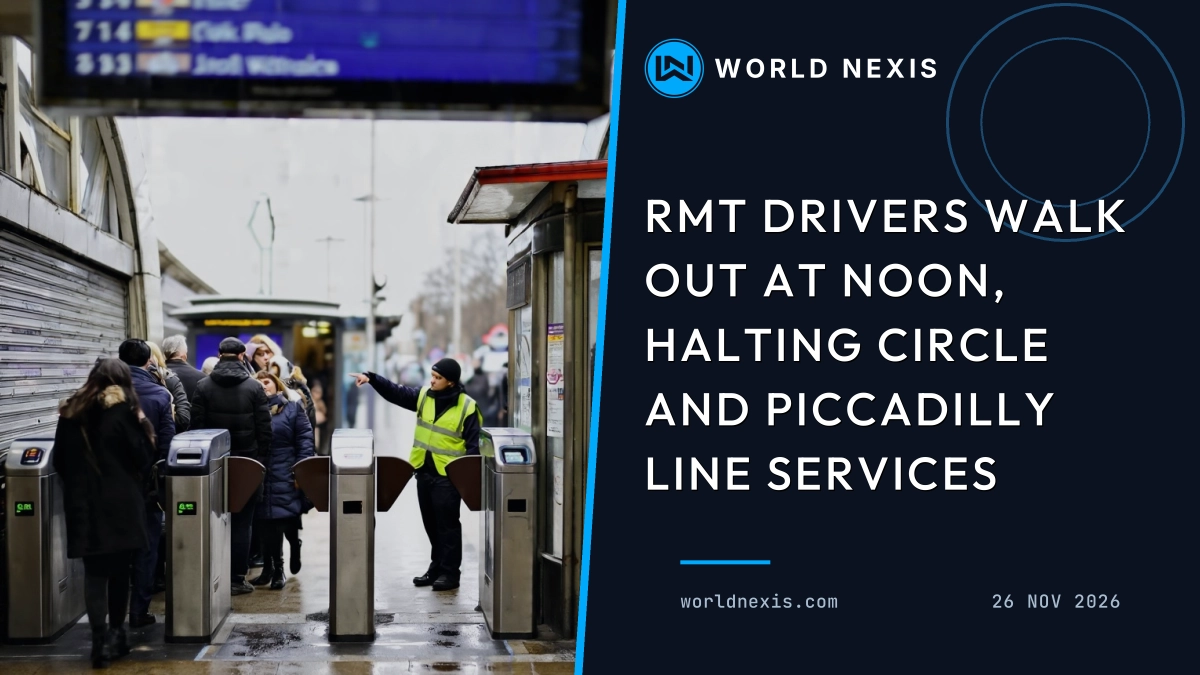
The first Tube strike of the winter began at noon on Thursday, when RMT train drivers walked out for 24 hours and Transport for London (TfL) cut services across the capital. A normal timetable ran until about 10am before trains were thinned out, and no service is expected on the Circle or Piccadilly lines for the rest of the day.
Key points
- The Tube strike started at 12 noon on Thursday after talks over a four-day week failed to produce a settlement.
- No trains are expected on the Circle or Piccadilly lines all day, or on the Waterloo & City line after midday.
- TfL said most services would run from midday, but warned of disruption on all lines before, during and after the walkout.
- Seven more 24-hour Tube strike dates are scheduled between 17 December and 25 February.
What the Tube strike means for Thursday and Friday
Passengers have been told to check before they travel. TfL said disruption would stretch beyond the hours of the walkout itself, reaching into Friday morning and the recovery through Friday evening.
From midday, most routes are expected to run. TfL nevertheless warned that gaps and crowding are likely on every line. Two services lose their trains completely during the Tube strike: the Circle and the Piccadilly. The Waterloo & City line, which carries commuters between Waterloo and the City, stops after midday.
Friday will be slower still. Services are due to start later than normal, with disruption across the network until around midday. Further problems are expected through the afternoon and evening before timetables return to normal at about 6pm.
The London Underground strike runs a full 24 hours from noon, so the second day of disruption is built into the timetable rather than an unexpected extra.
How the four-day week row led to the walkout
At the centre of the dispute is TfL’s revised offer on the working week for train drivers. The package sets out a voluntary four-day week, with an option for drivers to stay on five days and a guarantee that they will remain at the same depot.
The Aslef union has backed the proposals and its members are working normally, leaving the two drivers’ unions publicly at odds over the same offer. The RMT strike follows the failure of talks to resolve the dispute.
Nick Dent, director of customer operations for London Underground, said the terms had changed materially and stressed that they were voluntary. “We have made some significant changes to our proposals and have asked the RMT to put these to their members,” he said. “The proposals will lead to a more reliable service and will improve work/life balance.”
He also denied union claims that drivers were being asked to spend more time driving trains, which the RMT says would raise fatigue levels.
RMT general secretary Eddie Dempsey rejected that account. “This is not about improving work-life balance,” he said. “It is about squeezing more work out of fewer drivers while giving management greater flexibility at the expense of our members.”
Businesses warn on Christmas trading
Ruth Duston, chief executive of London Heritage Quarter, which represents 7,000 businesses across Victoria, Westminster and Whitehall, said the Tube strike had landed at the worst possible moment for traders. “Businesses across the capital rely on the Tube to bring in hundreds of thousands of staff, customers and visitors every single day,” she said. “This disruption will be hugely damaging for them during such an important trading period, and negotiations must resume to limit the economic impact on businesses across the capital.”
Why it matters
For the hundreds of thousands of people who move through the Underground on a normal weekday, the Tube strike means longer journeys, packed buses and, for some shift workers, a real question about whether they can reach work at all. The knock-on effects reach shops, hospitality venues and public services that depend on staff arriving on time.
It also lands in the run-up to Christmas, the trading period Duston describes as crucial. With further dates already fixed for 17 and 19 December, the dispute now carries an economic cost that goes well beyond one day of inconvenience.
Analysis
Having covered public services for World Nexis News, I look first at what has actually changed on the table rather than at the language around it. On the available evidence, TfL’s revised package is a real concession. The four-day week is voluntary, drivers who prefer five days keep them along with their depot, and the rival Aslef union has accepted the terms and is working normally. That makes it harder to argue a walkout is the only route left.
I think the RMT should put the revised offer to its members before the December Tube strike dates go ahead. Eight walkouts stretching to late February is a long campaign to sustain on a demand management has already partly met. Those who pay first are lower-paid shift workers who cannot do their jobs from home.
The strongest counter-argument is not trivial, though. In a safety-critical job, “voluntary” flexibility can quietly harden into routine once rosters and headcount are squeezed. Driver fatigue is a safety question rather than a lifestyle one. That is precisely why a ballot, with the fatigue issue settled in writing, would end this faster than another eight days of disruption.
What happens next
Seven more 24-hour walkouts are already scheduled: 17 and 19 December, 4 and 6 January, and 17, 23 and 25 February. Each Tube strike is due to begin at noon and run for a full day, with recovery time built into the following morning.
What we don’t know yet
Whether negotiations restart before 17 December remains open, and so does the question of whether the RMT will ballot its members on the revised offer. The practical scale of each date will only become clear on the day, as TfL builds its timetable around the drivers who report for duty.
Related coverage
- Eurostar strike: 25 November Paris-London travel warning
- Ann Widdecombe memorial service: major Westminster farewell
- Prison restaurant opens at HMP Drake Hall in major jobs push
Further reading
- London Underground drivers to launch 24-hour strike
- London Underground drivers to launch 24-hour strike
About the author: Liam O’Connor is the UK Politics Reporter at World Nexis News (WNN), covering uk politics. The analysis section reflects the writer’s view.

Liam O'Connor
Liam O'Connor is UK Politics Reporter at World Nexis News, covering Westminster, devolved politics and the issues that matter to voters across England, Scotland, Wales and Northern Ireland. Based in London, he reports from primary sources — Hansard, official statements, published data — and explains…



