Babcock submarine deal: major £8bn boost for 3,000 jobs
The Babcock submarine deal is worth £8bn over five years and promises 3,000 jobs in Plymouth, Clyde and Bristol, with dry docks running 24 hours a day.
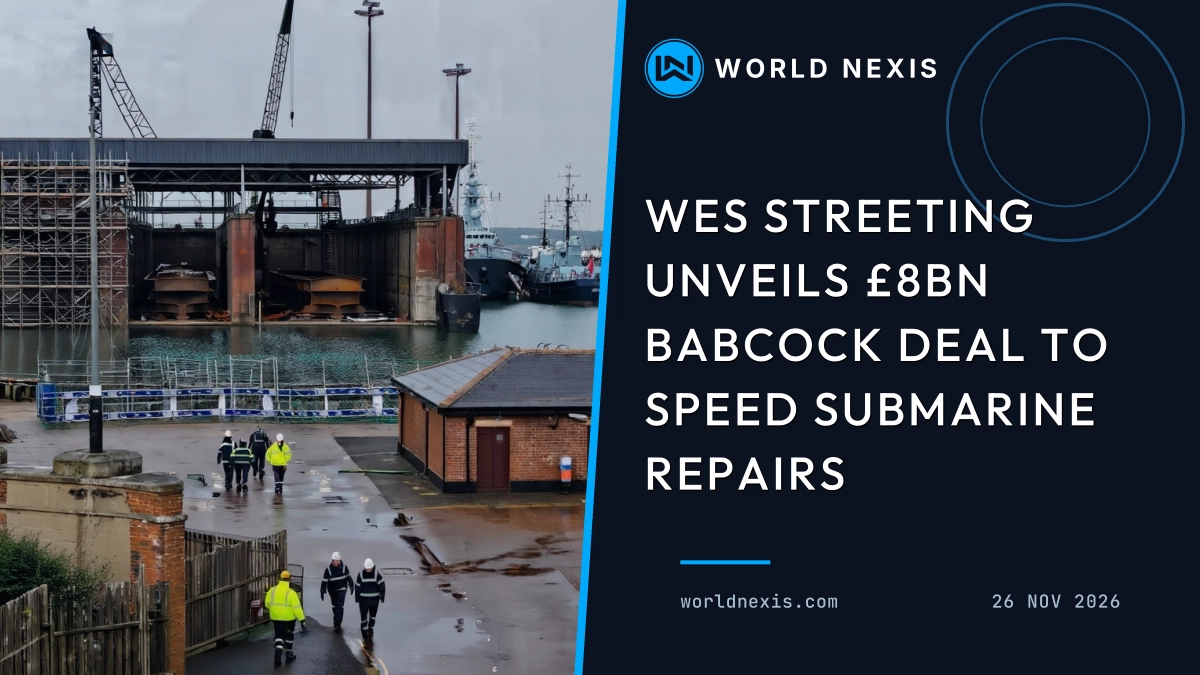
The Babcock submarine deal announced on Thursday is worth £8bn over five years and is meant to get Britain’s nuclear-armed boats back to sea faster. Defence Secretary Wes Streeting set out the contract during a visit to HMNB Devonport in Plymouth. Dry docks at submarine bases will move to round-the-clock working under the plan.
The Ministry of Defence said the agreement with Babcock would create around 3,000 highly-skilled jobs and 2,500 apprenticeship and graduate places. The roles are concentrated in Plymouth, at Clyde in Scotland and in Bristol.
Key points
- The Babcock submarine deal is a five-year contract worth £8bn, described by the company as the largest in its history.
- Around 3,000 jobs and 2,500 apprentice and graduate roles are expected, mainly in Plymouth, Clyde and Bristol.
- Dry dock yards will run 24 hours a day to cut maintenance turnaround times.
- The MoD says the work sits within a wider £26bn investment in naval bases announced earlier this year.
What the Babcock submarine deal covers
The Babcock submarine deal covers maintenance, repair and infrastructure at the sites that keep the Royal Navy’s submarines in service. Mr Streeting said the money would let yards operate around the clock, seven days a week. He argued that dry dock capacity, rather than shipyard labour, has been the real bottleneck.
“One of the constraining factors on our turnaround time for submarines is the availability of our dry dock facilities,” he said. The funding, he added, “will enable those yards to run 24/7, making much better use of those dry dock facilities and getting our boats out faster”.
The Defence Secretary called it what he expects to be “the single biggest procurement decision of this Parliament”. Babcock put the total at £8.7bn once a £700m framework is included.
Payment is tied to delivery. “The more productive they are, the more they earn but if they fall short, then they don’t get paid as much,” Mr Streeting said, describing the structure as a win for the Navy, for jobs and for the taxpayer.
Jobs in Plymouth, Clyde and Bristol
Much of the political sales pitch rested on employment. Andy Burnham, the Prime Minister, said the agreement combined security spending with investment in people. “With this new agreement we’re not just investing in our national security, we’re also making a huge investment in our people,” he said.
He added that the deal would “bring jobs to communities in Plymouth, Clyde and beyond” and boost growth across the UK. “Keeping the public safe will always be my top priority,” the Prime Minister said.
Under the Babcock submarine deal, site-level figures vary between announcements. About 900 posts have been linked to HMNB Clyde, which hosts the submarine fleet, and more than 1,000 to Plymouth. The MoD has also said the contract will sustain 8,500 existing jobs across the supply chain.
Babcock’s chief executive, Harry Holt, said the gateway agreement would let the company “increase submarine availability” and develop “the skills, infrastructure and capability to support the Royal Navy’s submarine force for the years ahead”.
The First Sea Lord and Chief of Naval Staff, General Sir Gwyn Jenkins, said the money would help the Navy “tackle delays that hold us back” by “getting submarines through maintenance quicker and back where they belong: beneath the waves”.
Why it matters
Britain’s deterrent depends on submarines being ready when they are needed, not when repair schedules allow. Faster nuclear submarine maintenance therefore has a direct bearing on national security and on the credibility of commitments to Nato allies.
For households in Plymouth, Clyde and Bristol, the offer is apprenticeships, graduate places and skilled work in places where those jobs are scarce. For taxpayers, the Babcock submarine deal is a test of whether a payment-by-results contract buys more time at sea than the old arrangements.
Analysis
Having covered devolution and public services for World Nexis News, I look first at where money lands and who can check it. On the core Babcock submarine deal, I think Streeting’s diagnosis is the stronger one. If dry docks are the choke point, adding shifts costs far less than buying new boats and can show results inside a five-year term, and the First Sea Lord’s language about delays suggests the Navy agrees.
Where I part company with ministers is the jobs arithmetic. Three thousand posts is a credible headline, but the regional numbers are being briefed in different shapes, and Faslane jobs carry particular weight in Scottish politics. Until the MoD publishes a site-by-site breakdown, voters in Glasgow and Plymouth should treat the local figures as ambitions rather than commitments. The strongest counter-argument is that maintenance cash cannot cure an ageing four-boat fleet, and that is fair, but a bottleneck is still a bottleneck.
The most honest part of the announcement is Streeting’s admission that funding may be moved from other departments. That turns readiness into a choice about priorities elsewhere in public spending. Readers should hold him to the promise that results, not press releases, decide what Babcock is paid.
What happens next
Delivery of the Babcock submarine deal now begins, with infrastructure work at the three main sites phased across the five-year term. The government has said upgraded yards will move to extended hours as facilities come back into service.
What we don’t know yet
No full site-by-site jobs breakdown has been published, and it is unclear which departmental budgets would absorb any transfer of funding. Nor has a timetable been set for measuring improvements in submarine availability.
Related coverage
- Prison restaurant opens at HMP Drake Hall in major jobs push
- Poundland administration crisis puts 11,000 jobs at risk
- Colman’s sale could unlock £33.8bn McCormick deal, CMA says
Further reading
- UK signs £8bn deal to ensure submarines are ‘warfighting ready’
- Streeting unveils £8bn deal to get nuclear submarines back to sea faster
About the author: Liam O’Connor is the UK Politics Reporter at World Nexis News (WNN), covering uk politics. The analysis section reflects the writer’s view.

Liam O'Connor
Liam O'Connor is UK Politics Reporter at World Nexis News, covering Westminster, devolved politics and the issues that matter to voters across England, Scotland, Wales and Northern Ireland. Based in London, he reports from primary sources — Hansard, official statements, published data — and explains…



