UK net migration falls to 77,000, lowest level since 1997
UK net migration fell to an estimated 77,000 in the year to June 2026, the lowest since 1997 outside the pandemic, down 62% on the previous year.
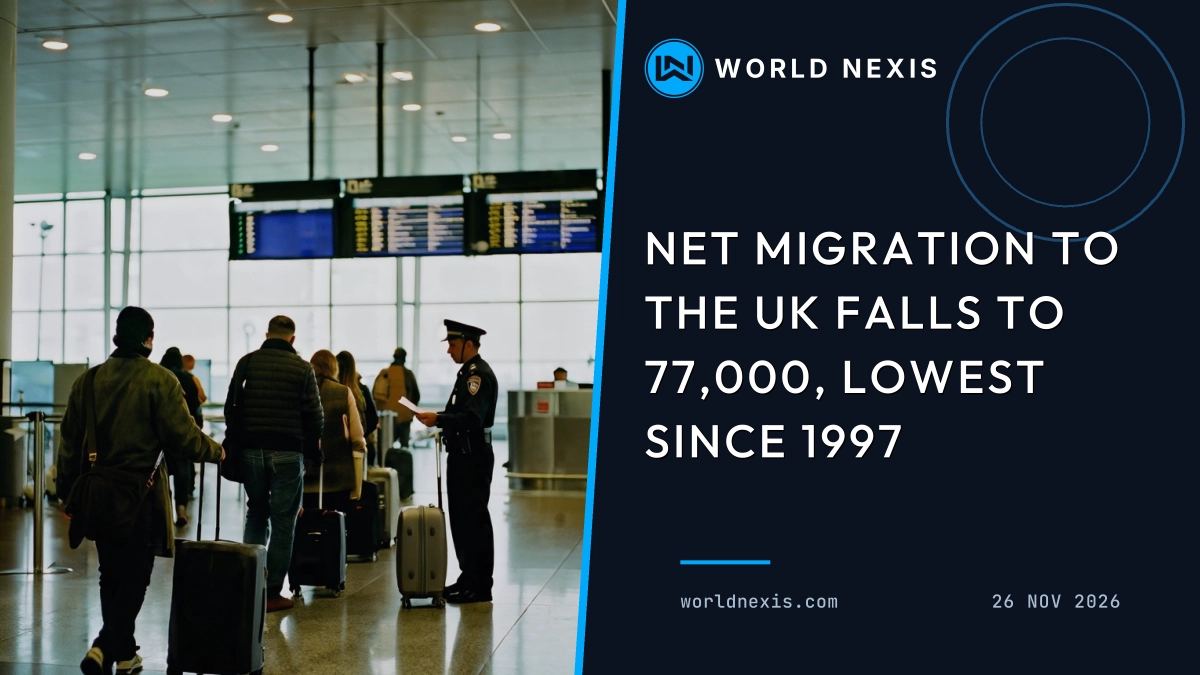
UK net migration fell to an estimated 77,000 in the year to June 2026, the lowest annual total since 1997 outside the pandemic, the Office for National Statistics said on Thursday. The figure is down 62% from 204,000 in the previous 12 months.
Net migration measures the gap between people arriving in the UK and people leaving. The annual total last stood lower in 1997, at 48,000, and dropped to 35,000 only briefly while Covid-19 travel restrictions were in force.
Key points
- UK net migration was 77,000 in the year to June 2026, against 204,000 a year earlier.
- An estimated 738,000 people arrived and 661,000 left.
- Non-EU citizens were the only group adding to the net total.
- Home Secretary Shabana Mahmood said the government had restored control.
UK net migration falls to levels last seen in the 1990s
The ONS said UK net migration had “fallen to levels not typically seen since the 1990s”. Its statisticians linked the continued reduction to fewer people arriving from outside the EU to work or study.
Overall movement in both directions is still far heavier than three decades ago. Sarah Crofts, the ONS deputy director of migration statistics, said more than double the number of people are arriving and leaving compared with 1997.
“In 1997, movement from inside and outside the EU made a positive contribution to net migration, partially offset by more British people leaving than arriving,” she said. “In 2026, non-EU citizens are the only group driving positive net migration.”
In 1997, movement from both inside and outside the EU pushed the net figure up, softened by more British people leaving than arriving. The ONS says that pattern has reversed, with EU nationals now emigrating in greater numbers than they arrive, as is the case for British nationals.
Who is arriving and who is leaving
The composition of UK net migration has shifted sharply. An estimated 245,000 British nationals left the country in the period while 109,000 arrived, and nationals of EU-plus countries — the 27 member states plus Norway, Iceland, Liechtenstein and Switzerland — recorded 124,000 departures against 79,000 arrivals.
British emigration has eased only slightly across three years: 257,000 in the year to June 2024, 251,000 a year later and 245,000 in the latest period.
Non-EU nationals moved the other way. About 550,000 arrived in the year to June and 292,000 left, making that group the sole source of positive net migration in the estimates.
Taken together, the flows describe a country receiving and losing people on a large scale: roughly 1.4 million movements in and out within a single year.
Home Secretary says control has been restored
Shabana Mahmood welcomed the net migration figures, arguing that ministers had delivered where the previous government had not.
“This Government has restored control. We have brought net migration to 77,000, down 92% from its peak under the Conservatives. Where they failed, we have delivered for the British people.”
That 92% comparison is measured against the highest annual total recorded under the previous administration. The estimate published on Thursday covers the 12 months to June 2026.
Why it matters
UK net migration feeds directly into population growth, and a smaller figure eventually shows up in demand for housing, school places and NHS services. It also sets the size of the workforce available to employers that recruit from overseas.
For most households the effect is slower population growth rather than a shrinking country, because arrivals still outnumber departures. What has changed is the pace, and the mix of people behind it.
Employers who hire from abroad will notice the shift before most families do, since the reduction is concentrated among people arriving to work or study.
Analysis
Having covered migration and verification for World Nexis News, I look first at how a net figure is built, because the headline can flatter a political claim. Here, 77,000 is the residue of 738,000 arrivals and 661,000 departures, and both of those flows sit far above 1990s levels. The total has fallen because fewer non-EU citizens came to work or study — the ONS’s own explanation — and because large numbers of British and EU nationals are leaving.
That distinction bears on whether the Home Secretary can claim control has been restored. The decline in non-EU arrivals is real, and it is the strongest part of her case; I do not dismiss it. Yet a headline shaped as much by who is leaving as by who is being let in is a thin foundation for declaring success, because departures respond to labour markets and conditions abroad rather than to the Home Office.
My view is that the government’s framing of UK net migration runs ahead of the evidence. The fairest reading is that the country has moved from an unusually high net inflow to a much lower one, with non-EU citizens now the only group adding to the total. The counter-argument is fair too: a 62% annual fall is hard to produce without policy doing real work.
What happens next
Attention now turns to how the Home Office explains the 127,000 drop, and to whether the downward trend holds in the next set of ONS migration statistics. The composition of the flows, rather than the headline, is likely to dominate scrutiny.
What we don’t know yet
It is not yet clear how much of the fall comes from fewer arrivals and how much from higher departures, although the ONS points to reduced non-EU arrivals for work and study. Nor is it known whether British and EU departures will keep outpacing arrivals at the same rate.
Related coverage
- Babcock submarine deal: major £8bn boost for 3,000 jobs
- Lambhill shooting: £20,000 reward in urgent appeal
- Nvidia stock: Dow gains 124 points as Nasdaq falls 148
Further reading
About the author: Tariq Al-Mansoori is the Breaking News Reporter at World Nexis News (WNN), covering breaking news. The analysis section reflects the writer’s view.

Tariq Al-Mansoori
Tariq Al-Mansoori is a Breaking News Reporter at World Nexis News, covering major incidents, official statements and developing stories across the UK, US and internationally. Based in London, he works to confirm details before publication, attributes information to named sources where possible and updates stories…



