Ilhan Omar search warrant: federal grand jury empaneled in fraud inquiry
More than 160 pages of Ilhan Omar search warrant records were unsealed with heavy redactions, showing a probe dating to 1980. Here is what happens next.
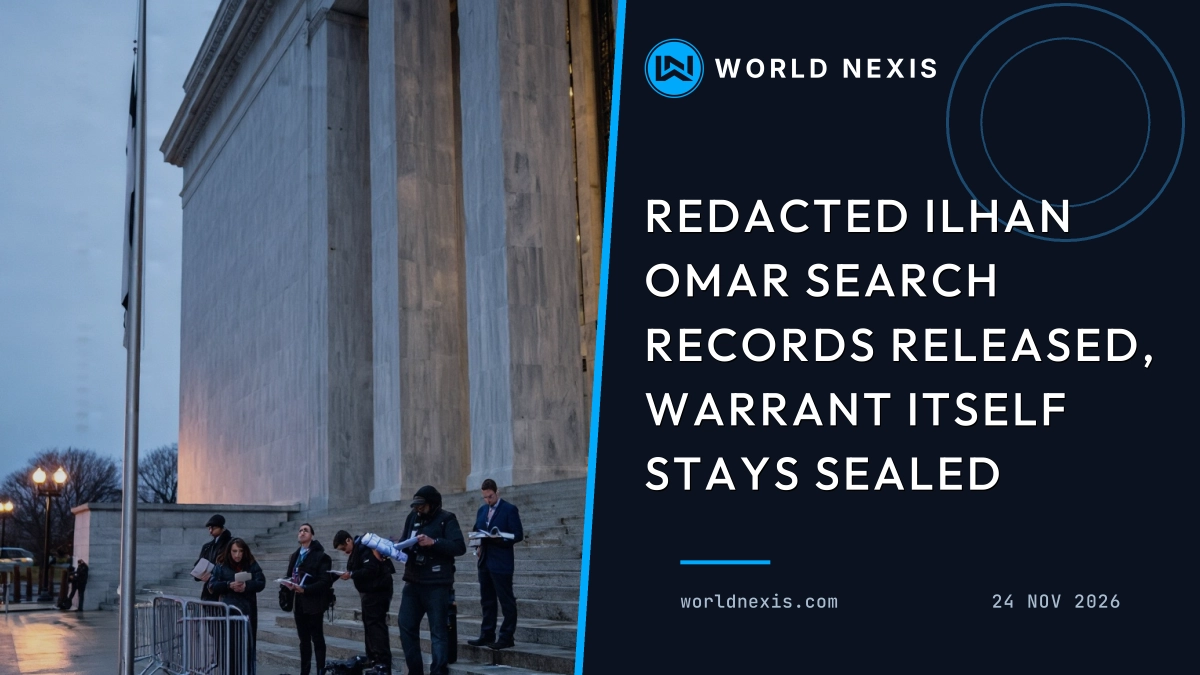
Updated 25 Nov 2026, 04:36 (UK time): A federal grand jury has been empaneled in Washington to hear evidence in the immigration-fraud inquiry involving Rep. Ilhan Omar, moving the case from a sealed search toward a possible indictment, though no charges have been filed and prosecutors have not confirmed the panel.
A federal grand jury has been empaneled in Washington to hear evidence in the immigration-fraud inquiry involving Rep. Ilhan Omar, according to people familiar with the case, with prosecutors from the District of Columbia and Minnesota presenting material about possible violations by the congresswoman or relatives who fled Somalia in the 1990s. No indictment has been returned, the timing of any charging decision is unknown, and the Justice Department has not confirmed the panel’s existence.
The disclosure follows the release of 169 pages of Ilhan Omar search warrant records, most of them heavily redacted, which show an inquiry whose stated window runs from 1980 to the present and whose specific alleged offenses remain blacked out. One filing in that release described the matter as a pre-indictment investigation; another said the government believes crimes were committed over decades, and that the case has nothing to do with Omar’s professional life.
What changes is the posture of the story: it is now a potential charging track rather than only a sealed search. What does not change is the substance on the public record. Omar has not been charged, has denied wrongdoing and calls the investigation a sham, and her office has not commented on the grand jury disclosure.
Grand jury secrecy means the public still cannot see what, if anything, prosecutors believe they can prove. A panel weighing evidence is not an accusation, and it is not a verdict. But a sitting member of Congress now faces the prospect of an indictment she would have to answer for while representing her district, and the country deserves a clearer account than redactions allow.
A federal judge unsealed more than 160 pages of Ilhan Omar search warrant records on Monday night, revealing an investigation the government says stretches from 1980 to the present while leaving the central allegations blacked out.
The documents come from the U.S. District Court for the District of Columbia and concern the Oct. 12 Ilhan Omar home search in Washington by Homeland Security Investigations agents. Chief U.S. District Judge James E. Boasberg cleared a redacted version for release after news organizations sought access to the sealed file. The warrant itself was not among the papers published.
Key points
- Much of the released Ilhan Omar search warrant file is heavily redacted, and the list of property agents seized is sealed in full.
- Prosecutors were authorized to look for evidence of offenses “occurring between 1980 to the present,” decades before Omar won a seat in Congress.
- A magistrate judge questioned the Justice Department repeatedly on probable cause and on Omar’s constitutional protections before signing.
- No charges have been announced, and Omar’s office has not commented on the newly released material.
What the unsealed Ilhan Omar search warrant files show
Prosecutors sought the Ilhan Omar search warrant in the days before a judge signed it on Oct. 9 and sealed it the same day. The sealing order cited reasonable grounds to fear flight from prosecution, destruction or tampering with evidence, intimidation of witnesses and “serious jeopardy to the investigation.” Agents executed the warrant three days later.
The material sought was described as “[a]ll records and information that constitute fruits, contraband, evidence, and instrumentalities of violations of” a redacted offense, “those violations involving Ilhan Nur Said Elmi a/k/a Ilhan Abdullahi Omar, and occurring between 1980 to the present.”
Agents could take papers, records, photographs, thumb drives, external hard drives, computers, cellphones and other digital devices owned or used by Omar. What they actually removed is blacked out. Omar has said agents took 17 items, including old phones that belonged to her and one of her daughters.
The claim at the center of the case
One Justice Department filing submitted after the search sets out the government’s position in blunt terms.
The United States believes ILHAN has committed [REDACTED] crimes over decades — beginning long before she was ever in Congress.
The alleged crimes are redacted wherever they appear. A second filing, objecting to how the court had summarized the government’s private arguments, insisted the inquiry is not about her work: “Nothing in the search warrant affidavit, briefing, or oral argument indicates that the United States’s case has anything to do with ILHAN’s professional life.”
Homeland Security Investigations covers immigration document fraud, identity fraud, immigration benefit fraud and other federal offenses. Omar is a naturalized citizen who came to the United States from Somalia as a child, and her congressional biography gives her birth date as October 1982. The period named in the Ilhan Omar search warrant therefore opens before she was born.
A magistrate judge’s doubts and the speech or debate clause
The Ilhan Omar search warrant file is at least as revealing about the court as about the congresswoman. Records show Magistrate Judge Matthew Sharbaugh asked the Justice Department for briefings explaining its theory of probable cause, and the department went through “several rounds” of affidavit revisions before he signed.
Sharbaugh found that the speech or debate clause — the constitutional protection shielding lawmakers from liability over legislative acts — was at least partly engaged, because agents were searching a sitting member’s home. “Special search procedures” were used during the search as a result, according to the records.
Boasberg approved the redacted release, and the exchange over that clause is among the material now public. Prosecutors had argued that nothing should come out, warning the files could be needed at a future trial.
Omar’s office said at the time of the search that she had “done nothing wrong” and called the operation “an outrageous abuse of power and an unprecedented escalation in the weaponization of federal law enforcement to target political enemies.” President Donald Trump has denied any involvement in the search, though he has repeatedly attacked her at political rallies.
Why it matters
The Ilhan Omar search warrant release matters first to the voters she represents. Their member of Congress is the subject of a federal investigation serious enough to justify a search of her home, with no charge on the public record and most of the reasoning still hidden. That is a hard thing for any incumbent to answer for.
It matters more widely because it tests whether courts can visibly police how far the executive branch goes when it investigates elected officials. A partly redacted file does not settle that question, but it does show a judge demanding answers before agents walked through the door.
Analysis
Having spent five years covering accountability reporting and constitutional law for World Nexis News, I read unsealing orders for what they leave behind, and this one leaves a great deal. The most important feature of the Ilhan Omar search warrant file is not the phrase about crimes over decades. It is that the probable cause theory stays redacted from beginning to end.
That undercuts the loudest version of the weaponization argument. The record shows a magistrate judge asking for briefings, forcing revisions and applying special procedures precisely because a lawmaker’s home was being searched. A rubber stamp does not look like that, and anyone calling the search a stunt has to explain it away.
Yet the record also undercuts the Justice Department’s comfort. An inquiry whose stated window opens in 1980, before the subject was born, and whose allegations cannot be described in public, is one the public cannot assess. Prosecutors cannot ask citizens to trust a case they will not outline. On balance I side with those demanding more disclosure, because a lawful search does not need indefinite secrecy to stay lawful. The counter-argument is real, since sealed files protect witnesses and future proceedings, but it does not justify hiding the warrant itself.
What happens next
The Ilhan Omar search warrant and the full inventory of seized property remain under seal, so any further disclosure needs another order from Boasberg or a higher court. Prosecutors have told the court the material may be needed at a future trial. Nothing in the released pages closes the Ilhan Omar investigation.
Omar’s office has not responded to requests for comment on the released documents. No charging decision has been made public, and no court date is attached to the inquiry.
What we don’t know yet
Three things matter most and none of them is visible: the offense named in the redacted warrant, the evidence that satisfied the magistrate, and whether the inquiry reaches beyond Omar herself. Until one of those is on the record, the argument over these files will rest on inference.
Related coverage
- Indonesia factory fire: crews search for 34 missing as rescued tally rises
- ICE airport arrest of two sparks major Seattle outcry
- Amtrak derailment: 5 injured as truck stalls in Louisiana
Further reading
- Federal court releases Rep. Ilhan Omar Washington, D.C. home raid documents
- Judge unseals documents related to search of Rep. Ilhan Omar’s home
About the author: Ayesha Rahman is the Senior Political Correspondent & Columnist at World Nexis News (WNN), covering politics & opinion. The analysis section reflects the writer’s view.

Ayesha Rahman
Ayesha Rahman covers politics and opinion for World Nexis News from London, focusing on elections, legislatures and the policy choices that shape everyday life in the US and UK. She writes analysis and columns that separate what is confirmed from what is claimed, working from…



