Amtrak derailment: 5 injured as truck stalls in Louisiana
Amtrak derailment east of Lafayette, Louisiana, leaves five hurt after a truck hauling a bulldozer stalls on a crossing; 95 passengers are moved by bus.
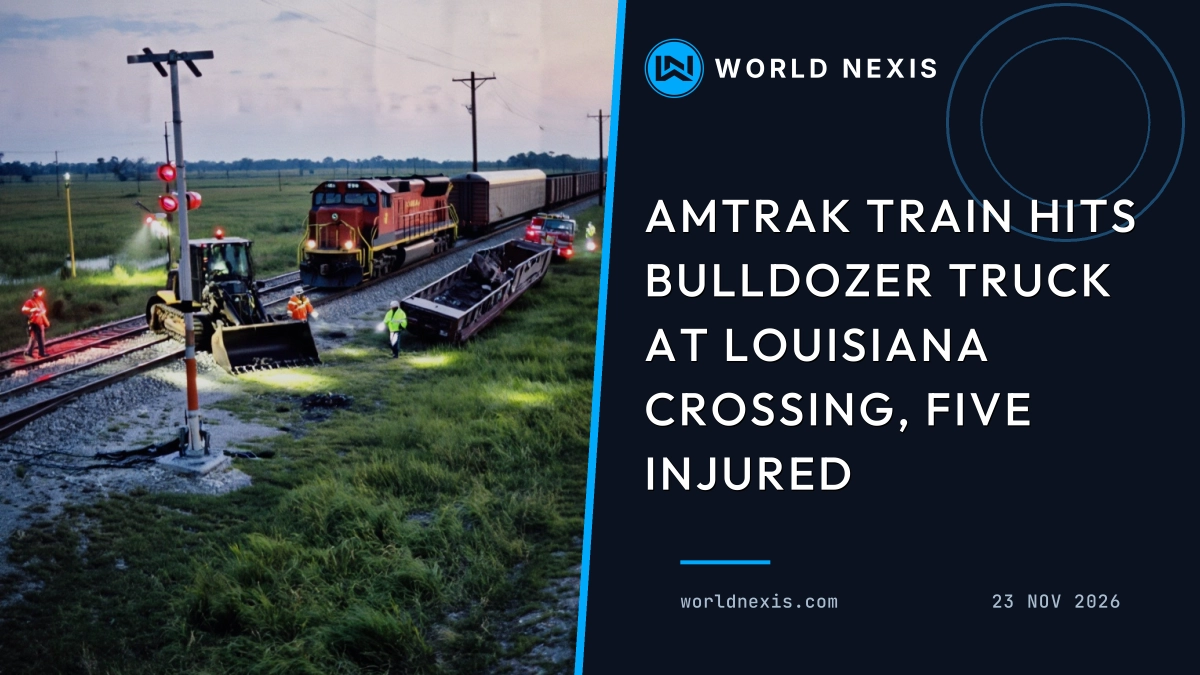
An Amtrak derailment east of Lafayette, Louisiana, has left five people injured and forced 95 passengers to finish their journey by bus after their train struck a tractor-trailer hauling a bulldozer at a railroad crossing on Sunday evening. The lead locomotive and two baggage cars left the track, though every passenger car stayed upright.
Nearly a day after the Lafayette train crash, the story has shifted from the wreckage to two quieter questions: why a loaded truck came to a halt on the crossing, and how much warning anyone could realistically have given the train.
Key points
- Five people were injured, and four were taken to an area hospital with injuries police said were not life-threatening.
- The collision happened on Sunday evening when the train hit a tractor-trailer carrying a bulldozer.
- Lafayette Police Sgt. Ashley Wood said the truck tried to cross the tracks, became stuck and was struck minutes later.
- Burlington Northern Santa Fe responded to the scene to investigate the cause.
What the Amtrak derailment looked like on the ground
Wood, speaking to reporters at the crossing, said the tractor-trailer attempted to pass over the tracks and became stuck. Within a few minutes the guard arms came down because a train was approaching. “The train appears to have attempted to slow but was unable to stop prior to impact,” she said.
“The lead locomotive and two baggage cars derailed,” Wood said. “All passenger cars remained upright.”
She said the crash happened at about 6:05 p.m. Images from the scene showed a rail car standing in an adjacent field, upright but angled away from the line. The bulldozer lay on its side beside the track with large sections torn apart, and emergency crews could be seen helping passengers down from the train.
Passengers, injuries and the Amtrak derailment investigation
The Lafayette Fire Department said 95 passengers were on board and that firefighters helped them off once it was safe to do so. The passengers were then moved onward by bus in an operation coordinated by Amtrak, police said.
Lafayette Mayor-President Monique Blanco Boulet posted on social media that only minor injuries were reported. Triage teams treated other injured passengers at the scene, authorities said.
Attention now turns to the truck at the center of the Amtrak derailment. Burlington Northern Santa Fe sent teams to the crossing to investigate, and police said it was not immediately clear what caused the tractor-trailer to become stuck between the rails.
Why it matters
For the 95 people on board, the effect was a night of disruption: a sudden stop, a climb down from the cars and a bus ride in place of a train journey. For anyone who uses a level crossing, the Amtrak derailment is a reminder that the danger is rarely the train alone.
Railroad crossing safety depends on the road user clearing the tracks before the barriers drop. A heavy, low-clearance vehicle that stalls leaves a window of minutes at most, and warning equipment is built to stop traffic entering, not to drag a stranded truck clear.
The numbers make the stakes plain. One stalled truck put 95 people at risk at once, and the reason casualties stayed low is that every passenger car stayed upright when the locomotive and baggage cars left the track. A level crossing packs a highway hazard and a rail line into the same few meters of ground.
Analysis
Having covered emergency response for World Nexis News, I look first at the gap between a hazard appearing and the warning system reacting. On the police account of the Amtrak derailment, that gap was minutes: the truck stalled, the barriers came down as the train approached, and the crew braked but could not stop in time.
That leads me to a clear view. The facts as we have them on the Amtrak derailment support the reading that this was a road-side failure rather than a rail one, a vehicle that should never have come to rest on the track and a warning sequence that did the job it was built for. The most useful thing investigators can produce is an answer on why the truck stalled and whether anything about that crossing made it more likely.
The strongest counter-argument concerns speed and approach: some will argue that trains running through populated areas should move more slowly so that a stranded vehicle is less likely to be hit hard. That has force as a longer-term argument and I would not dismiss it. It does not, though, explain this crash, and a lower speed limit would not have kept that bulldozer upright.
What happens next
The immediate work belongs to investigators. Burlington Northern Santa Fe is examining the crossing, and the first finding passengers and nearby residents should watch for is a stated cause for the truck stopping where it did. Until then, nothing about the crossing’s design or the train’s approach can be ruled in or out.
For the four people taken to hospital after the Amtrak derailment, the next step is recovery; police have released no further detail beyond describing their injuries as not life-threatening. The rest of those on board have already been moved on by road.
What we don’t know yet
- Why the tractor-trailer became stuck on the crossing.
- The current condition of the four people taken to hospital.
- Whether the railroad will recommend changes at the crossing once its investigation concludes.
Related coverage
- Delta flight delays hit 3,500 flights as Atlanta hub stalls
- Tate extradition: brothers say accusers’ anonymity leaves ‘hands tied’
- Medicare for All is back with a 2033 funding warning
Further reading
- Train derailment injures multiple people, sends 4 to hospital in Louisiana
- Train derailment injures multiple people, sends 4 to hospital in Louisiana
About the author: Tariq Al-Mansoori is the Breaking News Reporter at World Nexis News (WNN), covering breaking news. The analysis section reflects the writer’s view.

Tariq Al-Mansoori
Tariq Al-Mansoori is a Breaking News Reporter at World Nexis News, covering major incidents, official statements and developing stories across the UK, US and internationally. Based in London, he works to confirm details before publication, attributes information to named sources where possible and updates stories…



