Victims commissioner warns of crisis in 6,000-victim survey
Victims commissioner Claire Waxman warns she may tell crime victims there is no point reporting, as a 6,000-victim survey finds the system in crisis.
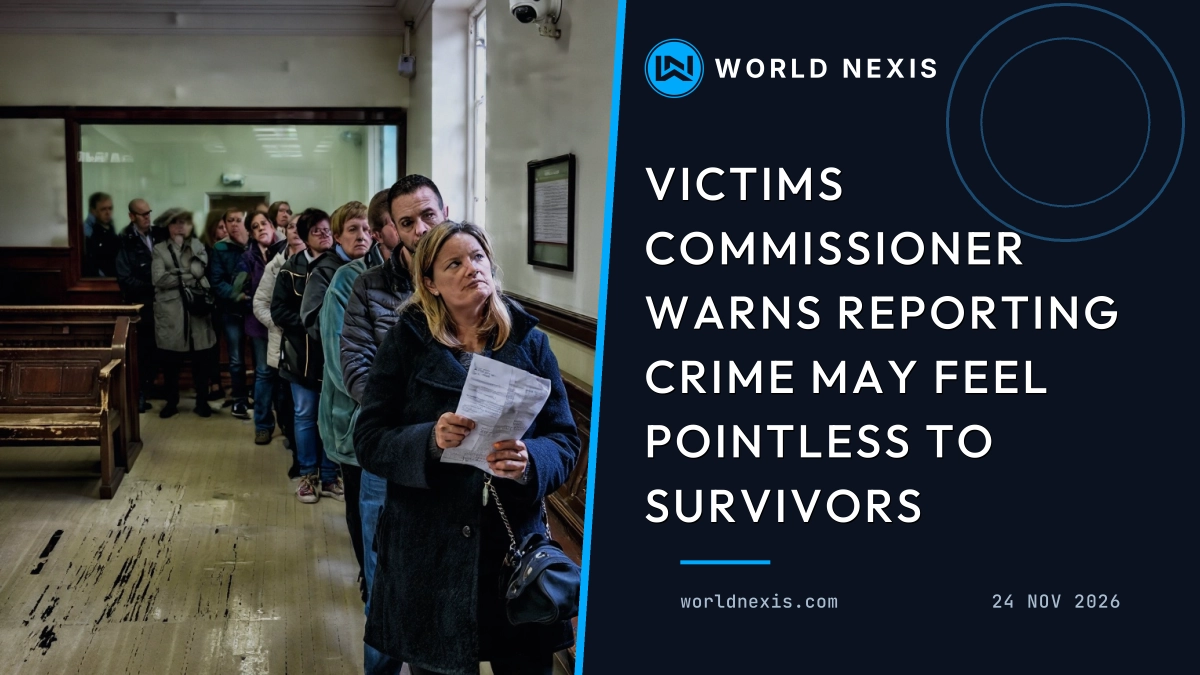
Victims commissioner Claire Waxman has warned she may have to tell the public there is no point reporting crime unless the justice system is overhauled, after a survey of 6,000 victims found people are being failed at every stage of the process. The Victim Survey 2026 describes a system in crisis, marked by poor police communication and unprecedented court delays.
It lands as 5,000 prisoners are scheduled to be released early in stages over the next year to ease overcrowding behind bars, adding to the anxiety of the people they harmed.
Key points
- Almost a third of victims (28%) chose not to report a crime, including 38% of black victims and 45% of Asian victims.
- Some 46% were dissatisfied with police communication, and 85% of that group said they would not report a crime again.
- 47% of victims whose case reached the crown court had a hearing postponed.
- Only 14% knew their rights under the Victims’ Code, and less than a quarter were referred or self-referred to support services.
What the Victim Survey 2026 found
The report, one of the largest of its kind, heard from 6,000 victims and paints a picture of a fragmented process in which people carry the burden of navigating the system alone. Poor communication undermines confidence, it says, and delays add years of anxiety to trauma that already exists.
It recounts cases in which victims had to chase the police for every update on their own case. One rape victim was told at 5.15pm on a Friday that her trial would begin the following Monday morning.
The victims commissioner said the findings carry a clear message. “Victims are still being let down by a criminal justice system that too often treats them as an afterthought,” she said. “Victims should not have to battle the very system that is meant to protect them.”
Victims commissioner calls for an end-to-end review
In an interview, the victims commissioner said the criminal justice system had been “underinvested” and “mismanaged” for many years. “It can’t continue,” she said, warning that otherwise she would have to be “very honest and open with victims publicly to say there’s no point coming forward and reporting”.
She is calling for an urgent end-to-end review of a victim’s journey through the system, from the first report to the end of any sentence. “After more than a decade of decline, the cracks in the system are too deep to paper over,” she said.
Ms Waxman also said the Prime Minister, Andy Burnham, should make justice reform central to his 10-year plan for Britain, arguing that public confidence depends on it.
Ministers say they inherited a broken system
Victims minister Alex Davies-Jones said she accepted how many people had been let down. “I know that far too many victims have felt unsupported by the criminal justice system or faced lengthy delays to get justice, which is why we are doing everything we can to fix the broken system we inherited,” she said.
She said the government had taken office with a growing court backlog and prisons “almost full to the brim”. The early release programme is intended to relieve that pressure, although the victims commissioner has said the staged releases add to victims’ anxiety.
Why it matters
For anyone who reports a crime, the practical effect is uncertainty: fewer updates, later hearings, and in many cases a decision to walk away. That reaches beyond individual cases, because a system that loses victims also loses the accounts and evidence needed to convict the people who caused the harm.
The early release of 5,000 prisoners over the coming year sharpens the point. Victims who already feel ignored will now watch offenders leave custody sooner, and the victims commissioner warns that trust, once lost, is difficult to rebuild.
Analysis
Having covered public services for World Nexis News, I look first at the number buried halfway down the survey: 85% of victims who were unhappy with police communication said they would not report a crime again. I think that single figure is the strongest argument in this row, because it turns what ministers might treat as a service complaint into a public safety problem.
The government’s counter-argument deserves a hearing. Ministers inherited a court backlog and prisons close to capacity, and releasing prisoners early is a safety valve rather than a policy of choice. But that explains why the system is strained, not why a victim still has to ring a force repeatedly to find out what is happening in their own case.
The risk I would flag to readers is that “review” becomes the word ministers use to postpone decisions. A review only counts if it has a deadline, a named owner and money attached to the support services that fewer than a quarter of victims reached. On the evidence here, the victims commissioner’s case is better made than the government’s defence.
What happens next
The victims commissioner will press for her end-to-end review to be adopted as part of the government’s 10-year plan for Britain. In the meantime, the early release scheme continues in stages over the next year, with 5,000 prisoners due to leave custody.
What we don’t know yet
It is not yet clear whether ministers will commission the review, what timetable it would follow, or how they intend to show that communication with victims has improved. The survey also leaves open what share of the 28% who did not report were deterred by the process itself.
Related coverage
- Economic revolution needed, Badenoch warns CBI chiefs
- Stormont budget: O’Neill seeks PM crisis talks on £1.5bn
- Andrew £750,000 bribe claim heard at High Court trial
Further reading
- Victims’ Commissioner demands justice reform or ‘no point’ reporting crimes
- Victims’ Commissioner demands justice reform or ‘no point’ reporting crimes
About the author: Liam O’Connor is the UK Politics Reporter at World Nexis News (WNN), covering uk politics. The analysis section reflects the writer’s view.

Liam O'Connor
Liam O'Connor is UK Politics Reporter at World Nexis News, covering Westminster, devolved politics and the issues that matter to voters across England, Scotland, Wales and Northern Ireland. Based in London, he reports from primary sources — Hansard, official statements, published data — and explains…



