Pope Francis diary: three devil visions and a power crisis
The Pope Francis diary, published by the Vatican, reveals three visions of the devil, a 2021-22 spiritual crisis and shame over the Chile abuse scandal.
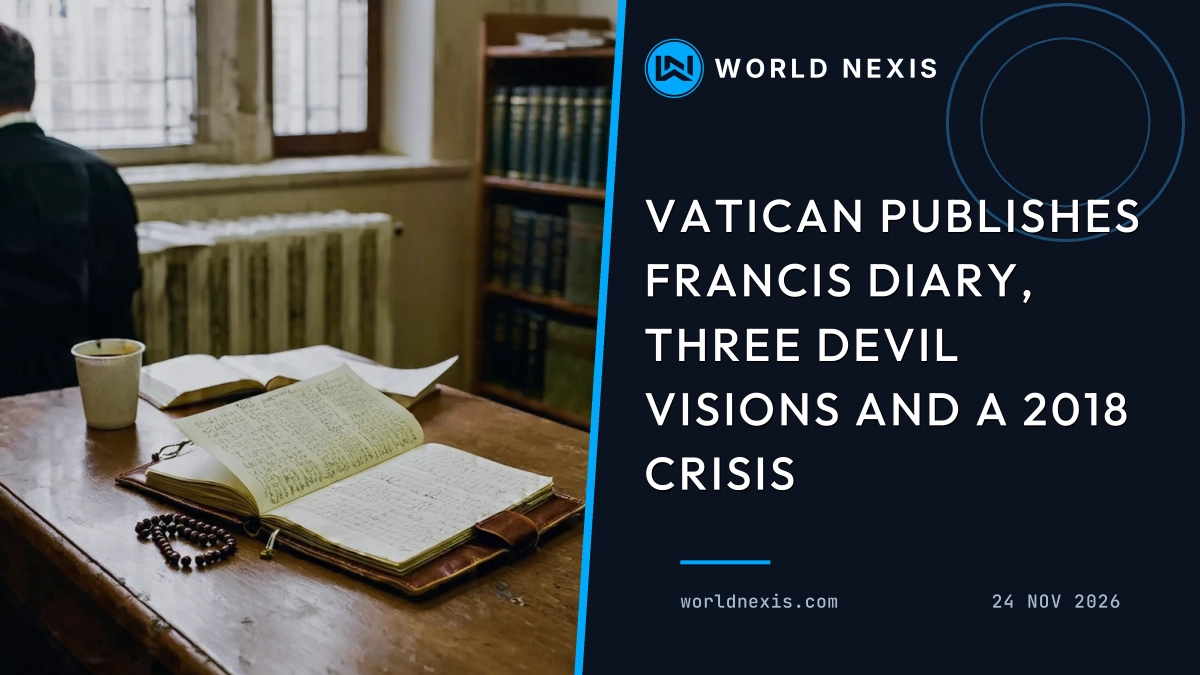
The Pope Francis diary, released by the Vatican on Tuesday in several languages, runs from 1992 to 18 August 2024 and records three encounters with the devil, one of them dated to the clergy sexual abuse scandal. The book also discloses a spiritual crisis across 2021 and 2022, which the late pope tied to his own temptation to exercise power without limit. Francis died in April 2025, aged 88, after 12 years leading the Catholic Church.
Key points
- The Pope Francis diary covers 32 years of entries, starting when Jorge Mario Bergoglio was auxiliary bishop of Buenos Aires.
- He describes three visions of the devil: two in Argentina and a third days after his 2018 trip to Chile.
- He wrote of seeing the gates of hell once he grasped the scale of the abuse scandal.
- Cardinal Víctor Manuel Fernández curated the book and is listed as its author.
What the Pope Francis diary says about the devil, Chile and power
Francis treated the encounters as interruptions rather than metaphors. Two came while he was archbishop of Buenos Aires. The third arrived in Rome, days after he flew home from Chile in January 2018. “I saw him and heard his voice, triumphant, possessing everything,” he wrote. “Just as I can’t forget his eyes from the previous two, in this case, I can’t forget the powerful raspiness of his voice.”
Chile is the hinge of the book. On that trip he discredited victims of the country’s most notorious abuser, and the uproar that followed forced him to order an inquiry. The inquiry convinced him the victims had been right and that the Chilean hierarchy had misled him. “It was hard for me to admit what happened in Chile; I didn’t think it was so serious,” he wrote, describing himself as devastated by the exchange with journalists on the flight home.
Months later, in June 2018, he recorded that he had seen the gates of hell. The diary keeps returning to the image as the scandal deepened, with entries on the shame and the evil it brought on the church.
The diary lists where each encounter happened, from a car to a choir loft during Mass, and Francis writes that he could not forget the devil’s eyes. Those are the passages that will be quoted most. They are also the ones no reader can check.
A crisis about power
The later pages describe a crisis that began in 2021 and lasted about two years. The book presents it as a struggle with his own desire for control, and says he came through it by entrusting himself entirely to God’s mercy. The tone is harsh throughout, with passages on worthlessness and shame sitting beside his account of the abuse years.
How the Pope Francis diary was assembled and cleared
Cardinal Víctor Manuel Fernández, head of the Vatican’s doctrine office and one of Francis’s closest aides, curated the material. His commentary frames the entries, which is why he is credited as author. The raw text is a leather-bound calendar used as a notebook, carried from Buenos Aires to Rome and filled across four decades.
According to the book, Fernández raised with Pope Leo XIV his fear that the manuscript would be “left forgotten in some storage”. He was allowed to publish, he writes, because the spiritual concerns in Francis’s heart “are very clear and can do us good”. The permission of Francis’s successor is the reason readers outside the Vatican archive can now see the entries at all.
Why it matters
For abuse survivors and for ordinary Catholics, the value of the Pope Francis diary is not the supernatural detail. It is the paper trail. A pope concedes in his own hand that he misjudged victims, that he was slow to see the problem, and that the scandal reached further than he wanted to believe. That concession is now permanent, and it will be quoted in every argument about safeguarding, compensation and access to church records.
For the institution, the book tests how much of a pope’s interior life the Vatican is willing to expose. Leo XIV let these passages out. That choice shapes how the Francis archive will be handled, and how his record on abuse will be judged while his successor governs.
Analysis
Having spent four years covering the Vatican as a diplomatic actor for World Nexis News, I look first at what a document like this does to the church’s standing, not at whether the devil can be photographed. On the evidence in the book, publication is the right call. The visions cannot be verified and never will be. The Chile admission can be checked, and it contradicts the line Francis took in 2018, when he discredited the victims and defended a bishop.
The strongest counter-argument is that a dead man’s private fears should stay private, and that a global release risks turning spiritual struggle into spectacle. I take that seriously. But the Pope Francis diary does not only contain visions. It contains an admission of institutional failure that survivors have spent years requesting, written by the man who ran the church, and burying it would have protected the institution rather than the people it harmed.
What I will watch is whether the Chile pages survive the news cycle. My expectation is that the devil material travels further, because it is stranger, while the admission that he was misled does the heavier work inside the church. If Leo XIV wants reform to outlast his predecessor, those are the pages that matter.
What happens next
The book is on release now in several languages with Fernández’s commentary attached, so the extracts will circulate far beyond Rome. Because the last entry is dated 18 August 2024, the record stops about eight months before Francis died. The final stretch of his papacy, and the handover to Leo XIV, sit outside the text.
What we don’t know yet
- Whether the Vatican intends to publish the entries that did not make the book.
- Whether survivors’ groups will cite the Chile passages in campaigns for accountability.
- Whether Leo XIV will comment publicly on the decision to release them.
Related coverage
- Victims commissioner warns of crisis in 6,000-victim survey
- Stormont budget: O’Neill seeks PM crisis talks on £1.5bn
- Congo mining lawsuit: 27 residents sue over toxic pollution
Further reading
- Pope Francis’ diary reveals claims he saw the devil three times
- Pope Francis had visions of the devil and
About the author: Marcus Ellington is the International Correspondent at World Nexis News (WNN), covering world affairs. The analysis section reflects the writer’s view.

Marcus Ellington
Marcus Ellington is International Correspondent at World Nexis News, reporting on diplomacy, conflict and the political forces reshaping Europe, the Middle East, Asia and the Americas. Based in London, he focuses on explaining why events unfold as they do, using official statements, diplomatic documents and…



