Congo mining lawsuit: 27 residents sue over toxic pollution
Twenty-seven Kolwezi residents have filed a Congo mining lawsuit against a Chinese-owned copper and cobalt mine and the state, alleging toxic pollution.
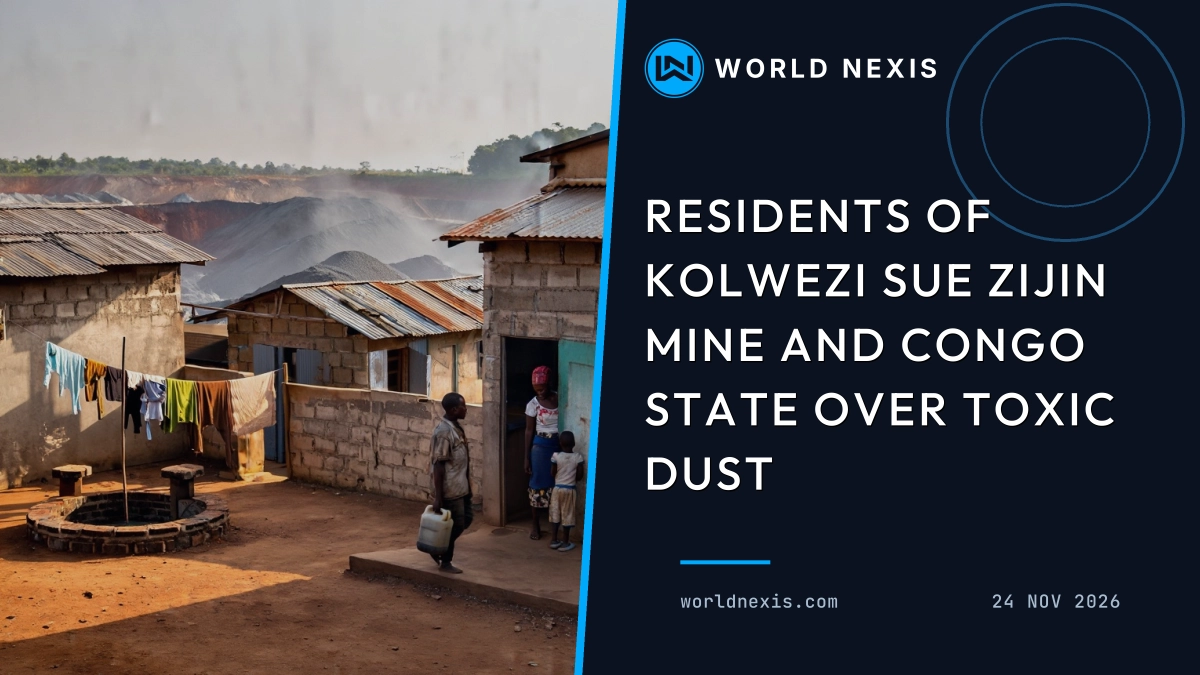
Twenty-seven residents of Kolwezi have filed a Congo mining lawsuit against a Chinese-owned copper and cobalt mine and against the Congolese state, alleging that pollution from the operation has poisoned their community and that officials failed to enforce environmental rules. The case opened in court on 3 November in the Democratic Republic of Congo, the world’s second-largest copper producer and the source of more than 70% of global cobalt.
The mine at the centre of the claim is COMMUS, owned by the Chinese multinational Zijin. It sits in Kolwezi, a city of more than 500,000 people in the heart of the country’s southern copper belt.
Key points
- Twenty-seven Kolwezi residents have brought a Congo mining lawsuit against Zijin’s COMMUS mine and the Congolese government.
- The plaintiffs describe contaminated water, nosebleeds, skin rashes, miscarriages and birth defects, which they blame on the mine.
- A study published in June recorded PM2.5 levels three to six times the World Health Organization guideline, with the highest readings near COMMUS.
- The study did not measure health effects directly, and its authors called for formal epidemiological research.
Inside the Congo mining lawsuit
The claim names COMMUS as the source of the contamination and accuses the government of failing to police it. Open-pit operations have spread into residential areas, leaving industrial pits pressed against homes and mine tailings within sight of front doors.
Plaintiffs describe a shared pattern of harm: dirty water, repeated nosebleeds, skin rashes, miscarriages and children born with defects. They attribute all of it to dust and water leaving the neighbouring operation.
One claimant, a mother living in a small cinderblock home in the scrub beside the mine, has lost three children. Two died at birth. A third suffered repeated nosebleeds before dying. One of her two surviving children has stunted growth.
“Our children are the first victims. What we’re hoping for is to see justice done.”
Like the other claimants, she asked not to be identified, fearing retaliation from the company or from officials. Their names appear in court documents, but their lawyers also worry about intimidation from other residents.
The suit against the state is the unusual half of the case. It argues that regulators have the powers and the duty to enforce Congo’s environmental rules, and have not used them.
What the Kolwezi pollution study found
Researchers from the environmental organisation Source International, working with the advocacy groups RAID and Afrewatch and scientists from the University of Lubumbashi, measured air quality across the city for a study published in June. They found fine particulate matter, known as PM2.5, at three to six times the World Health Organization’s air quality guideline. The highest concentrations were recorded near the COMMUS mine.
The team also tested dust samples and found residues of copper, cobalt and manganese, which they said pointed to mining waste as the main source. Residents near the pits describe an acrid smell that they link to the sulphuric acid used to process minerals.
Flaviano Bianchini, Source International’s executive director, said the readings stood out from years of monitoring: “These are among the most concerning air quality results we have documented in years of monitoring pollution at industrial mining sites around the world.”
PM2.5 particles are small enough to travel deep into the lungs and into the bloodstream. Exposure is considered especially dangerous for pregnant women and young children.
The health evidence is not yet complete
The June study did not examine health outcomes directly. Its authors recommended formal epidemiological research before any link between the mine and specific illnesses could be established. That gap is likely to shape the argument in court.
Why it matters
Copper and cobalt from this corner of Congo end up in rechargeable batteries, including those inside electric vehicles sold in Europe and the United States. Cobalt mine pollution has drawn comparatively little scrutiny given the metal’s strategic value, so buyers who assume a clean supply chain are leaning on exactly the enforcement the plaintiffs say has failed.
The Congo mining lawsuit also tests a wider promise. Last year Washington signed an economic partnership with Kinshasa aimed at attracting American investment and challenging the dominance of Chinese companies in Congolese mining. A credible legal route for polluted communities is now part of what investors and buyers will watch.
For households in Kolwezi, the stakes are narrower and more immediate: water, air and medical care. A ruling that forces testing or cleanup would change daily life faster than any international pledge.
Analysis
Having covered global trade and sanctions for World Nexis News, I look first at leverage rather than at verdicts. In my view the strongest part of this Congo mining lawsuit is not the medical claim but the administrative one: 27 people are asking a Congolese court to state plainly that the state did not do its job. If that argument lands, it shifts the bargaining position of every community living beside a pit.
I side with the plaintiffs on that point. The June data, with PM2.5 at three to six times the WHO guideline and peak readings beside the COMMUS fence line, is hard to wave away, and “we did not test for that” is not a defence an operator should want to rely on. The fairest counter-argument is that no epidemiological study yet ties this mine to these particular birth defects, and a court may reasonably refuse to make that leap on the evidence available.
That is precisely why the outcome travels. Battery buyers and Western governments now speak constantly about responsible sourcing, and a court ruling will define what the phrase means far more sharply than another voluntary pledge.
What happens next
The court in Kolwezi has begun hearing the case, which opened on 3 November. No date has been announced for a ruling.
What we don’t know yet
Several questions remain open. It is not clear whether the court will commission independent air or water testing, or how long the proceedings will run. Whether the case produces its own epidemiological study, rather than resting on the June monitoring, is also unresolved.
Related coverage
- Australia US alliance: Wong warns against abandoning ties
- Battery manufacturing warning over Australia’s minerals
- Pentagon fact sheet: Canada’s NATO gap and what comes next
Further reading
- Bleeding, birth defects: Congo residents sue over alleged mining pollution
- Bleeding, birth defects: Congo residents sue over alleged mining pollution
About the author: Marcus Ellington is the International Correspondent at World Nexis News (WNN), covering world affairs. The analysis section reflects the writer’s view.

Marcus Ellington
Marcus Ellington is International Correspondent at World Nexis News, reporting on diplomacy, conflict and the political forces reshaping Europe, the Middle East, Asia and the Americas. Based in London, he focuses on explaining why events unfold as they do, using official statements, diplomatic documents and…



