Pentagon fact sheet: Canada’s NATO gap and what comes next
The Pentagon fact sheet accuses Canada of falling short on NATO spending and readiness, days after Pete Hegseth's memo curbed military cooperation.
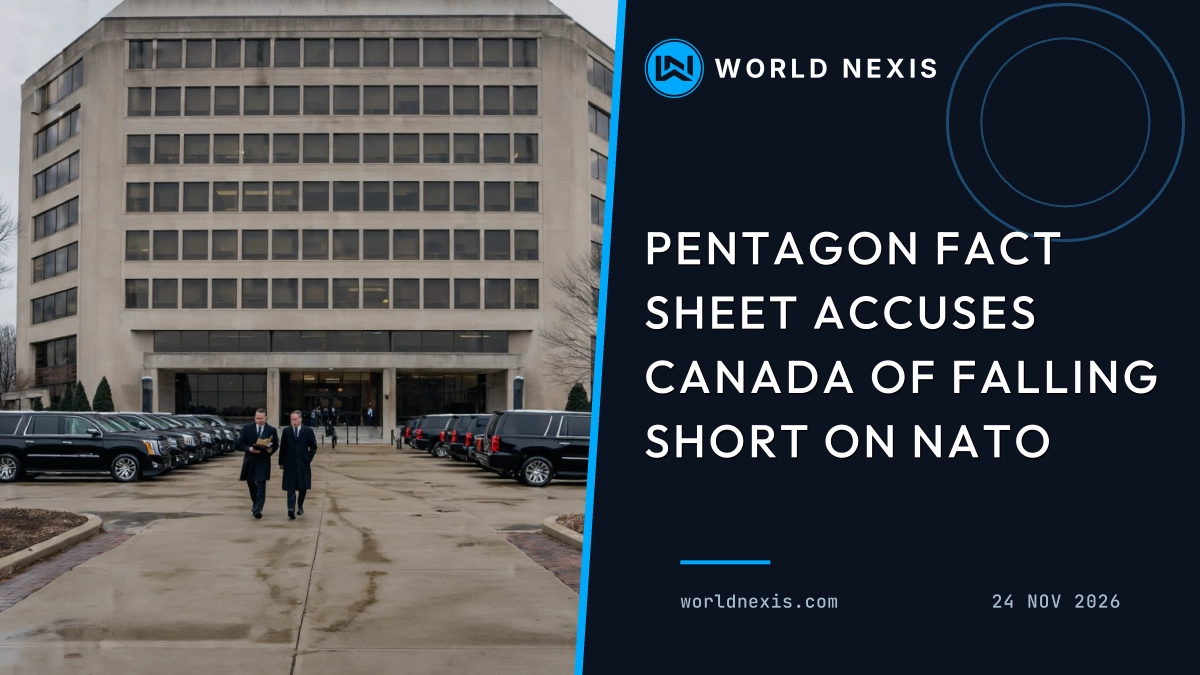
The Pentagon fact sheet released publicly on Monday accuses Canada of falling short as a credible partner in the defense of North America, warning that Ottawa has not made the hard decisions and tradeoffs its NATO pledge requires. The document cites readiness gaps across air, land and sea operations, and it arrives while the two countries’ Permanent Joint Board on Defense, established in 1940, remains paused.
Defense Minister David McGuinty’s office had not responded to a request for comment on the Pentagon fact sheet. That leaves his weekend assessment, given at the Halifax International Security Forum, as Ottawa’s only public position: he described relations between the two militaries as “business as usual” and said cooperation on defense, security and intelligence was continuing.
Key points
- The Pentagon fact sheet says Canada has yet to make the tradeoffs needed to meet its NATO Defense Investment Pledge.
- It points to operational readiness deficits in air, land and sea operations and criticizes Canadian leaders for favoring commercial interests over military optimization.
- A classified memo from Defense Secretary Pete Hegseth restricts cooperation on think-tank events and social engagements; Republican Sen. Mike Rounds says military operations are unaffected.
- The Pentagon paused the Permanent Joint Board on Defense, created in 1940, in May to reassess the forum, and Washington says Ottawa has not delivered a credible response on shared continental defense.
What the Pentagon fact sheet says about Canada
The Pentagon fact sheet does not soften its language. It states that Canada has not made the hard decisions and tradeoffs needed to become a credible partner in the defense of the shared continent, and it frames the shortfall as a choice rather than an accident of geography or budget cycles.
It denounces Canadian political leadership for pursuing what it calls parochial economic and commercial interests over military optimization. The summary line that follows is equally direct.
“Canada’s defense shortfalls speak for themselves. Canada must get serious and focused.”
The document also accuses Canada of leaving American taxpayers to shoulder the burden of continental defense, and the criticism reaches into Ottawa’s reconsideration of American-made F-35 fighter jets. On the Pentagon’s account, it has engaged Canada on NORAD and NATO since 2025 without the procurement and spending decisions it considers necessary.
A classified memo, a paused board and a widening rift
The Pentagon fact sheet is the second stage of a pressure campaign that began behind closed doors. Hegseth issued a classified memo last week which, according to Rounds, largely restricts officials’ participation in Canadian think-tank events and social engagements.
Speaking to reporters at the Halifax International Security Forum on Saturday, Rounds said the move would not affect military operations. Chief Pentagon spokesperson Sean Parnell said the department is “taking steps to ensure its engagements with Canada advance tangible U.S. defense objectives and ultimately support a reinvigorated defense relationship.”
The pattern is not new. In May, undersecretary of defense for policy Elbridge Colby announced a pause in the Permanent Joint Board on Defense, the advisory body set up in 1940, saying the department needed to reassess how the forum benefits shared North American defense. A senior U.S. defense official said at the time that Washington had given Ottawa a classified paper setting out priorities for continental defense and received no credible response.
The timing of the release carries its own message. The Halifax gathering produced unusually open criticism of Washington: its president, Peter Van Praagh, warned on Friday that the United States can no longer be counted on as a predictable leader of the democratic world.
Why it matters
For American readers, the dispute is about money and risk. The Pentagon argues that U.S. taxpayers are underwriting a continental defense Canada should share, and that gaps in Canadian readiness become American gaps the moment NORAD tracks a threat over the Arctic.
For Canadians, the consequences are industrial as well as military. The F-35 review sits at the centre of the argument, because the choice between American aircraft and other suppliers shapes both capability and how smoothly Canadian forces operate alongside U.S. units. Every allied government currently weighing Canada defense spending is watching how Washington treats a partner that hesitates.
Analysis
Having covered alliance management for World Nexis News, I look first at what a document like this is built to do, not only at what it says. On substance, the department’s complaint is better supported than Ottawa’s reassurance. “Business as usual” is hard to defend when a bilateral board dating to 1940 is paused, a classified memo is restricting contact, and a public accounting lists readiness deficits across all three services.
Where I part company with the Pentagon is the method. Rounds is right that military operations are unaffected, and that is exactly the problem: if the Hegseth memo touches only think tanks and dinners, it is political signalling rather than a change in defense posture. Scolding an ally for parochial commercial instincts rarely accelerates a single procurement decision, and it hands Canadian politicians a sovereignty argument to hide behind. The strongest counter-argument is that quiet diplomacy has already failed, since the board was paused in May and Washington says the decisions still have not been made.
My reading is that the readiness criticism is fair and Canada should answer it with numbers rather than adjectives. The pressure campaign wrapped around that criticism, however, is a bet that embarrassment beats cooperation, and nothing published so far shows the bet working.
What happens next
The immediate next step is a Canadian response. McGuinty’s office has not commented on the Pentagon fact sheet, and ministers will now be asked whether “business as usual” still describes a relationship with the department that underwrites continental defense.
Beyond that, three things are worth watching: whether the restrictions in Hegseth’s memo stay confined to think-tank events and social engagements, whether the Permanent Joint Board on Defense is reconvened, and how Canada resolves its F-35 review. The Pentagon says its aim is a reinvigorated defense relationship advancing tangible U.S. objectives, a standard Canada will now have to meet in public.
What we don’t know yet
No deadline has been set for Canadian action, and the full text of the classified memo has not been published. It is also unclear whether the Pentagon fact sheet changes any operational arrangement, or whether its practical effect is as limited as Rounds’s assessment implies.
Related coverage
- Next cyber attack: retailer warns over supplier data breach
- Fit to Lead report: 71% of Australian MPs harmed by job
- Russian warship sunk by 7 drones in major Libya strike
Further reading
- Pentagon criticizes Canada in ‘fact sheet’ after Hegseth memo
- Pentagon criticizes Canada in ‘fact sheet’ after Hegseth memo
About the author: Marcus Ellington is the International Correspondent at World Nexis News (WNN), covering world affairs. The analysis section reflects the writer’s view.

Marcus Ellington
Marcus Ellington is International Correspondent at World Nexis News, reporting on diplomacy, conflict and the political forces reshaping Europe, the Middle East, Asia and the Americas. Based in London, he focuses on explaining why events unfold as they do, using official statements, diplomatic documents and…



