Russian warship sunk by 7 drones in major Libya strike
A Russian warship was sunk by seven Ukrainian drones at Benghazi, Zelensky said, as Libya's rival governments warn against foreign forces using its ports.
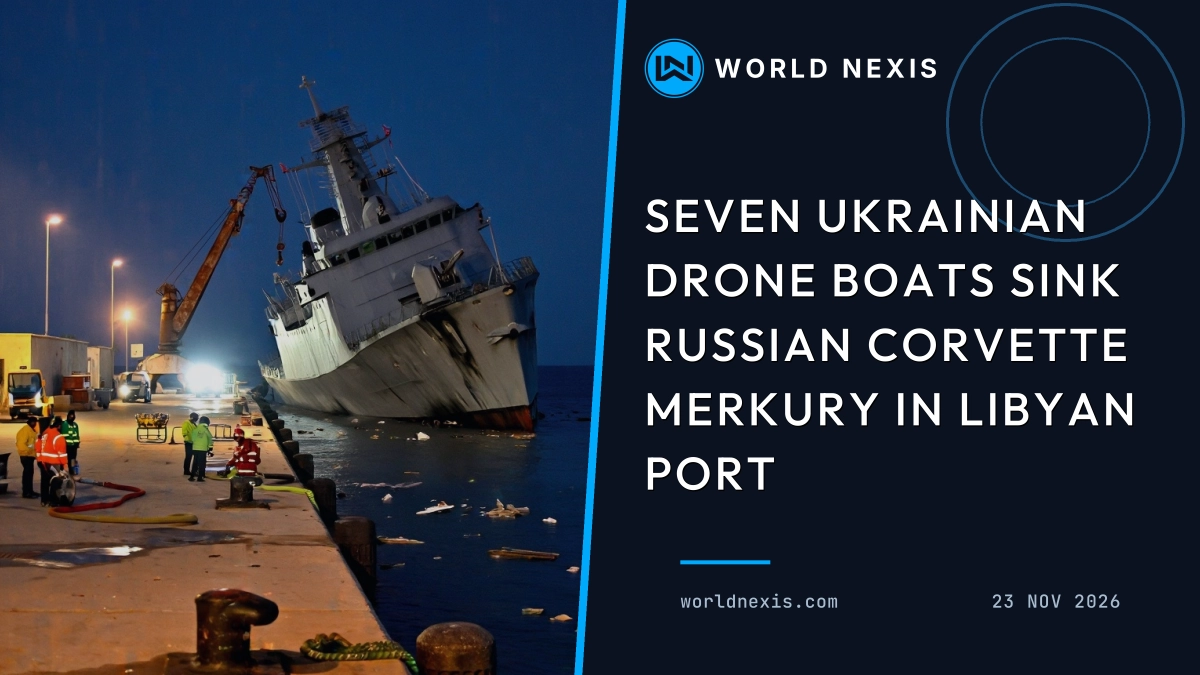
A Russian warship was sunk at Benghazi on Sunday by seven Ukrainian naval drones. President Volodymyr Zelensky confirmed the operation on Monday, calling it an “exemplary Ukrainian operation in response to Russia’s war”. The corvette Merkury was commissioned in 2023 and went down in a Libyan port more than 2,000 km from Moscow.
Zelensky said the dry cargo carrier MV Angara, which he described as a weapons transport ship, was also hit, and that a Ka-27 combat helicopter was destroyed. He said he had received detailed briefings on Sunday and Monday and that “the targets we set were achieved”.
Key points
- Seven Ukrainian-made naval drones sank the Russian warship Merkury at Benghazi naval base, according to Zelensky.
- The MV Angara was also struck, and a Ka-27 helicopter was destroyed, he said.
- Libya’s eastern government says the ship had stopped for fuel and supplies on its way back to Russia, and condemned the attack on its sovereignty.
- The United Nations mission in Libya has called for an immediate, independent and transparent investigation.
How the Russian warship was sunk at Benghazi
Video and satellite imagery showed the ship engulfed in flames and smoke in the early hours of Sunday. Later images showed most of the hull capsized and submerged, with only the forward bow above the water.
Zelensky said the Russian warship was one of Moscow’s newest vessels and that the drones broke through “despite all the enemy’s efforts to counter the attack”. Libyan military officials gave a different account of the engagement, saying two explosive-laden sea drones struck the ship while at least four others were intercepted.
The Ukrainian leader said his forces would keep operating in “designated waters”. “We are responding to Russia’s aggression. We are developing Ukrainian weapons,” he said.
Libyan medical sources said about ten people, among them Russian and Libyan nationals, were treated for minor injuries. The eastern health ministry said it had received injured people from a commercial ship targeted off the port, though it is not yet clear whether that vessel was the Angara.
What the Russian warship sinking means for Libya’s two governments
Libya has been divided since the 2011 uprising that toppled Muammar Gaddafi, leaving a UN-supported government in Tripoli and a rival administration in the east. Benghazi sits in the east, where the Government of National Stability said the Russian warship had stopped for fuel and supplies on its way home.
That administration said the vessel was using the port under an existing maritime agreement, and that the incident is under investigation in coordination with Russian counterparts. It condemned an attack inside a Libyan port as a violation of maritime safety and of Libyan sovereignty, insisting Libya is not a party to the Russia-Ukraine war.
In Tripoli, the internationally recognised Government of National Unity warned against hosting foreign forces and allowing them to use Libyan facilities. It said such activity raises “serious fears” about involving ports and civilian facilities in external conflicts, and about the threat to citizens’ lives and national assets.
The UN Support Mission in Libya said it was seriously concerned and warned that “Libya cannot afford, and must not become a battleground for foreign conflicts”. In March, Russia accused Ukraine of attacking the tanker Arctic Metagaz in the Mediterranean between Libya and Malta with sea drones launched from the Libyan coast.
Why it matters
For Libya, the strike turns a long diplomatic balancing act into a live security problem. Ports that host foreign warships become targets, and both administrations are now under pressure to say openly whether foreign militaries may use their territory.
For the region, the Russian warship strike shows Kyiv can reach Russian naval logistics across the Mediterranean, not only in the Black Sea. It also drags a fragile, oil-rich state into a war it says it never joined, at a moment when its two governments are already arguing over sovereignty and foreign basing.
Analysis
Having covered sanctions and maritime logistics for World Nexis News, I look first at what this does to Russia’s ability to move warships and weapons between the Black Sea, the Mediterranean and Africa. I think the facts support Ukraine’s case. The Merkury was a warship heading home from deployment, refuelling at a base used under a deal between Moscow and Benghazi. A warship is a legitimate military target wherever it docks, and permission from one of Libya’s two governments does not make it a civilian asset.
The strongest counter-argument is that Kyiv has now struck inside a third country without its consent, and that the UN’s call for an independent investigation is the correct instinct. That concern is real, and Libyan anger is not manufactured. But leaving Russian naval logistics untouched across the central Mediterranean would only encourage more such arrangements.
What I watch next is whether Benghazi treats the sinking as a reason to loosen or deepen its Russian ties. My reading is that the eastern administration has a maritime agreement with Moscow and little incentive to abandon it weeks after condemning an attack on its own soil.
What happens next
The eastern government says it is investigating the incident with Russian counterparts, while the UN mission wants an independent, transparent inquiry. Zelensky has promised more operations in “designated waters” and more Ukrainian weapons development, so further strikes on Russian shipping cannot be ruled out.
Tripoli’s warning against foreign forces using Libyan facilities is likely to be tested soon, because Benghazi’s maritime agreement with Moscow remains in place. Whether the Russian warship sinking changes that arrangement, or hardens it, is now the central question for Libya’s foreign partners.
What we don’t know yet
- Where the drones were launched. Libyan military officials said an initial investigation indicated a base in western Libya, which Kyiv has not confirmed.
- Whether the injured people received by the eastern health ministry came from the Angara or from another commercial vessel.
- How Moscow will respond, and whether Libya’s two governments move to restrict foreign warships from their ports.
Related coverage
- Benghazi drone strike sinks £150m Russian warship Merkury
- Trump data centre tax: Australia warns of major AI risk
- PIP review: major overhaul to tailor disability benefits
Further reading
- Russian ships hit by Ukrainian drones off Libya coast, Zelensky says
- Zelenskyy says Ukraine responsible for sinking Russian warship in Libya – Europe live
About the author: Marcus Ellington is the International Correspondent at World Nexis News (WNN), covering world affairs. The analysis section reflects the writer’s view.

Marcus Ellington
Marcus Ellington is International Correspondent at World Nexis News, reporting on diplomacy, conflict and the political forces reshaping Europe, the Middle East, Asia and the Americas. Based in London, he focuses on explaining why events unfold as they do, using official statements, diplomatic documents and…