PIP review: major overhaul to tailor disability benefits
The PIP review from Sir Stephen Timms proposes payments matched to claimants' actual costs and fast-track checks for the most severe cases, due on Tuesday.
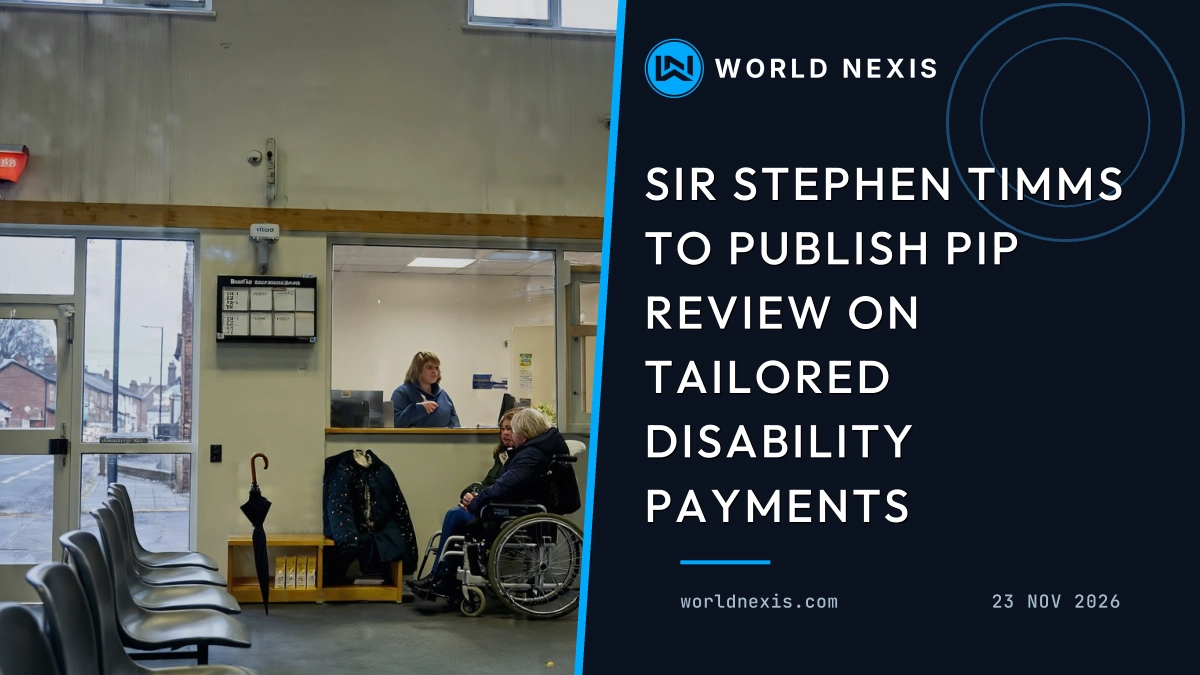
The PIP review will be published as early as Tuesday, with Sir Stephen Timms recommending that disability benefit payments be tailored to each claimant’s actual costs through a “fundamental overhaul” of the assessment process. The government-commissioned report concludes that personal independence payment, known as Pip, had the right aims but is no longer fit for purpose.
Sir Stephen, the social security minister who led the work, has said the system cannot be fixed with minor changes. His final report is expected to set out how a different model would work, and who would qualify for the lighter-touch route.
Key points
- Sir Stephen Timms publishes his final PIP review as early as Tuesday.
- Payments would be matched to the costs a claimant’s disability actually creates.
- About 10% of claimants, those with the most severe conditions, would get a “fast-track”, less burdensome assessment.
- Timms has said Pip had the right aims but needs a fundamental overhaul.
What the PIP review would change
The central proposal moves away from the present standardised payment structure, under which awards are fixed against set criteria. In its place, claimants would face a new “impact” assessment designed to establish the real costs that arise from their disability.
For the roughly 10% of claimants with the most severe conditions, the review proposes a “fast-track” route that is “less burdensome”. That group would be spared the repeat assessments Sir Stephen has criticised.
The two-tier design is the most consequential part of the package. A cost-based assessment for the majority would require far more individual evidence about the day-to-day expense a condition creates, rather than a standardised award applied to everyone who meets the same threshold.
Sir Stephen has been direct about the scale of the change he wants. Writing before publication, he said the system was “no longer fit for purpose” and that Pip, while well aimed, required a fundamental overhaul.
“Someone with a lifelong or degenerative illness should not need regular reassessments which feel adversarial and unnecessary.” — Sir Stephen Timms
Why the PIP review says the checks have failed
Sir Stephen has said Pip’s aims were the right ones. The failure, he argues, lies in the assessment process: standardised questions, repeated reviews, and a procedure that treats a lifelong condition as though it might one day improve.
That diagnosis explains why the answer is a different way of deciding who gets what, rather than simply a higher rate of payment. An impact assessment for most claimants, a fast-track for the most severe cases and fewer repeat tests for people whose conditions will not change are all attempts to repair the machinery.
It also explains the unusual politics of publication day. Sir Stephen is the minister who will have to respond to recommendations he wrote himself, and the department that will have to deliver them sits in his own portfolio.
Why it matters
For claimants, nothing changes on Tuesday. The PIP review is a set of recommendations, not legislation: ministers must decide which proposals to adopt, how to fund them and how fast to move.
The PIP review matters because it accepts that disability creates costs that differ sharply between individuals. If the government follows that logic, the test of a claim shifts from a fixed checklist to a judgement about a person’s circumstances, a change that touches money, independence and the strain of proving a condition again and again.
It also matters because the assessment is often the only sustained contact a disabled person has with the state. Changing how that contact feels is not a technicality, for many households it is the difference between a manageable process and a hostile one.
Analysis
Having covered Westminster and public services for World Nexis News, I read the PIP review less for what it says about compassion and more for what it says about money and machinery. On both counts, Sir Stephen Timms has the stronger argument. His central point, that people with lifelong or degenerative conditions are pushed through reassessments that cannot change the outcome, describes a design fault that extra funding alone cannot repair.
Where I am less confident is delivery. A cost-based impact assessment is only as good as the evidence decision-makers hold and the time they are given to weigh it. Bolted onto the existing assessment machinery, it would reproduce the same adversarial atmosphere with a longer form attached.
The fairest counter-argument is that standardised tariffs are cheap, predictable and hard to game, and that individualised judgments invite inconsistency between regions and decision-makers. That risk is real, and any claimant who receives less than a neighbour with a similar condition will feel it. I still think Timms is right to take it on, because a system that is predictable but wrong is no bargain for the people living inside it.
My expectation is that the Treasury becomes the real constraint. The recommendations that cost little, a fast-track for the most severe cases and fewer repeat reviews, will be adopted quickly. The ones that redistribute money will be consulted on for months, and the claimants who gain will wait longest.
What happens next
The PIP review is expected to be published as early as Tuesday. Sir Stephen will then face questions in his ministerial role about recommendations he authored, and the government will indicate which proposals it intends to take forward.
Publication of the PIP review starts a process rather than ending one. Any change to assessment rules and payment structures has to be designed, costed and written into guidance before a single claimant sees a different award.
What we don’t know yet
The overall cost of the overhaul has not been set out. Nor is it clear whether payments would rise or fall in aggregate, how existing claimants would be moved onto a new Pip assessment, or how quickly a fast-track route for the most severe cases could open.
Related coverage
- Rejoin EU option on table, Miliband says after major deals
- Medicare open enrollment 2027: 4 million face major shift
- Trump data centre tax: Australia warns of major AI risk
Further reading
- Theresa May ‘aghast’ at Burnham’s EU plans and says ‘Brexit is done’
- The looming UK winter may spawn a double headache for Andy Burnham | Richard Partington
About the author: Liam O’Connor is the UK Politics Reporter at World Nexis News (WNN), covering uk politics. The analysis section reflects the writer’s view.

Liam O'Connor
Liam O'Connor is UK Politics Reporter at World Nexis News, covering Westminster, devolved politics and the issues that matter to voters across England, Scotland, Wales and Northern Ireland. Based in London, he reports from primary sources — Hansard, official statements, published data — and explains…



