Benghazi drone strike sinks £150m Russian warship Merkury
The Benghazi drone strike has capsized the £150m Russian corvette Merkury, and Libya's rival governments are warning about foreign forces in their ports.
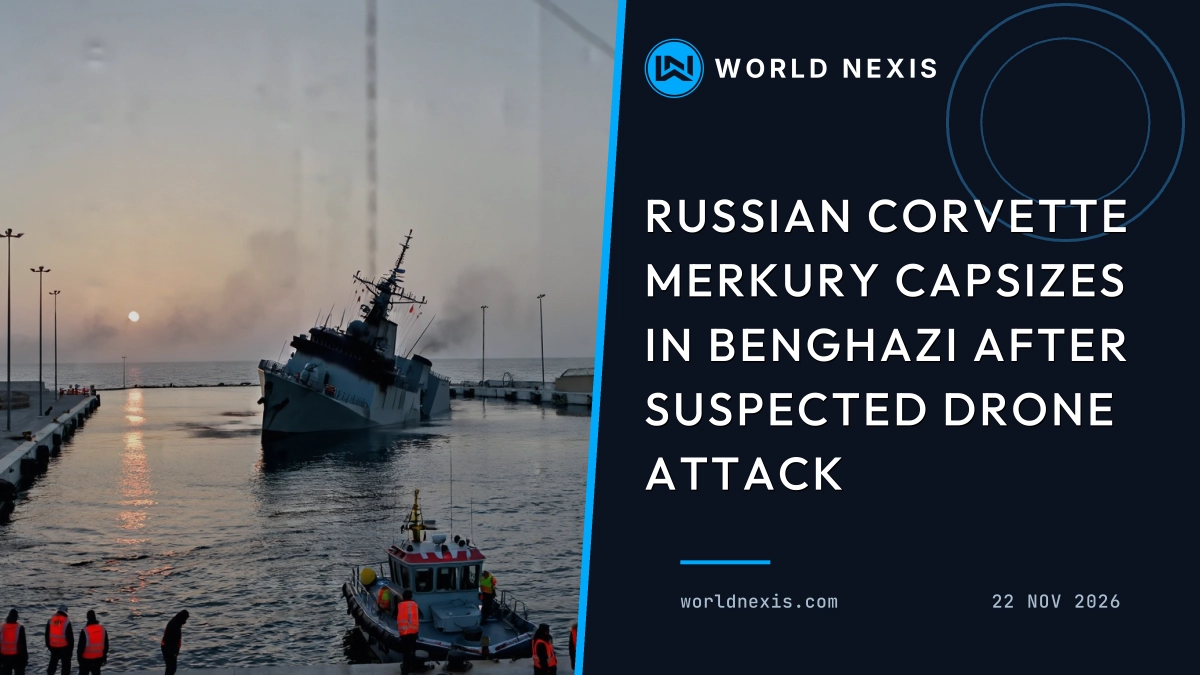
The Benghazi drone strike has left a £150m Russian warship capsized in the harbour at the city’s naval base, with satellite imagery showing only the forward bow above the waterline. The corvette Merkury was hit before dawn on Sunday while moored in the eastern Libyan port to take on fuel and supplies on its journey home. Libya’s eastern government says a suspected drone attack caused the explosion and that nobody on board was hurt.
Two Libyan military officials say at least four drones were intercepted and destroyed, while two reached the warship and set off the blast. Nobody has claimed responsibility, and the Kremlin has not commented.
Key points
- The Benghazi drone strike capsized the Merkury, a Steregushchiy-class corvette estimated at around £150m.
- Libya’s eastern Government of National Stability says the ship was refuelling under an existing maritime agreement and reported no casualties on board.
- Hours later a Russia-linked cargo ship was also targeted off Benghazi; the health ministry says injured crew had minor injuries and are stable.
- Analysts say only Ukraine had the reach and the motive to mount such an operation far from the front lines.
What we know about the Benghazi drone strike
Commercial satellite imagery taken on Sunday showed the Russian warship Merkury on fire at the port. Later images showed the capsized Merkury corvette mostly under water, with the sea closing over its stern.
Libya’s eastern Government of National Stability said the ship was using Benghazi within the framework of an existing maritime agreement. It condemned the attack as a violation of Libyan sovereignty and a threat to maritime safety.
The two Libyan military officials, who spoke on condition of anonymity, said the drones had been launched from a base in western Libya run by Ukrainian forces. That account has not been independently confirmed, and no government has publicly endorsed it.
Hours after the Benghazi drone strike, a Russia-linked commercial cargo ship was also targeted off the coast. Libyan naval forces rescued its crew, and the health ministry said those treated had minor injuries and were in a stable condition. The number and nationalities of the injured have not been released.
Why a Russian warship was in Benghazi
Benghazi sits in territory held by the Libyan National Army of Khalifa Haftar, which controls eastern and southern Libya and has been aligned with Russia. Libya fractured into rival administrations after Muammar Gaddafi was overthrown in 2011, leaving two governments and competing security forces.
That split now decides how far the country can be pulled into a war fought elsewhere. The eastern authority said port and naval base facilities, including warehouses, were safe, and that normal operations would resume once the fire was out and the site secured.
The internationally recognised Government of National Unity in Tripoli warned separately against hosting foreign forces. It said such activity raised “serious fears” about the risk of involving ports and civilian facilities in external conflicts.
Analysts point to Ukraine
“Ukraine is the only actor brazen enough to pull something like that off,” said Jalel Harchaoui, a Libya specialist at the Royal United Services Institute. “If I were to bet my own money, I would bet that it was the Ukrainians.”
Harchaoui also expects a response from Haftar’s circle. “You’re going to have a response by the Haftar family. They will ask questions about who is hosting the Ukrainians,” he said.
He added that strikes of this kind hit Russia’s ability to move oil and gas through its shadow tanker fleet, and are seen as humiliating for the Kremlin. The Benghazi drone strike is not the first operation of its kind in the Mediterranean. Moscow has previously accused Ukraine of hitting the tanker Arctic Metagaz between Libya and Malta with uncrewed sea drones launched from the Libyan coast.
Why it matters
For Libyans, the Benghazi drone strike turns a working port into part of someone else’s war. Both Libyan administrations are now saying a version of the same thing: foreign navies refuelling on the coast bring risk to civilians, cargo and trade.
For Russia, the loss is small in tonnage and heavy in prestige. A corvette sunk in a partner’s harbour shows Ukraine can reach ships far beyond the Black Sea, and it exposes the Mediterranean stops that keep the fleet supplied.
Analysis
Having covered sanctions and arms flows for World Nexis News, I look at the maritime agreement first. The eastern government accepts the Merkury was there under a deal. That makes the exposure a choice taken in Benghazi, not a misfortune that arrived uninvited.
In my view, the facts around the Benghazi drone strike support the Tripoli government’s warning more than Haftar’s position. The strongest counter-argument is that Ukraine struck a military target, not a civilian one, and that Russia’s navy has been used to hit Ukrainian cities. Both things can be true. Yet a cargo ship was hit within hours, and its injured crew were the people taken to hospital.
I think the lesson for Haftar is blunt. Hosting a foreign fleet buys patronage, and it buys targets. The questions his family will ask about who hosted the drones are the same questions Tripoli has been asking about who hosted the Russians.
What happens next
The eastern government says the Benghazi drone strike is under investigation, and that authorities are coordinating with Russian counterparts to establish where the drones came from and who sent them. It has promised legal and diplomatic measures against anyone found responsible.
The port is expected to reopen once the fire is out and the site is secure. Russia’s eventual response will decide whether Benghazi stays a refuelling stop for the Russian navy, and whether other Mediterranean ports rethink the same arrangement.
What we don’t know yet
No state or group has claimed the Benghazi drone strike, and the reported launch site in western Libya has not been verified. It is also unclear whether the maritime agreement between Benghazi and Moscow survives the loss of the ship, and what form any Russian retaliation would take.
Related coverage
- Indonesia factory fire: firm insists safety systems worked as DNA sought
- Trump data centre tax: Australia warns of major AI risk
- Chapo Isidro capture triggers violence warning in Sinaloa
Further reading
- Explosion on Russian ship at Libya port caused by suspected drone attack, officials say
- Russian warship sinks in Benghazi after suspected Ukrainian drone attack
About the author: Marcus Ellington is the International Correspondent at World Nexis News (WNN), covering world affairs. The analysis section reflects the writer’s view.

Marcus Ellington
Marcus Ellington is International Correspondent at World Nexis News, reporting on diplomacy, conflict and the political forces reshaping Europe, the Middle East, Asia and the Americas. Based in London, he focuses on explaining why events unfold as they do, using official statements, diplomatic documents and…



