Chapo Isidro capture triggers violence warning in Sinaloa
The Chapo Isidro capture in Sinaloa removed an FBI most-wanted fugitive, but burned roadblocks and a cartel war leave Guasave braced for reprisals.
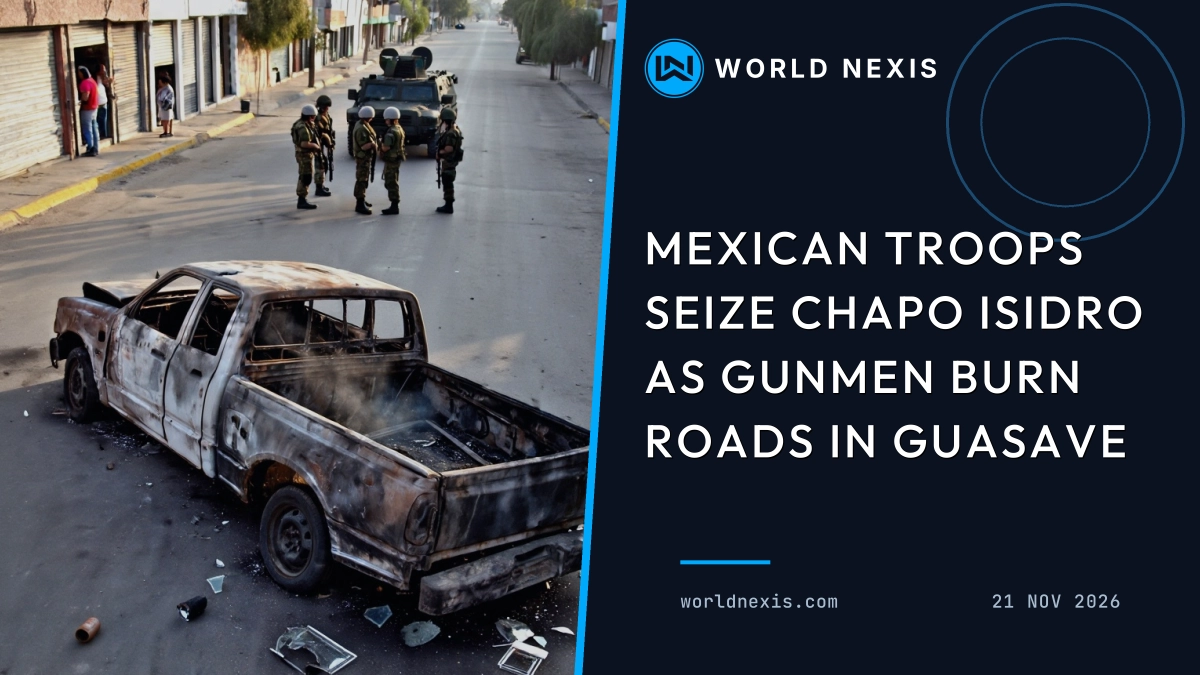
The Chapo Isidro capture has left Guasave tense but quieter, after Mexican special forces detained Fausto Isidro Meza Flores and two alleged lieutenants in a raid that set off burning roadblocks, gunfire near a packed baseball stadium and an extraction that ran into Saturday morning. The operation, announced by Mexico’s defence ministry, removed one of the FBI’s ten most wanted fugitives and a man with a $5m US reward on his head.
All three detainees were flown to Mexico City on a Mexican air force plane and placed at the disposal of prosecutors. Officials in both countries have released few details of how the raid was coordinated, and it is not yet clear whether Washington will seek extradition.
Key points
- Fausto Isidro Meza Flores, known as Chapo Isidro, was held alongside his alleged second-in-command, Germán N, alias Serafín, and José N, described by Mexican authorities as a financial operator for the Beltrán Leyva organisation.
- Elite troops came under fire from suspected cartel gunmen using guns and explosives before entering a house in Guasave and making the arrests.
- Mexican officials say US intelligence supported the raid, and the FBI had offered up to $5m for information leading to his arrest.
- Gang members burned vehicles into at least ten roadblocks, and a baseball game was abandoned as supporters fled.
How the Chapo Isidro raid unfolded
Military planners built the operation around stealth and surprise. The defence ministry said troops reached the target area, set a security perimeter and closed in from several directions before coming under attack. Soldiers forced their way into a house, seized the three men and moved them out under heavy guard.
The hard part was the exit. A federal official, speaking on condition of anonymity, said army and National Guard special forces could not lift the prisoners from Guasave until about 4am, because gang members had blocked at least ten streets with burning vehicles. “Getting him out was extraordinary,” the official said, describing an intense response by members of the criminal group.
Video released by the authorities showed heavily armed men in camouflage escorting a prisoner through a dimly lit house and into the back of a truck. Other footage, much of it unverified, appeared to show security helicopters firing at ground targets while players and fans ran from a baseball game in the city.
Paola Sánchez, a Guasave firefighter, said thousands of residents had taken shelter in grocery stores and other buildings as the shooting intensified. “Last night, many businesses were burned … along with cars and trucks,” she said. Her crews stayed inside their station until Saturday morning, waiting for orders to check what was still alight. Security Secretary Omar García Harfuch said armed forces would remain in Sinaloa to protect civilians.
Who is Chapo Isidro, and why Washington wanted him
Mexican authorities describe Meza Flores as the leader of the Beltrán Leyva organisation, a network allied to Los Mayos, one of two factions fighting for control of the Sinaloa cartel in the north-west of the country. He is wanted in Mexico on organised crime charges.
The FBI’s wanted notice states that his organisation “is allegedly responsible for the possession, distribution, and importation of large quantities of heroin, methamphetamine, cocaine, fentanyl and marijuana into the United States”. That mix of drugs, fentanyl above all, is why the Chapo Isidro case drew attention far beyond Sinaloa.
The Trump administration has designated the Sinaloa cartel a foreign terrorist organisation and has pressed President Claudia Sheinbaum’s government to move harder against criminal groups. Saturday’s arrest gave both capitals a result to point to, and the US Drug Enforcement Administration commended the Mexican operation.
Why it matters
For families in and around Guasave, the price of the Chapo Isidro arrest was a night of fear, burned vehicles and shuttered businesses, plus the risk that the struggle over trafficking routes moves closer to their streets. Sinaloa cartel violence has already reshaped daily life across the state, and a leadership vacuum rarely makes a city calmer.
For Washington, the El Chapo Isidro arrest is a test of whether years of intelligence-sharing with Mexico can turn into prosecutions and, eventually, extraditions. For the cartel, losing a faction leader and his finance man changes who controls production and transport at a moment when two rival groups are fighting over the same territory.
Analysis
I think the victory framing in Washington is the weaker reading of this news. The operation was a real intelligence success, since nobody walks into a Guasave safe house on a hunch, but the four-hour delay in getting him out, with ten roads blocked and shops in flames, shows an organisation that could still put a city on lockdown within minutes of losing its boss. That is the figure I would watch, not the reward.
In my view, the warnings about a fresh wave of violence are better supported than the idea that removing Chapo Isidro ends anything. The Beltrán Leyva network has absorbed the loss of senior figures before, and its fight with a rival is over routes and plazas, not one man. Sanctions and terrorist designations change the legal tools available in Washington; they do not by themselves slow the fentanyl moving north, and the Chapo Isidro raid does not change that arithmetic.
The strongest counter-argument is that captures like this do real damage, because they produce phones, ledgers and cooperating witnesses, and a cartel that must spend its time protecting its leaders moves fewer drugs. I accept that. I simply do not think the evidence yet shows it outweighs the reprisal risk for people in Guasave this weekend.
What happens next
In the Chapo Isidro case, Meza Flores and the two men detained with him now face federal prosecutors in Mexico City, where organised crime charges are expected. The case will move through Mexican courts unless US prosecutors file an extradition request, which would open a second, slower legal track in Washington.
Troops are staying in Sinaloa, so expect more patrols and checkpoints around Guasave and the state capital while the government tries to head off reprisals.
What we don’t know yet
- Whether the United States will seek his extradition.
- How closely US intelligence agencies and the Mexican military worked together in planning the raid.
- Whether the two arrested lieutenants will cooperate, and what that means for the wider network.
Related coverage
- Chapo Isidro captured: gun battles and the extradition ahead
- Strait of Hormuz swim: Briton’s 15km warning on war’s cost
- Rahul Gandhi Israel remarks spark ‘complicity’ warning
Further reading
- Alleged Mexican drug cartel boss ‘El Chapo Isidro’ arrested in special forces raid
- Mexico detains top cartel boss ‘El Chapo Isidro,’ setting off violence
About the author: Marcus Ellington is the International Correspondent at World Nexis News (WNN), covering world affairs. The analysis section reflects the writer’s view.

Marcus Ellington
Marcus Ellington is International Correspondent at World Nexis News, reporting on diplomacy, conflict and the political forces reshaping Europe, the Middle East, Asia and the Americas. Based in London, he focuses on explaining why events unfold as they do, using official statements, diplomatic documents and…



