Strait of Hormuz swim: Briton’s 15km warning on war’s cost
Lewis Pugh completed a 15km Strait of Hormuz swim over three days to highlight war's environmental cost, as attacks on shipping reach their highest level.
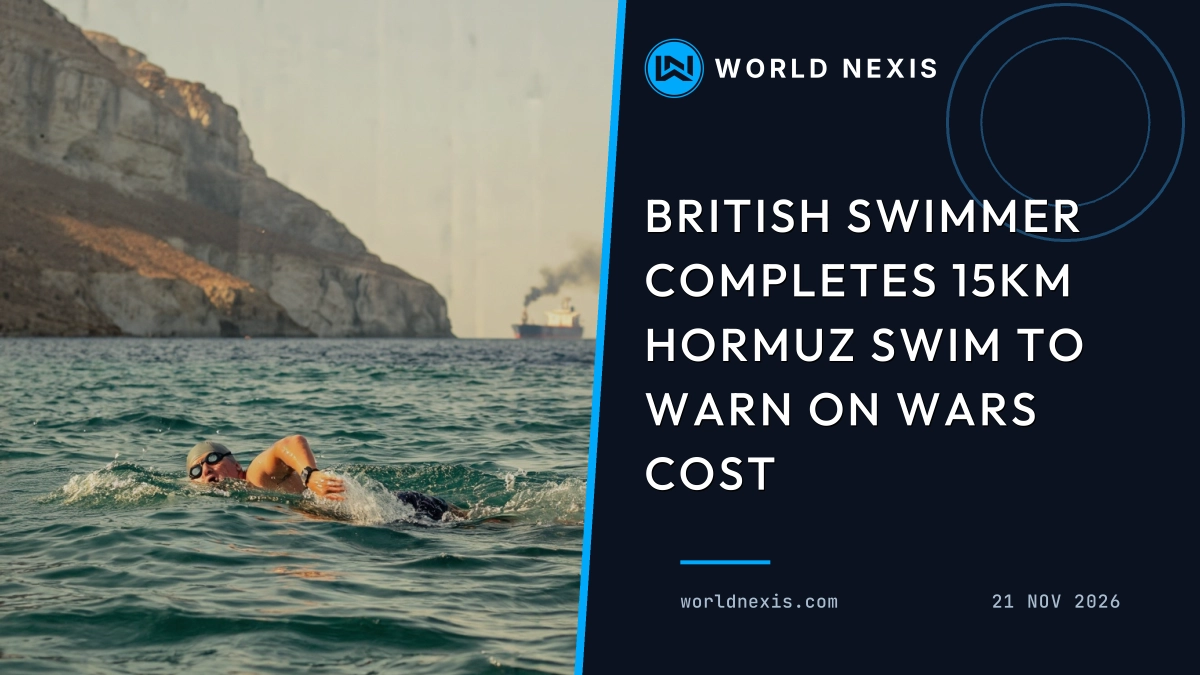
The Strait of Hormuz swim completed by British endurance swimmer Lewis Pugh this week took three days and covered about 15km (9.3 miles) through one of the world’s most dangerous waterways. Pugh, 56, set off from the Musandam Peninsula at the southern tip of the strait and finished by rounding the Cape of Hormuz, wearing only trunks, goggles and a cap bearing the UN logo. He says the aim was to draw attention to “the devastating environmental cost of war”.
Key points
- Lewis Pugh, 56, a UN patron of the oceans, completed a Strait of Hormuz swim of roughly 15km over three days this week.
- He is believed to be the first person to attempt a long-distance swim in the strait since the US-Israel war with Iran began in late February.
- Reported attacks in and around the waterway are running at their highest monthly level of the conflict, according to the maritime bodies that track them.
- Foreign Secretary Ed Miliband has called for an “all-out diplomatic effort” to end the war and properly reopen the strait.
What the Strait of Hormuz swim involved
Pugh is a Plymouth-born ocean activist who became the first person to complete a long-distance swim in every ocean of the world, and he often swims through fragile ecosystems to draw attention to them. The Strait of Hormuz swim brought him into a shipping lane at the centre of a war.
The strait, he argued, is far more than a chokepoint on an oil map. In a post on his website he described “towering mountains and spectacular fjords, coral reefs and mangrove forests”. Dolphins, sea turtles and dugongs live in these waters, he added: “It is one of the great natural wonders of the world.”
Strait of Hormuz attacks climb as the swim goes ahead
Maritime data shows the pace of attacks in and around the strait running far above its earlier level. The UK Maritime Trade Operations Centre recorded 31 incidents in October and about 19 more up to 18 November, after 53 between March and September.
The International Maritime Organization, a UN agency, has confirmed 34 attacks across October and November, against roughly 50 in the March-to-September period. It has counted 138 attacks on vessels across the Middle East since the war began. The two bodies log incidents differently, so their figures vary.
Most of the ships reported hit in the Strait of Hormuz attacks were in the far south, close to the Omani coastline. The United States has enforced a naval blockade of Iranian and Iran-linked shipping since 13 April, with a pause between 18 June and 13 July.
Sina Toossi, a senior fellow at the Center for International Policy, said Washington has kept oil moving through ship-to-ship transfers. Smaller tankers cross with tracking systems switched off and hand their cargo to larger vessels on the far side, he said.
“Washington and its regional partners have found ways to keep oil flowing through the Strait of Hormuz,” said Hamidreza Azizi, a senior Iran analyst at the International Crisis Group. “Tehran now seems determined to make these arrangements more costly and less reliable.”
What Pugh saw from the water
The Strait of Hormuz swim brought the war within a few kilometres almost immediately. “Just 30 minutes after I began swimming, an oil tanker was struck a few kilometres away,” Pugh said. “The explosions rocked the sea around me.”
Over the following days he reported further attacks on commercial shipping and saw vessels engulfed in flames. Pictures he shared on social media showed smoke billowing from a burning liquefied petroleum gas tanker off the Musandam Peninsula in Oman.
In his website post, he argued that nature is the conflict’s forgotten casualty alongside the lives lost and the homes destroyed on shore.
“War causes immense human suffering. Lives are lost, families are torn apart, and homes are destroyed. But there is another casualty that receives far too little attention: nature itself.”
His conclusion was a three-part demand. “My message is simple: Stop the fighting. Open the Strait. Clean up the pollution,” he said.
Why it matters
The Strait of Hormuz is the main sea route for oil exports from the Gulf, and it has been repeatedly closed during this war. Each new round of attacks makes the passage more expensive to use, and those costs eventually reach fuel prices and shop shelves far from the region.
Damage to reefs, mangroves and marine life is harder to price and slower to appear in official figures. That makes it the sort of cost that is settled long after the fighting stops.
In London, the war has become a diplomatic problem. Earlier this month, Foreign Secretary Ed Miliband warned the conflict was causing “deep economic pain” and called for an “all-out diplomatic effort” to end the “no war, no peace” stalemate and properly reopen the strait.
Analysis
Having covered conflict and the trade routes that wars run through for World Nexis News, I read the Strait of Hormuz swim as something closer to evidence-gathering than to publicity. Pugh entered a waterway where the attack data is now unambiguous, and he came back with an eyewitness account of a tanker being hit within half an hour. Very few people can describe this war from sea level.
I think his framing holds up better than the sceptical one. Shipping figures show a campaign against commercial vessels that has intensified sharply since the summer, and pollution from burning tankers will not pause when a ceasefire is signed. The strongest counter-argument is that a lone swimmer in a live weapons environment adds risk without changing a decision in Washington or Tehran, and that is fair.
Even so, symbolism has value here. The war’s ecological cost barely appears in the diplomatic language coming out of London, and the Strait of Hormuz swim puts it in front of people who would never read a maritime bulletin. I will be watching to see whether the pollution claim is backed by monitoring data, because that is what turns a gesture into a case.
What happens next
The swim is over, but the waterway remains contested. British diplomacy is now focused on breaking the “no war, no peace” stalemate and restoring normal traffic through the strait, while the November attack figures are still being compiled.
What we don’t know yet
It is unclear whether the diplomatic push will produce talks, or whether the attack rate will keep climbing into December. Nor is it clear how much of the pollution from the strikes can realistically be cleaned up while the war continues.
Related coverage
- Rahul Gandhi Israel remarks spark ‘complicity’ warning
- AI killer robots: UN talks end with two-year delay, no rules
- Russian missile crash in Poland: Tusk sees major provocation
Further reading
- Strait of Hormuz attacks have increased to highest level since Iran war began
- Briton swims in Strait of Hormuz to highlight ‘environmental cost of war’
About the author: Marcus Ellington is the International Correspondent at World Nexis News (WNN), covering world affairs. The analysis section reflects the writer’s view.

Marcus Ellington
Marcus Ellington is International Correspondent at World Nexis News, reporting on diplomacy, conflict and the political forces reshaping Europe, the Middle East, Asia and the Americas. Based in London, he focuses on explaining why events unfold as they do, using official statements, diplomatic documents and…



