Russian missile crash in Poland: Tusk sees major provocation
A Russian missile crash in Poland was an intentional provocation, PM Donald Tusk says, as Nato jets scrambled and eight people died in Ukraine.
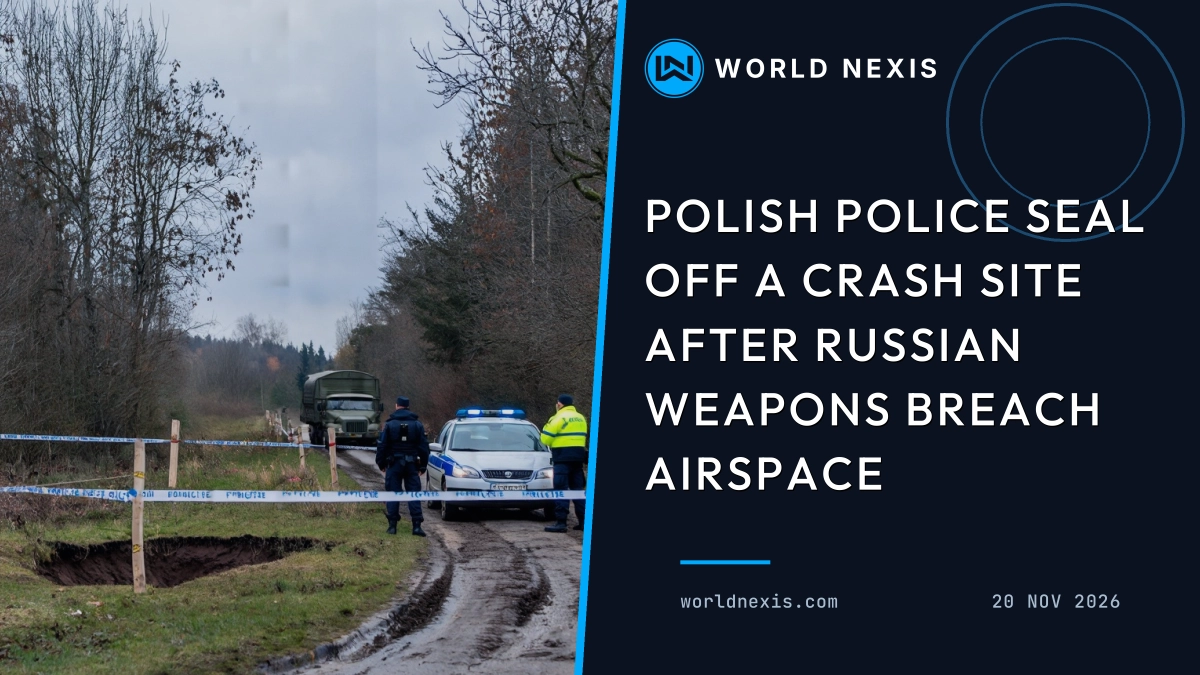
Updated 21 Nov 2026, 17:56 (UK time): Fresh reporting shows the overnight wave behind the Russian missile crash struck Kyiv’s bridges and railway stations, in what Ukraine’s president called one of the war’s largest assaults and which Kyiv reads as Moscow’s promised retaliation for the attack on the Crimean Bridge.
Fresh reporting has filled in what the overnight wave behind the Russian missile crash was aimed at. Beyond Poland’s border, ballistic missiles struck key crossings in Kyiv and railway stations were hit in the capital, in what President Volodymyr Zelenskyy called one of the most massive strikes of the war so far.
The Kremlin had promised retaliation for Ukraine’s attack on the Crimean Bridge, the crossing it built to link Russia with the occupied peninsula, and officials in Kyiv are treating the strikes on the capital’s bridges as that answer. Moscow has been targeting those crossings since early October, trying to sever the city centre on the west bank from the largely residential east, home to about a third of Kyiv’s population.
Traffic is now restricted as a result. The Northern Bridge carries only buses, cyclists, scooter riders and pedestrians, the Southern and Podilskyi bridges are under limits, and mayor Vitali Klitschko has urged residents to avoid car journeys. Earthworks have begun for a floating pontoon crossing in case the spans fail.
What this changes for the Polish story is the shape of the threat Warsaw is describing. The Russian missile crash looks less like a stray round from a border incident and more like part of a campaign against transport and logistics nodes — the same infrastructure a stabilisation mission would depend on. The bridges are still standing, which is the most important fact of the week; the second is that Moscow has now said openly why it is hitting them.
The Russian missile crash in Poland is being treated in Warsaw as a deliberate political act rather than an accident. Prime Minister Donald Tusk said the weapon came down on Polish soil as an intentional provocation, timed to coincide with large allied military drills. Nato jets were scrambled overnight as the incursion unfolded.
Polish officials said two Russian cruise missiles and a jet-powered drone came down in the south-east of the country. The same overnight wave of attacks killed at least eight people and injured nearly 30 across Ukraine, President Volodymyr Zelenskyy said.
Key points
- Tusk called the Russian missile crash “an intentional provocation” by Moscow, timed to coincide with exercises in south-east Poland.
- Poland’s defence minister confirmed three violations of Polish airspace and said nobody was injured.
- Nato secretary general Mark Rutte condemned the “grave violations” and said allied jets were scrambled in response.
- At least eight people were killed and nearly 30 injured in the overnight attacks across Ukraine.
What Warsaw confirmed after the Russian missile crash
Defence minister Władysław Kosiniak-Kamysz confirmed three violations of Polish airspace. He said no injuries had been reported on the ground. He added that he did not believe it was accidental that the incursion came on the same day as the allied drills.
The Russian missile crash left nobody hurt, and the likely impact site sits near the village of Nowy Lipowiec, roughly 37 miles from the Polish-Ukrainian border. Polish police said roads around the site were closed while investigators worked.
Major General Ireneusz Nowak, who leads Poland’s operational command, said as many as 11 objects had been identified as posing a danger to Polish airspace. That points to a crowded and fast-moving night over the border region.
Allied drills put the Russian missile crash next door
Thousands of troops from allied countries, including the UK, were taking part in an unprecedented exercise in south-eastern Poland on Friday. The drills are intended to prepare for a possible post-war mission to help stabilise Ukraine and rebuild its military once the fighting ends. The crash sites lay about 47 miles from the exercise area near Nowa Dęba.
Tusk said he had spoken to Nato secretary general Mark Rutte, who agreed it did not seem to be a coincidence that the attack came the night before the drills. “Today’s incident shows clearer than ever before why Poland must participate in decisions on Ukraine’s future,” Tusk said. He argued that Warsaw has a “better understanding” of the threat posed by Russia.
Rutte said he and Tusk had discussed the “grave violations of Polish airspace overnight”. “This incident is clearly dangerous – a consequence of Russia’s ongoing war against Ukraine,” he said. He added that allies would keep strengthening their ability to deter and defend.
Britain condemns the incursion
British reaction to the Russian missile crash was swift. UK Prime Minister Andy Burnham condemned the breach at a press conference at the UK-EU summit. “The incursion into Polish airspace is utterly unacceptable, and I condemn it unreservedly,” he said. He also sent “a strong message of solidarity to Prime Minister Tusk and the Polish people”.
Burnham said Europe was becoming more co-ordinated on defence and security, and that the agreement reached at the summit would deepen that further. He repeated his argument that nobody is winning the war and that Russia is losing the most. “No ground is being taken, minimal gains,” he said.
Defence secretary Wes Streeting, who is in Poland for the exercises, described the incursion as “very serious”. He said the impact of Russia’s illegal war “is being felt across Ukraine and increasingly in neighbouring countries”.
Deadly night across Ukraine
Zelenskyy described the overnight assault as one of the largest since the full-scale invasion in 2022. Bridges and transport infrastructure were damaged, and rescue work continued through the day. “The Russians spread this attack across many cities and regions of Ukraine,” he said. “Absolutely all the targets were ordinary civilian infrastructure – things that literally sustain people’s lives.”
He also accused Moscow of trying to compensate for military and diplomatic failure with terror. “Russia is trying to compensate for its military and diplomatic impotence with precisely this kind of terror,” he said, arguing that recent diplomatic meetings had produced nothing of substance for the Kremlin.
Why it matters
The Russian missile crash matters most to Britain because UK personnel were on Polish soil when the weapons came down. It turns a long argument about defence spending into a question about safety for troops deployed on the alliance’s eastern edge.
The Russian missile crash also strengthens Warsaw’s claim to a seat at any table deciding Ukraine’s future, a demand Tusk made explicitly on Friday. For households in the UK and US, the knock-on effects are indirect but real: more pressure on defence budgets, more debate about how far allies should go in arming Kyiv, and a greater chance that the war’s cost is felt well beyond Ukraine’s borders.
Analysis
Having covered conflict and alliance politics for World Nexis News, I look first at the timing and the distances involved in the Russian missile crash rather than at the wreckage itself. Several separate objects came down between roughly 37 and 47 miles from a live multinational exercise involving British troops. Tusk’s reading — that this was a message rather than a malfunction — is the better supported one.
I side with Warsaw here. Moscow has every reason to show that it can reach the logistics hubs and training areas a post-war stabilisation mission would depend on, and doing so on the eve of the drills costs the Kremlin very little. The strongest counter-argument is that any mass strike near a border will spill over, and that treating an accident as a deliberate signal carries escalation risks nobody controls.
What worries me more than the incursion is the precedent. Once breaches of allied airspace become routine, politicians start normalising them and the threshold for a response drifts upward. The answer is not panic, but a clear, public standard for what Nato will intercept and what it will let pass.
What happens next
Nato secretary general Mark Rutte will be in Warsaw on Saturday for talks with Tusk, the alliance said. Polish investigators will keep working the crash sites and identifying debris. The multinational exercises were continuing on Friday, with the UK defence secretary visiting.
Poland will press its case for a role in any decisions on Ukraine’s future, and Britain will point to the summit agreement as evidence that European defence co-ordination is deepening. Both moves were in train before Friday; the Russian missile crash gives them new momentum.
What we don’t know yet
- Whether the weapons were aimed at Polish territory or drifted off course during a large strike near the border.
- What type of munitions were involved, and how many separate objects crossed the border.
- Whether Warsaw will ask allies for additional air-defence assets.
Related coverage
- Brexit impact: Burnham seeks major EU reset at summit
- Ukraine security guarantee: Europe ready for major talks
- Coalition of the Willing: Martin backs major US-Russia talks
Further reading
- Russian missiles and drone hit Poland during attacks on Ukraine
- Russian missile’s crash in Poland was likely an intentional provocation, Polish PM says
About the author: Marcus Ellington is the International Correspondent at World Nexis News (WNN), covering world affairs. The analysis section reflects the writer’s view.

Marcus Ellington
Marcus Ellington is International Correspondent at World Nexis News, reporting on diplomacy, conflict and the political forces reshaping Europe, the Middle East, Asia and the Americas. Based in London, he focuses on explaining why events unfold as they do, using official statements, diplomatic documents and…



