Brexit impact: Burnham seeks major EU reset at summit
Brexit impact is back at the centre of UK politics as Andy Burnham meets EU leaders in Brussels to seek closer ties and cut trade costs for business.
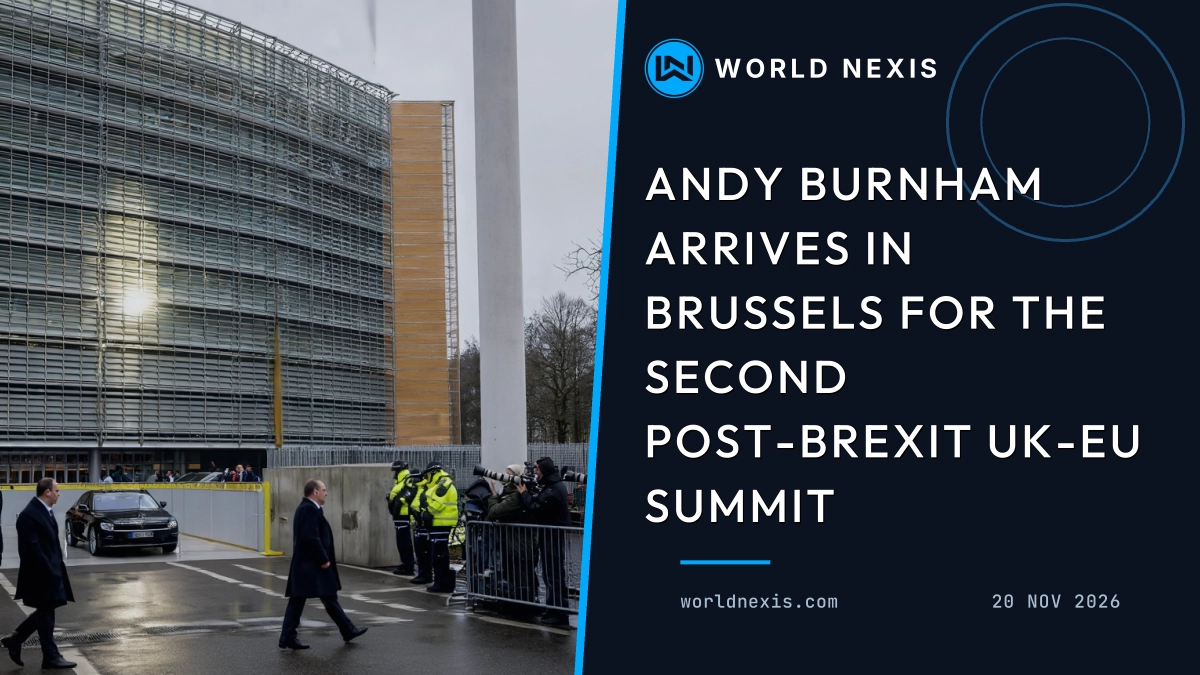
The Brexit impact on British trade, growth and the public finances is back in focus on Friday, as Andy Burnham arrives in Brussels for the second UK-EU summit since Britain left the bloc. The prime minister meets European Commission president Ursula von der Leyen and European Council president António Costa, with food, energy and youth mobility on the agenda.
The talks come against a volatile backdrop. War in the Middle East is weighing on the global economy, and the government borrowed £17bn in October, less than forecast, with debt interest costs still climbing.
Key points
- Andy Burnham meets Ursula von der Leyen and António Costa at the second UK-EU summit since Brexit.
- Food, energy and youth mobility are the areas where agreements could be reached.
- The Brexit impact is sharpest in goods: UK exports to the EU were 14% below 2019 levels in real terms in 2025.
- The Office for Budget Responsibility estimates a 4% hit over a 15-year period.
Burnham takes the case for closer ties to Brussels
Burnham has said that Brexit “has not worked”, citing damage to the UK economy from leaving the bloc. He arrives in Brussels aiming to reshape the relationship rather than reopen the arguments of 2016.
The agenda is deliberately narrow. Negotiators are working on possible agreements on food, energy and youth mobility, the areas where the costs of leaving are most visible to voters and to businesses.
For exporters, the practical burden is red tape. Under the trade deal agreed by Boris Johnson, goods moving to the EU face new barriers and customs paperwork, and years of political turmoil after the 2016 vote damaged business investment.
For households, the stakes are simpler: food and energy are where closer cooperation would reach prices and bills most directly.
The Brexit impact in numbers
Analysis by the economist Nick Bloom puts UK GDP per head between 6% and 8% lower than it would have been without Brexit. The Office for Budget Responsibility estimates a 4% hit over a 15-year period.
Trade data tell a more mixed story. UK goods exports to the EU in 2025 were 14% below 2019 in real terms, and exports to the rest of the world were 8% lower. Services have fared far better, with exports 28% higher to the EU and 26% higher elsewhere, helped by financial services, travel, accountancy, law and IT.
Brexit trade barriers have therefore hit goods far harder than services. That split matters, because the Brexit impact has fallen hardest on smaller manufacturers and food producers that sell into Europe, while the City and professional services have kept growing.
Trade policy: independence has a price
Britain has run its own trade policy since leaving, and ministers have used those powers to cut tariffs on selected products to ease living costs. They also point to a tariff deal struck with Donald Trump’s administration, which they argue is on better terms than the EU secured.
Critics counter that the UK has lost negotiating clout and that diverging sharply from EU rules risks damaging trade with its single largest partner.
Growth and AI
The UK has grown at the second-fastest pace in the G7 so far this year, with artificial intelligence investment supporting output. Britain ranks third in the Global AI Index, while France, in sixth, is the highest-ranked EU nation, partly because of a lighter regulatory touch in London.
What Brexit did to the EU economy
The Brexit impact on the EU has been smaller because the bloc is a much larger market, but it is real. New barriers have made Britain harder to reach for EU exporters, and migration to the UK has fallen.
Politically, the vote energised populist and Eurosceptic parties across the continent. A wave of copycat exits never materialised, partly because Britain’s own turmoil served as a warning, but fights over immigration, sovereignty and democratic accountability have not gone away.
Brussels also has problems that have nothing to do with Britain. Germany has been squeezed by high energy costs and Chinese competition, France by political uncertainty that has pushed up borrowing costs, while Poland and several southern European economies have boomed.
Borrowing and the fiscal backdrop
At home, the public finances underline how little room the government has. Borrowing reached £17bn in October, below forecasts, but rising debt interest costs ate into the improvement.
The Brexit impact shows up in those forecasts too. The fiscal watchdog’s 4% estimate is measured across 15 years, which means the loss is not a one-off that fades with time.
Why it matters
For readers, the summit matters through prices, bills and paperwork. Food and energy sit in every household budget, and youth mobility decides whether young people can study or work on the continent without a visa fight.
For the country, the Brexit impact is now a permanent feature of the fiscal background. If the cost really runs for 15 years, every budget is written against a smaller economy than Britain would otherwise have had, which is why ministers are spending political capital on a summit that will not produce a single headline-grabbing treaty.
Analysis
Having covered global trade and foreign policy for World Nexis News, I look first at what a summit can actually deliver. On the evidence in front of us, the case that the current trading relationship is costing Britain money is stronger than the case that it is working well. Goods exports to the EU are 14% below their 2019 level, business investment was damaged by years of uncertainty, and the independent fiscal watchdog puts the long-run cost at 4%.
That does not make Brexit an economic catastrophe, and Leavers have a fair point when they cite services exports up 28% to the EU, the second-fastest growth in the G7 and a tariff deal with Washington that Brussels did not get. In my view those are arguments for fixing the deal rather than defending it. The gains come from sectors that were always going to trade, while the losses fall on smaller exporters with less capacity to absorb paperwork.
The strongest counter-argument is that incremental deals on food, energy and youth mobility are tinkering, and that only rejoining the single market would recover the lost growth. I think that overstates what is available politically in 2026, when no government has a mandate to rejoin and the EU has its own reasons not to reopen membership. A delivered reduction in trade friction is worth more than a symbolic fight.
What happens next
The summit takes place in Brussels on Friday, with von der Leyen and Costa hosting Burnham. Work on food, energy and youth mobility will continue after the leaders leave, and the European Commission’s latest forecasts suggest both economies have been more resilient to the Middle East war than feared.
A clearer picture of the Brexit impact will only emerge once negotiators finish.
What we don’t know yet
Whether any of the three areas produces a signed agreement on Friday, how far either side will move on alignment, and what the package would cost. Any deal would also have to be written into law in London and Brussels, which is where promises tend to slow down.
Related coverage
- Brexit reset deal: what Burnham’s Brussels summit changes
- Peace declaration caps Trump Xi Putin summit in Shenzhen
- Shenzhen summit: historic Trump-Putin-Xi peace declaration
Further reading
- What the Brussels summit could mean for the UK-EU Brexit deal
- What impact has Brexit had on the UK and EU economies?
About the author: Marcus Ellington is the International Correspondent at World Nexis News (WNN), covering world affairs. The analysis section reflects the writer’s view.

Marcus Ellington
Marcus Ellington is International Correspondent at World Nexis News, reporting on diplomacy, conflict and the political forces reshaping Europe, the Middle East, Asia and the Americas. Based in London, he focuses on explaining why events unfold as they do, using official statements, diplomatic documents and…