Brexit reset deal: what Burnham’s Brussels summit changes
Andy Burnham meets EU leaders in Brussels to close a Brexit reset deal on food, energy and youth mobility. Here is what really changes for the UK.
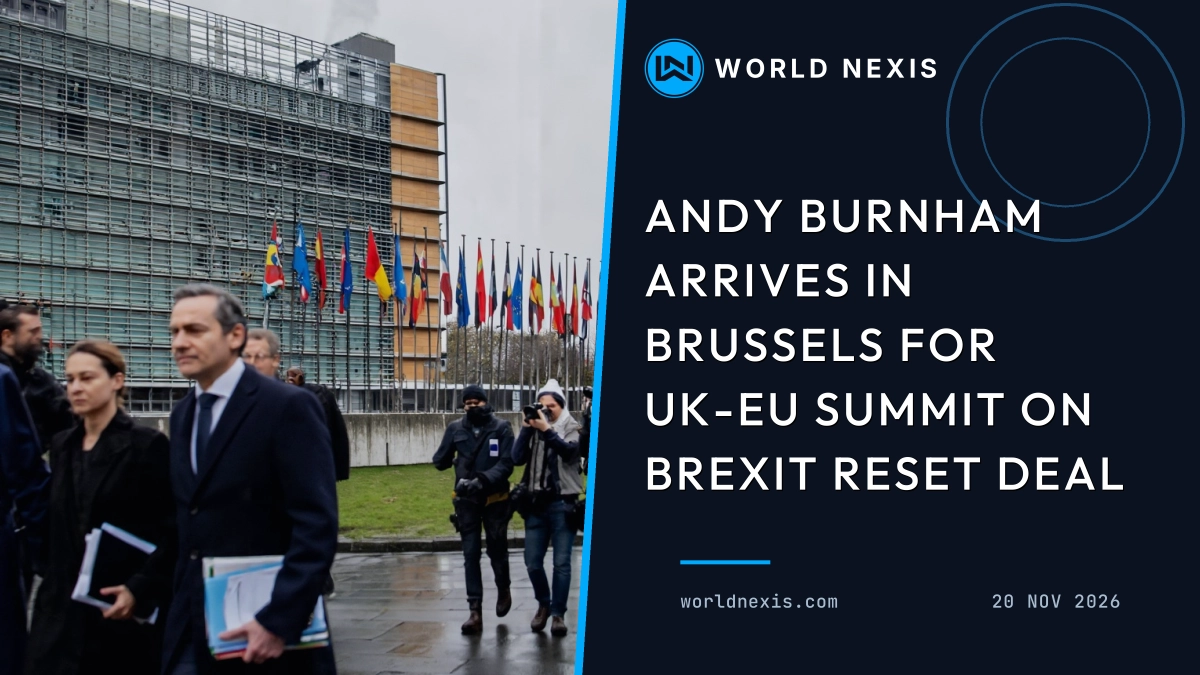
The Brexit reset deal moves to its decisive stage on Friday, when Andy Burnham joins European leaders in Brussels for a UK-EU summit intended to reshape Britain’s relationship with the bloc a decade after the 2016 referendum.
Negotiators have worked up to the wire on the package, which is expected to cover farm and food trade, energy and easier movement for young people. Several elements of the text were still being settled as leaders arrived in the Belgian capital.
Key points
- Andy Burnham attends a UK-EU summit in Brussels on Friday to close a Brexit reset deal.
- Food trade barriers, linked emissions trading and youth mobility are the expected centrepieces.
- The talks went down to the wire, with the final text unconfirmed as leaders met.
- Kemi Badenoch has condemned the plan as “the worst of both worlds”.
What the Brexit reset deal covers
The Brexit reset deal is built around three areas where officials on both sides believe friction can be cut without reopening the arguments of 2016. Each one carries a different kind of gain, and a different kind of political risk.
Food and farm trade
Removing trade barriers on food products would reduce the checks and paperwork that have weighed on exporters since Britain left the single market. Every extra certificate and inspection adds cost and delay to a trade in goods that spoil.
For households, the effect is indirect but real. Smoother food supply chains mean fewer gaps on shelves and less upward pressure on prices when harvests or transport are disrupted. Farmers would gain easier access to their nearest and largest export market.
Energy and carbon markets
Linking the UK and EU emissions trading systems would tie British carbon pricing to the bloc’s. For energy-intensive manufacturers, that matters: it keeps them inside the European carbon architecture rather than outside it, facing costs their continental competitors do not.
More predictable energy trade is the promise. The risk is that alignment on carbon rules invites the question of who writes them, which is exactly where the sovereignty argument bites hardest.
Youth mobility
The most visible element for ordinary families is a scheme giving young people new opportunities to live, study and travel on the continent. Universities, hospitality and seasonal industries on both sides have long argued that the loss of easy movement has made recruitment harder.
It is also the most politically charged. Any youth mobility scheme that looks like restored freedom of movement will be attacked as a breach of the promises made when Britain left.
Badenoch’s attack and the political price of a Brexit reset deal
Kemi Badenoch has described the plan as “the worst of both worlds”. The charge behind that phrase is familiar: Britain would take on obligations without the influence that comes with membership, and pay for access it once had for free.
Burnham’s answer is that the current settlement fails on its own terms. “The hard Brexit we were given is not good enough,” he said in a foreign policy speech this week, referring to the 2020 exit agreement.
He has gone further in public than his predecessor, saying he would like Britain to rejoin the bloc in his lifetime while ruling that out for this parliament. The government’s manifesto red lines — no return to the single market, the customs union or freedom of movement — remain in place.
Defenders of the Brexit reset deal argue that alignment on specific rules is not the same as membership. Nick Thomas-Symonds, who served as Europe minister under Keir Starmer, said the agreement was “90% there” when Burnham’s team took over, which suggests most of the text was settled before the current prime minister entered Downing Street.
Why it matters
Britain’s biggest trading partner is next door, and friction at that border is felt in prices, in waiting times and in the paperwork small firms complete before they can sell abroad. Anything that lowers those costs helps growth at a time when the government has few other levers.
For readers, the changes are unlikely to be dramatic or immediate. Whether the Brexit reset deal delivers depends less on Friday’s staging than on whether food, energy and travel become a little cheaper and a little simpler over the next few years.
Analysis
Having covered devolution and public services for World Nexis News, I look at announcements like this one from the delivery end. Summits produce communiqués; public services produce outcomes, and the gap between them is usually where political promises quietly die.
In my view the substance of this Brexit reset deal is worth having, but it is being sold as something larger than it is. The measurable gains on food, carbon and youth mobility will arrive slowly and unevenly, and the loudest claim of the day — that Britain is turning a corner on Europe — will not be tested for years. That is not an argument against signing. It is an argument for describing it accurately.
The critics have half a point, and Badenoch’s “worst of both worlds” line captures a genuine anxiety about obligations without influence. But her conclusion does not follow. The settlement she defends has delivered maximum friction and minimum leverage, and demanding access while refusing alignment is the true worst-of-both-worlds position. The strongest counter-argument is that piecemeal deals let ministers dodge the harder question of what Britain actually wants from Europe; fair enough, but that question will not be answered by rejecting this one.
What I will watch is not the signing ceremony but the schedules behind it: when checks actually fall away, when the carbon link begins, and whether the youth scheme is drawn tightly enough to survive a hostile press.
What happens next
The summit in Brussels on Friday is the milestone the government has worked towards, and the agreements are expected to be set out formally once leaders have met. Burnham has committed to opening talks with the EU on “options for our long-term relationship” after the summit, without giving a detail or a timetable.
Once concluded, the Brexit reset deal moves into implementation, where the practical effects for traders, students and energy users will show up first.
What we don’t know yet
- Whether every element survives in the final text, given how late the negotiations ran.
- The timetable for putting the agreements into practice, and who polices them.
- Whether the long-term relationship talks promised after the summit will carry a deadline.
Related coverage
- Peace declaration caps Trump Xi Putin summit in Shenzhen
- Shenzhen summit: historic Trump-Putin-Xi peace declaration
- Trump Xi Putin summit: 3 leaders vow peace in historic talks
Further reading
- What the Brussels summit could mean for the UK-EU Brexit deal
- Ten years on, is the UK preparing to undo Brexit?
About the author: Liam O’Connor is the UK Politics Reporter at World Nexis News (WNN), covering uk politics. The analysis section reflects the writer’s view.

Liam O'Connor
Liam O'Connor is UK Politics Reporter at World Nexis News, covering Westminster, devolved politics and the issues that matter to voters across England, Scotland, Wales and Northern Ireland. Based in London, he reports from primary sources — Hansard, official statements, published data — and explains…



