Rahul Gandhi Israel remarks spark ‘complicity’ warning
Rahul Gandhi Israel remarks at the University of Chicago drew backlash after he condemned Gaza while backing strong ties, warning neutrality is complicity.
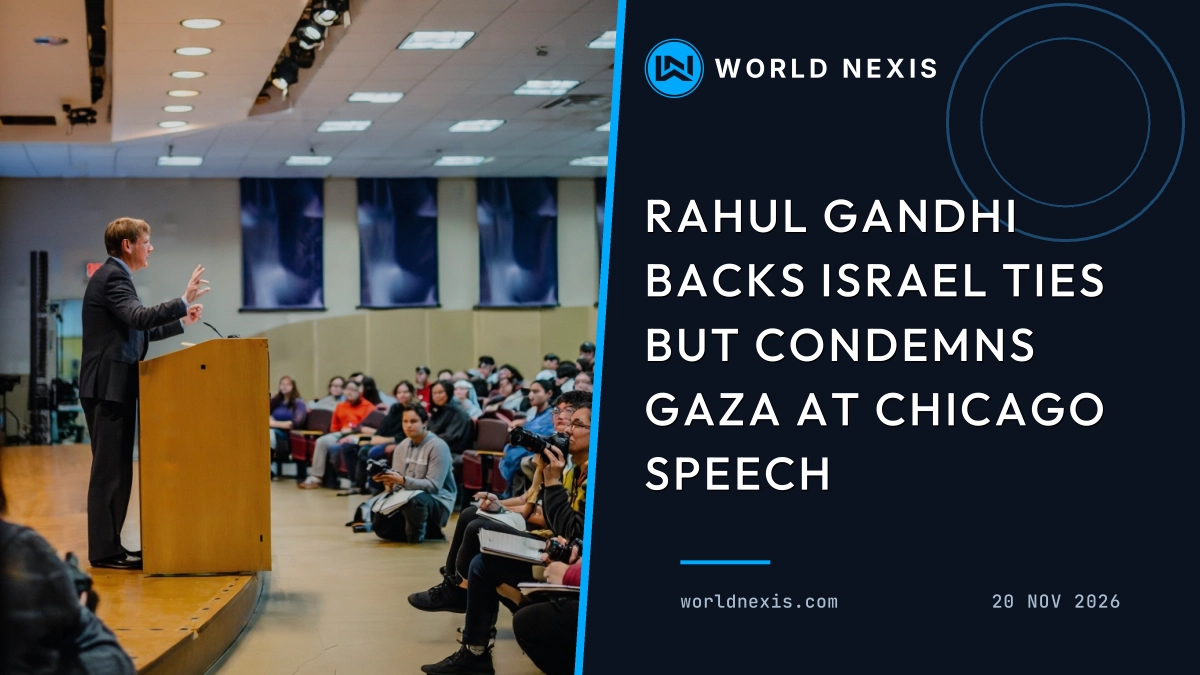
Rahul Gandhi Israel remarks at the University of Chicago have triggered a fierce political row, after the senior Congress leader said he supports strong ties with Israel but condemned its actions in Gaza and warned that “neutrality in the face of genocide is complicity.” In the same speech he set out his argument that India’s foreign policy must be judged by whether it serves the country’s national interest.
Key points
- Speaking at the University of Chicago, Rahul Gandhi said India should maintain a strong relationship with Israel.
- He condemned Israel’s actions in Gaza and said “neutrality in the face of genocide is complicity.”
- He argued that India’s foreign policy must serve the country’s national interest.
- The Rahul Gandhi Israel comments drew immediate flak, including from BJP figures who said he was harming India’s interests from foreign soil.
The Rahul Gandhi Israel remarks that started the row
The Congress leader used the appearance to separate state-to-state ties from what he described as a moral duty. He said India should keep a strong relationship with Israel, then argued that partnership could not mean silence about the campaign in Gaza. Staying neutral in the face of genocide, he said, amounts to complicity.
“Neutrality in the face of genocide is complicity.”
He paired that condemnation with a defense of the relationship itself, saying India’s foreign policy must serve national interest. Taken together, the comments set out two positions at once: support for Israel as a partner, and open criticism of how it has fought in Gaza.
Backlash at home
The remarks drew immediate flak. Critics argued that a senior opposition figure should not attack the government’s foreign policy line from a foreign campus, and much of the anger settled on his use of the word genocide. BJP leader Prakash Reddy said that questioning India’s election process on foreign soil goes against the country’s interest, widening his attack to Gandhi’s conduct during the trip.
The exchange has turned the Rahul Gandhi Israel controversy into a domestic political fight as much as a statement about the Middle East. The charge he now has to answer is that the opposition speaks more freely abroad than it does in the chamber where policy is actually decided.
Pakistan, elections and a three-power summit
Gandhi also said that bilateral talks with Pakistan are impossible until support for terror ends. On the election process, his remarks abroad drew the sharpest response from the BJP, which accused him of undermining the country’s interests rather than arguing a case.
The speech landed in the same news cycle as a diplomatic first: Donald Trump, Vladimir Putin and Xi Jinping held their first-ever trilateral meeting, in the southeastern Chinese city of Shenzhen. Trump described both men as his friends, a remark that prompted criticism from some foreign leaders.
For Indian audiences following the visit from the United States, the setting mattered too. A campus hall in Chicago has become part of the arena in which India’s foreign policy is argued, and the reaction travels back home within hours.
Why it matters
The Rahul Gandhi Israel dispute matters less for what it changes in Delhi’s policy today than for what it reveals about the limits of acceptable criticism. A senior opposition figure has now said publicly, and on foreign soil, that a strategic partner’s conduct can be called genocide. That word will follow him into every foreign policy debate he has from now on.
The row also matters outside India, because it tests whether a country can keep a close relationship with Israel while publicly condemning the war in Gaza. For readers who follow Indian politics from abroad, the practical question is whether Congress turns this into a sustained position or leaves it as a single stop on a foreign tour.
For Indian students and researchers in the United States, the episode is a small test of how far political speech on campus can travel back home. What is said in Chicago does not stay in Chicago.
Analysis
Having covered foreign policy and conflict for World Nexis News, I look first at the room a leader of the opposition is allowed to speak in, and at what closing that room would cost a democracy. The Rahul Gandhi Israel argument, as I read it, is simple: a partnership that cannot survive criticism of a partner’s war is not a partnership, it is a purchase. On the facts in front of us, I side with him, because the loudest attacks so far have been about the venue and the vocabulary rather than about whether his description of Gaza is wrong.
The counter-argument deserves its sentence. Critics are right that an opposition leader using the word genocide on an American campus hands the government an easy way to change the subject, and that the term carries a legal weight no speech can settle. That is a real cost, but it is a cost created by the reaction, not by the criticism.
What I will watch next is follow-through. One line in Chicago is a headline; a party position that survives the next attack is a policy. If Gandhi’s team holds the distinction between strong ties and silent ties, it will have changed the terms of a debate the government would rather keep closed. If it retreats to safer ground, this becomes another story about where he speaks, not what he says.
What happens next
The Rahul Gandhi Israel row has no announced timetable. Neither the government nor Congress has announced a formal response, and no date has been set on which the dispute would be settled one way or the other.
What we don’t know yet
- Whether Congress will adopt the formulation as official party policy or leave it as a personal view.
- Whether the government answers the genocide charge directly or keeps attacking where he said it.
- Whether the remarks change how Indian officials discuss Gaza in international forums.
Related coverage
- Israeli settler sanctions spark ambassador’s retaliation vow
- Musk midterms: $500m spending flop delivers blunt warning
- Kemi Badenoch EU warning: Burnham dragging UK backwards
Further reading
About the author: Marcus Ellington is the International Correspondent at World Nexis News (WNN), covering world affairs. The analysis section reflects the writer’s view.

Marcus Ellington
Marcus Ellington is International Correspondent at World Nexis News, reporting on diplomacy, conflict and the political forces reshaping Europe, the Middle East, Asia and the Americas. Based in London, he focuses on explaining why events unfold as they do, using official statements, diplomatic documents and…



